
Multi-Agent Systems for Content Marketing: How the Workflow Runs
Written from AfM's working notes and the public sources listed at the end. Examples marked illustrative are hypothetical, not client results.
Updated 27 September 2026
3 sources cited.
First published 7 February 2026
AfM guide
Search, brand voice, publishing systems, and topical authority.
On This Page
The idea in one paragraph
A multi agent content workflow takes one brief (a product launch, an event, a topic) and produces the content each channel needs: emails, social posts, an SEO article, video scripts, graphics. Instead of one AI doing everything, a director agent breaks the brief into channel tasks and hands each to a specialist agent with its own instructions and tools. The advantage is focus: each specialist does one kind of work to one standard. The cost is coordination: every handoff is a place where meaning can be lost.
"Autonomous" is often attached to these systems. We have narrowed the title, because a workflow like this runs its steps automatically but should not publish without people deciding what it says. The rest of this article explains why.
An example workflow
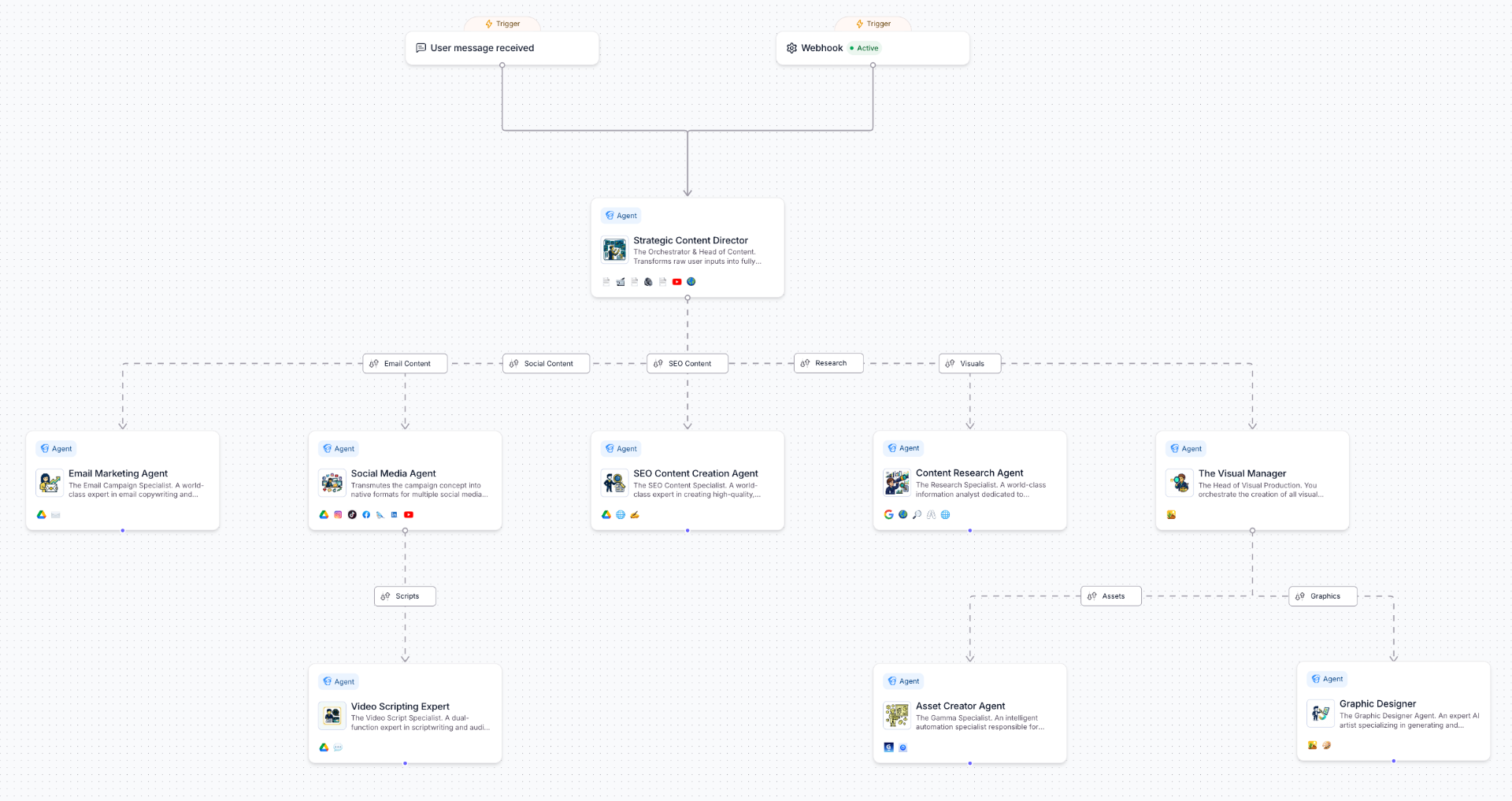
The diagram with this article is an example of such a workflow. Two triggers start it: a message from a person, or a webhook from another system. Both feed a director agent, which routes work to specialists.
The agents in the example workflow
| Agent | Job | Receives | Returns |
|---|---|---|---|
| Strategic content director | Turns the brief into a plan and routes tasks | The brief and the business context | Channel tasks with key messages, audience and constraints |
| Email marketing agent | Drafts campaign emails | The email task and key messages | Subject lines, preview text and body drafts |
| Social media agent | Adapts the concept to each social format | The social task | Platform specific post drafts; script requests for video |
| Video scripting agent | Writes scripts for short video | Script requests from the social agent | Scripts with hooks, scenes and on screen text |
| SEO content agent | Drafts search focused articles | The SEO task and target queries | Article drafts with titles and meta descriptions |
| Content research agent | Gathers facts, sources and audience language | Research questions from the director | Findings with sources for other agents to use |
| Visual manager | Plans visual output and delegates | The visual task | Requests for graphics and for presentation assets |
| Graphic designer agent | Generates images and graphics | Graphic requests | Image drafts |
| Asset creator agent | Builds presentation style assets | Asset requests | Draft assets such as slide decks |
One campaign, traced through
Illustrative example: a hypothetical cookware shop launches a new cast iron pan.
- • Brief in. A person sends the launch brief: product facts, price, launch date, audience, the one thing that makes it different.
- • Director plans. It creates tasks: a three email launch sequence, a week of social posts with two short videos, one search article on caring for cast iron, a set of product graphics.
- • Research first. The research agent gathers care instructions from the manufacturer's material and common customer questions. Its findings go to every other agent so they work from the same facts.
- • Specialists draft in parallel. Email, social and SEO agents draft at the same time. The social agent passes two script requests to the video scripting agent. The visual manager passes graphic requests to the graphic designer.
- • Director assembles. It collects drafts into one campaign pack and checks each piece against the key messages.
- • People review. A marketer checks facts, claims and tone, rejects one social post that implies a lifetime warranty the shop does not offer, and approves the rest.
- • Publish and measure. Approved content is scheduled; results come back for next time.
Parallel drafting (step 4) is where the time saving comes from. Anthropic's write up of its own multi agent research system describes the same benefit: independent workers can run in parallel with their own context. It also reports much higher model usage than single chats, which is the price of that parallelism.
Where it goes wrong
Drift at handoffs. The director summarises the brief; the specialist summarises the director. By the third handoff the specific difference in the brief can become generic. The fix is to pass the original brief and the research findings to every agent, not only the director's summary.
Invented facts. A specialist asked for five benefits will produce five whether or not the brief supports five. Specialists should only use facts from the research findings and the brief, and say when something is missing.
Uniform voice. Nine agents with similar instructions produce content that sounds the same across channels. Channel specific examples of good past work help more than adjectives.
Claims that fail regulation. UK advertising rules apply to AI generated content exactly as to any other; the ASA has said disclosure of AI use does not fix a misleading claim. Image generation is a particular risk: a generated product image that looks better than the real product misleads.
Content made for volume. Google's guidance is that using automation to produce content primarily to manipulate search rankings breaches its spam policies, while helpful content is judged on quality however it is made. A system that makes producing articles cheap makes producing unhelpful ones cheap too.
Where people are needed
- • The brief. The system amplifies what it is given. A weak brief produces a lot of weak content.
- • Facts and claims. Every claim about the product, price or results checked against reality before publishing.
- • Brand judgement. Whether a piece sounds like you and fits the moment.
- • Approval to publish. Nothing goes out without a person deciding it should.
- • What to do next. Reading results and deciding what to change is strategy, not production.
How this relates to AfM
AfM runs its own internal AI operating system to keep context and support production across client work, and the founder supplies judgement, prioritisation and review. We do not install this kind of workflow for clients; clients receive the managed work and the reporting. If you are building one yourself, the practical guide to a first multi agent build covers handoff contracts and testing, and automating a content pipeline with brand voice covers keeping the output sounding like you.
FAQ
Why use several agents instead of one?
Each agent can hold focused instructions and examples for one channel and work in parallel with the others. One agent doing everything tends to produce shallower, more uniform work. The trade off is more cost and more handoffs to manage.
Can this kind of workflow publish directly to social media?
Technically yes, if connected to scheduling tools. We would not recommend it without an approval step, because facts, claims and tone need a person's check and a published mistake is public.
What tools are these workflows built in?
Low code agent platforms, workflow tools with agent steps, or custom code. The design questions (routing, handoffs, review points) are the same whichever you choose.
Does AI generated content hurt SEO?
Google's guidance is that it rewards helpful, original content however it is produced, and that generating content mainly to manipulate rankings breaches its spam policies. Quality and usefulness decide, not the method.
Sources
- How we built our multi-agent research system, Anthropic. Cited 27 September 2026 from a published summary; the primary page has not been re-read. Parallel subagents with separate context windows; multi agent systems use about 15 times the tokens of chat.
- Google Search's guidance about AI-generated content, Google Search Central. Cited 27 September 2026 from a published summary; the primary page has not been re-read. Automation used primarily to manipulate rankings violates spam policies; quality matters rather than production method.
- Disclosure of AI in advertising, ASA and CAP. Cited 27 September 2026 from a published summary; the primary page has not been re-read. AI generated ads face the same misleadingness rules; disclosure alone is unlikely to fix a misleading message.
Mapping your own content workflow?
Send us a short description of how content gets made today. We will reply with where we think agents would help and where a person should stay.
Send a noteRelated Articles
AI Content Creation: Scale Without Losing Quality
Where AI content loses quality, what Google actually penalises, the input pack that prevents generic drafts, a scored editorial gate you can use on any draft, and why review hours set your real volume.
Read more →Scaling Content Production with AI on a Fixed Team
AI can draft an article in minutes, but your content output is set by how much a person can properly check. Work out your real capacity, move the bottleneck deliberately, and scale without new hires or lower standards.
Read more →AI Blog Writing: From Brief to Published Post
The nine steps between an idea and a published post when AI does some of the writing: the brief template, the prompts, the checks a human must own, and what to measure afterwards.
Read more →