
The Content Production Bottleneck (And the AI Fix)
Written from AfM's working notes and the public sources listed at the end. Examples marked illustrative are hypothetical, not client results.
Updated 27 September 2026
2 sources cited.
First published 1 March 2026
AfM guide
Search, brand voice, publishing systems, and topical authority.
On This Page
The short answer
Content rarely gets stuck where people think. Teams assume writing is the slow part because writing is the visible effort. When you measure where pieces wait, the queue often sits somewhere else: waiting for a subject-matter expert to supply information, or waiting for someone to approve a draft. AI agents are very good at widening some bottlenecks and useless for others, so find the constraint before you add agents.
It may help explain a finding in Content Marketing Institute's research for 2026: around nine in ten B2B marketers use AI to create content, yet fewer than four in ten say it has improved performance. Speeding up a stage that was not the constraint changes nothing downstream.
Find the real bottleneck in one week
For every piece of content in progress this week, record five timestamps:
- • Requested: the idea is approved.
- • Inputs complete: the brief, sources and expert input are all in.
- • Draft complete.
- • Approved.
- • Published.
At the end of the week, calculate the average wait between each pair. The longest wait is your bottleneck. It is common for "inputs complete" and "approved" to take days while drafting takes hours, but measure yours; the fix depends entirely on which it is.
Match the fix to the bottleneck
Content bottlenecks: symptoms and fixes
| Bottleneck | Symptom | Does AI help? | Fix |
|---|---|---|---|
| Ideas | Nobody knows what to write next | Yes | An agent that collects questions from Search Console, support tickets and call notes into a ranked queue |
| Inputs from experts | Drafts wait days for a product manager, engineer or founder | Partly | Replace written requests with a 15-minute recorded interview; an agent turns the transcript into a research pack |
| Drafting | Briefs are ready but drafts are slow | Yes | Drafting agent with brief, voice guide and exemplars attached |
| Review and approval | Drafts pile up waiting for sign-off | Barely | One named approver, a review rubric, a fixed turnaround slot, and fewer reviewers |
| Repurposing | One article never becomes the email, posts and scripts it could | Yes | Specialist agents generating each format from the approved source |
| Publishing | Approved work waits for formatting and upload | Yes | Automated formatting, metadata and scheduling |
How a multi-agent workflow changes the picture
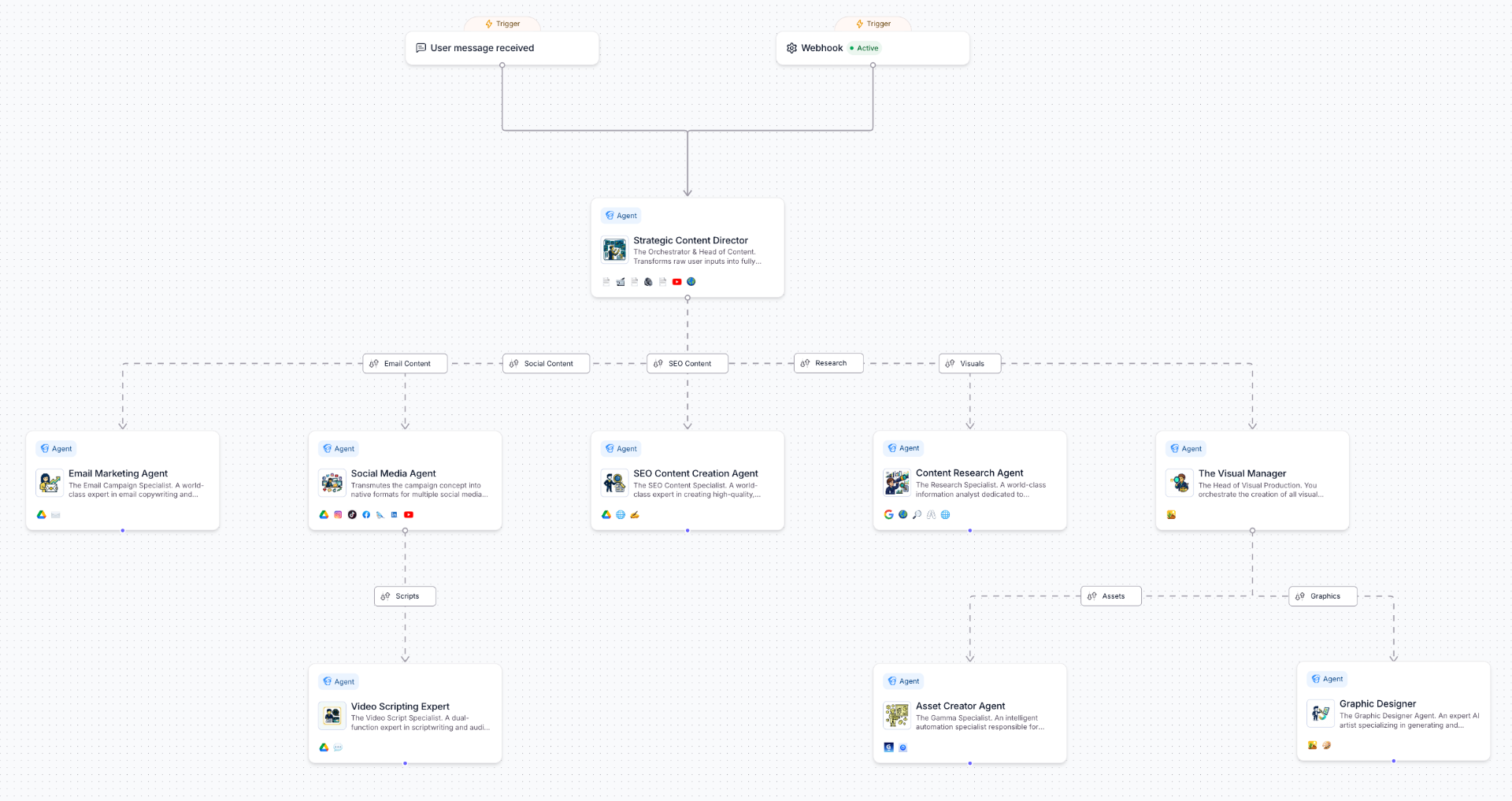
The diagram above shows the shape of a multi-agent content workflow: a director agent receives a request and routes parts of it to specialist agents for email, social posts, SEO, research, visuals, video scripts, assets and graphics. It is an example of the pattern, not a record of any particular deployment.
A workflow like this is a strong fix for three of the bottlenecks in the table: ideas, drafting and repurposing. One approved article can turn into a full set of channel assets without anyone writing them from scratch. The director's value is consistency: it passes the same brief, voice guide and source to every specialist, which is what stops each channel drifting.
It also creates a new problem that is easy to miss. Every specialist agent produces work that someone has to check. If the diagram's eight specialists each produce one asset per article, one approved article becomes eight things to review. The bottleneck moves to approval, and approval was often the constraint already.
So a multi-agent workflow needs its review designed in from the start:
- • Tier the review. High-risk outputs (claims, pricing, anything regulated, anything new) get full human review; low-risk derivatives of an approved source get sampled.
- • Automate the checks that do not need judgement: banned phrases, character limits, broken links, missing alt text.
- • Batch approvals into one fixed slot a day rather than interrupt-driven sign-off.
- • Cap output at review capacity. Google's guidance warns that generating many pages without adding value for users can breach its scaled content abuse policy; producing more than you can check is how that happens.
Fixing the two bottlenecks AI cannot
Expert input. Experts do not avoid writing briefs because they are lazy; the request is too big. Ask for fifteen minutes on a call instead, with five prepared questions. Record, transcribe, and let an agent draft the research pack for the expert to correct. Correcting is faster than writing, and experts tend to be better at spotting what is wrong than at writing from a blank page.
Approval. Most approval delays come from unclear ownership (several people must agree), unclear criteria (reviewers rewrite for taste) or no scheduled time. Name one approver per content type, give them a rubric (accurate, on brief, on voice, claims supported), and book the review slot in their calendar.
Re-measure after four weeks
Run the five-timestamp measurement again. If the wait at the old bottleneck has fallen and total time from request to publish has fallen with it, the fix worked. If total time has not moved, the constraint has shifted to another stage; that is normal, and it tells you where to go next.
This is how we approach capacity at AfM: our system carries the production work, and the constraint we manage deliberately is review, so that more output never means less checking. The related article on automating a content pipeline without losing voice covers the review gates in detail.
FAQ
How many AI agents does a content team need?
As many as there are distinct, repeatable jobs at your bottleneck, and no more. Many teams get most of the benefit from a drafting agent and a repurposing agent before a full multi-agent set-up is worth it.
Will AI agents reduce the time our experts spend on content?
They can, if the request changes from write a brief to answer five questions on a call. The agent's job is turning the transcript into usable material, so the expert corrects rather than writes.
Why not remove the approval step for low-risk content?
Sampling rather than full review is reasonable for derivatives of already-approved content. Removing review completely means nobody notices when drift, errors or off-brand claims start, which is how small problems reach customers.
What does a director agent actually do?
It takes a request, breaks it into tasks, sends each to the right specialist agent with the shared brief and voice context, and assembles the results. Its main value is that every specialist works from the same source.
Sources
- B2B content and marketing trends: insights for 2026, Content Marketing Institute. Cited 27 September 2026 from a published summary; the primary page has not been re-read. Around nine in ten marketers use AI for content while fewer than four in ten say it improved performance.
- Google Search's guidance on using generative AI content on your website, Google Search Central. Cited 27 September 2026 from a published summary; the primary page has not been re-read. Generating many pages without adding value for users may violate the scaled content abuse policy.
Want help finding your bottleneck?
If you have run the one-week measurement, or want to talk through where your content gets stuck, book a short call. We will look at the numbers with you and say which fix we would try first.
Book a short callRelated Articles

AI Content Creation: Scale Without Losing Quality
Where AI content loses quality, what Google actually penalises, the input pack that prevents generic drafts, a scored editorial gate you can use on any draft, and why review hours set your real volume.
Read more →Scaling Content Production with AI on a Fixed Team
AI can draft an article in minutes, but your content output is set by how much a person can properly check. Work out your real capacity, move the bottleneck deliberately, and scale without new hires or lower standards.
Read more →AI Blog Writing: From Brief to Published Post
The nine steps between an idea and a published post when AI does some of the writing: the brief template, the prompts, the checks a human must own, and what to measure afterwards.
Read more →