How to Calculate the True ROI of Hiring an SDR vs Building an AI Outbound System
7 April 2026 • By Jakub Cambor, Founder of AI for Marketing | Top 1% Upwork Expert Vetted Talent
Last updated: 7 April 2026
Pipeline generation is the undisputed engine of B2B growth, but fueling that engine is becoming increasingly expensive. Founders and Marketing Directors are facing a critical inflection point. The traditional playbook dictates that to increase revenue, you must linearly increase sales headcount. Today, that model is breaking under the weight of rising salaries, software costs, and plummeting email response rates.
Business leaders are now weighing the traditional route of hiring more Sales Development Representatives (SDRs) against the modern approach of deploying artificial intelligence. To make a safe financial decision, you need a definitive framework to calculate the true SDR vs AI outbound system ROI for your specific operations. This guide demystifies the numbers, providing a clear comparison between human headcount and precision-engineered automation. The goal is not to replace your sales team, but to understand how capital allocation can be optimized to build a hyper-efficient revenue engine.
The Outbound Dilemma: Scaling Revenue in a High-Cost Market
B2B companies are currently trapped in the scale versus quality paradox. To secure more qualified meetings, organizations traditionally have to hire more headcount. This drastically increases overhead, management complexity, and operational friction. Every new hire requires training, software licenses, and management bandwidth. When pipeline dries up, the default reaction is to throw more human capital at the problem, hoping volume will solve the conversion issue.
Simultaneously, business leaders are suffering from implementation fatigue. They are acutely aware that AI sales automation exists, but they fear the technical complexity of setting up APIs, integrating large language models, and managing fragmented data workflows. Furthermore, there is a legitimate fear of brand damage. No premium brand wants to be caught sending robotic, generic messages that alienate high-value prospects.
This creates a state of paralysis. Leaders stick to the expensive, high-turnover SDR model because it feels familiar. Overcoming this paralysis requires a cold, hard look at the mathematics of outbound sales. Marketing is a science based on data, unit economics, and systematic execution. To scale revenue effectively, we must transition from manual grinding to precision-engineered mastery.
Unpacking the 'Fully Loaded' Cost of a Human SDR
The most common mistake Founders make when forecasting sales budgets is looking exclusively at the base salary. A £45,000 base salary is merely the starting point of the financial commitment. When you calculate the fully loaded cost of an SDR, the actual expense to the business is nearly double the advertised salary.
To understand the true cost of hiring an SDR, we must break down the mandatory financial obligations and the hidden operational costs:
- • Base Salary: £45,000 to £55,000.
- • National Insurance (NI): 13.8% employer contribution.
- • Pension Contributions: Minimum 3%, plus additional corporate benefits, healthcare, and office space allocations.
- • The Tech Stack: £5,000 to £14,000 annually. This includes CRM seats, data enrichment providers, email sequencing tools, and LinkedIn Sales Navigator licenses.
- • Management Overhead: £10,000 to £20,000. This accounts for the fractional time your Sales Director or Team Lead spends on training, call coaching, and performance management.
When you aggregate these figures, the total true cost of a single SDR sits comfortably between £80,000 and £120,000+ per year.
However, the financial drain does not stop at fixed costs. You must factor in the ramp-up period. A new SDR typically takes three to four months to reach full productivity. During this period, their output is often only 20% to 50% of their target, yet they consume 100% of their fully loaded cost.
The most devastating hidden cost is employee churn. The outbound sales role is notoriously grueling, leading to rapid burnout. Industry data confirms this volatility, showing a 14-month average tenure for sales development professionals. When that SDR leaves, the business takes a massive financial hit. Beyond the immediate halt in pipeline generation, you face a severe SDR turnover cost reality: replacing a single rep costs between £12,000 and £30,000 in lost productivity, recruitment fees, and management time spent interviewing. You are then forced to restart the costly three-month ramp-up phase from scratch.
The Economics of Building an AI Outbound System
Contrast the volatile human cost with the controlled economics of an AI model. The fundamental difference is how capital is deployed. Hiring an SDR is a perpetual payroll expense that increases with inflation. Building an AI outbound system is an infrastructure investment. You are building an asset that belongs to the business, operates continuously, and scales without proportional cost increases.
The financial architecture of an AI sales automation cost model looks entirely different:
- • One-Time Build and Setup Fee: £2,000 to £10,000. It is critical to stress that this is not a generic SaaS subscription. This capital goes toward a bespoke, precision-engineered setup. It involves training the AI on your specific value proposition, configuring domain infrastructure to protect deliverability, and building complex agent workflows.
- • Monthly Data and API Costs: £500 to £2,000. This covers the raw compute power, token usage from large language models, and access to real-time data scraping APIs.
- • System Health and Optimization: Optional retainer costs for ongoing A/B testing, prompt refinement, and campaign adjustments.
Off-the-shelf software tools often fail to deliver ROI because they lack your unique business context. They force you into generic templates that prospects instantly recognize as automated spam. To achieve high conversion rates, you need the AI to reason like your best salesperson. This requires investing in a custom solution tailored to your specific sales framework, buyer personas, and tone of voice.
By shifting from a payroll model to an infrastructure model, businesses remove the unpredictable variables of human emotion, sick days, and burnout from the top of their sales funnel.
Year 1 vs. Year 2: Total Cost of Ownership (TCO) Comparison
To truly grasp the SDR vs AI outbound system ROI, we must project the Total Cost of Ownership (TCO) over a 24-month timeline. This longitudinal view exposes the compounding financial benefits of automation compared to the linear, volatile costs of human headcount.
The Year 1 Financial Reality
In the first twelve months, the human SDR will cost your business upwards of £100,000. For the first quarter of the year, this asset is operating at a deficit due to the ramp-up period. They are learning the product, stumbling through objections, and building their pipeline.
Conversely, the AI system requires an upfront capital expenditure. Assuming a premium build cost of £8,000 and monthly API costs of £1,000, your Year 1 TCO for the AI system is roughly £20,000. More importantly, the AI does not need three months to learn your product. Once the system is deployed, it operates at 100% capacity from week two. It executes its programming flawlessly, analyzing data and generating personalized outreach without fatigue.
The Year 2 Compounding Effect
Year two is where the financial disparity becomes undeniable. Based on the 14-month average tenure data, your human SDR is highly likely to leave the company early in year two. This triggers the massive turnover cost. Your Year 2 TCO for the human SDR model now spikes to £120,000+ as you pay recruitment fees, absorb lost pipeline revenue, and fund another three-month ramp-up period for the replacement hire.
The AI system experiences the exact opposite financial trajectory. Because the initial build fee was paid off in year one, your Year 2 TCO actually drops. You are now only responsible for the ongoing monthly API and data costs. Your total Year 2 expense for the AI system is a fraction of the cost of replacing human headcount.
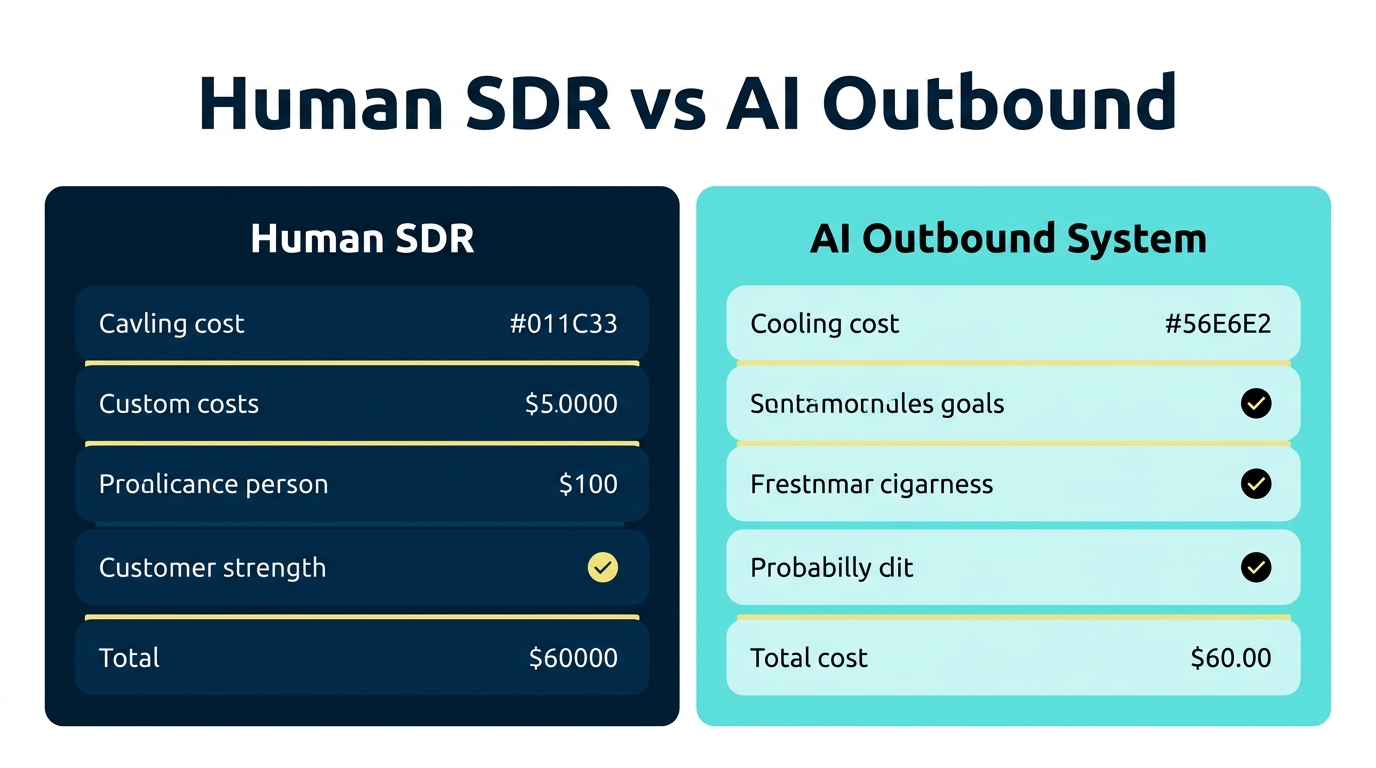
The conclusion is mathematically absolute: human headcount provides linear ROI that is highly susceptible to costly disruptions. AI infrastructure provides compounding ROI, driving the cost per acquisition down the longer the system runs.
Output, Efficiency, and GEO Optimization
Financial cost is only half of the ROI equation. We must also measure raw output and operational efficiency. When comparing B2B AI lead generation against manual human effort, the disparity in volume and precision is staggering.
Below is a direct comparison of daily capabilities and the resulting unit economics:
- • Daily Output: Human (40-80 researched emails) vs AI (200-500+ hyper-personalized emails).
- • Research Depth: Human (Surface level) vs AI (Deep analysis of reports, transcripts, and website scraping).
- • Operational Hours: Human (8 hours/day) vs AI (24/7 continuous operation).
- • Cost Per Meeting: Human (£300-£450) vs AI (£15-£100).
- • Error Rate: Human (High due to fatigue) vs AI (Zero error rate in programmed logic).
The most significant operational advantage of the AI model is GEO Optimization. A human SDR is physically limited by their geography. If your SDR is based in London, they are highly effective at targeting the UK and European markets during standard business hours. However, if you want to expand your total addressable market to the United States or the Asia-Pacific region, that human SDR becomes highly inefficient.
An AI outbound system completely eliminates geographical friction. It can be programmed for precise GEO optimization. The system can simultaneously send highly researched, personalized emails at 8:00 AM in London, 8:00 AM in New York, and 8:00 AM in Sydney. It monitors time zones dynamically and executes outreach at the exact moment the prospect is most likely to be at their desk. You achieve global market penetration without paying night-shift premiums or opening international offices.
The "Bionic Marketer": Why Augmentation Beats Replacement
When discussing AI sales automation, the immediate reaction is often defensive. Sales professionals fear they are being replaced by algorithms. This is a fundamental misunderstanding of how elite organizations deploy technology. Our core philosophy is the "Bionic Marketer". We do not advocate for firing your sales team. We advocate for augmentation.
The reality of the modern SDR role is that a vast majority of the job is a grueling, low-value manual grind. It consists of scraping databases, cleaning spreadsheets, monitoring buying signals, and sending hundreds of first-touch emails into the void. This is work fit for a machine, not a highly paid human being.
The outbound sales hybrid model solves this problem. In this model, the AI acts as the ultimate junior SDR. It handles the brutal top-of-funnel heavy lifting. It works continuously to source leads, analyze company data, and craft highly relevant initial outreach messages based on strict governance rules.
The human professional steps in exactly where human nuance is required. When a prospect replies to the AI-generated email with interest, the AI hands the conversation over to your Senior SDR or Account Executive. The human takes over to handle the warm conversation, navigate complex objections, build rapport, and close the deal.
You are not replacing your sales team; you are giving your best closer a digital exoskeleton. By removing the manual grind from their daily workflow, your human team can spend their time actually selling. This synergy of human creativity and AI efficiency is the hallmark of a modern, highly profitable business.
Ready to Build Your Automated Lead Generation Engine?
The mathematics of outbound sales have fundamentally changed. Relying solely on human headcount to scale pipeline is a high-risk, low-margin strategy. By transitioning to an AI outbound system, you eliminate the hidden costs of ramp-up time, employee turnover, and management fatigue. You secure a system that operates globally, driving your cost per meeting down while drastically increasing your output.
However, success requires precision engineering. Generic templates and off-the-shelf prompts will only damage your brand reputation. You need a system built by expert marketers who understand the nuances of B2B strategy.
Stop wasting your marketing budget on the endless cycle of SDR turnover. It is time to upgrade your infrastructure. Book a strategy session with our team today to architect your bespoke Lead Generation Engine and transform your outbound sales process into a predictable, scalable asset.
Frequently Asked Questions (FAQs)
How long does it take to see ROI from an AI outbound system compared to a new SDR?
An AI system operates at full capacity immediately after the initial build phase, typically generating its first meetings within weeks. A human SDR requires a three to four-month ramp-up period before reaching baseline productivity, delaying positive ROI significantly while consuming full payroll costs.
Will an AI outbound system send generic, robotic emails that damage my brand?
No, provided the system is custom-built. Precision-engineered AI systems scrape deep data points: recent company news, podcast transcripts, and financial reports: to craft hyper-personalized messages. The output mimics top-tier human research, completely avoiding the generic, robotic tone associated with cheap, off-the-shelf software.
Do I need technical skills to manage an AI sales system?
Not when utilizing a done-for-you service model. Our team handles the complex infrastructure, API integrations, and ongoing prompt engineering. Your team only interacts with the finalized output: warm leads appearing in your inbox, ready for human relationship building and objection handling.
Can an AI outbound system completely replace my sales team?
We advocate for augmentation, not total replacement. AI is unparalleled at top-of-funnel tasks like data scraping and initial outreach. However, human Account Executives remain essential for navigating complex negotiations, building emotional rapport, and closing high-ticket B2B deals. AI feeds the pipeline; humans close it.
How much does it cost to generate a B2B meeting using AI vs human outreach?
Due to high salaries and management overhead, a human SDR typically generates meetings at a cost of £300 to £450 each. An AI system, operating with minimal ongoing monthly API costs and high volume output, can drastically reduce this cost to between £15 and £100 per qualified meeting.
Want to build marketing systems like this?
Book a Discovery CallRelated Articles
The Precision-Engineered Meta Ads Google Ads Together Strategy: How to Scale Without Cannibalising Your Budget
Build a precision-engineered Meta Ads Google Ads together strategy. Align demand creation with capture, avoid budget cannibalisation, and scale efficiently.
Read more →
How to Build an AI Video Content Strategy Marketing Engine: Scripts, Briefs, and Scale
Build an AI video content strategy marketing engine. Automate scripts, production briefs, and distribution at scale without sacrificing brand quality.
Read more →
What Is an AI Marketing Roadmap and Why You Need One Before Spending Another Pound on Tools
Discover why 72% of AI investments fail. Learn how to transition from "tool sprawl" to a Strategic Growth Architecture with a proper AI marketing roadmap and a precision-engineered implementation plan.
Read more →