What Is an AI Marketing Roadmap and Why You Need One Before Spending Another Pound on Tools
7 April 2026 • By Jakub Cambor, Founder of AI for Marketing | Top 1% Upwork Expert Vetted Talent
Last updated: 7 April 2026

The marketing industry is currently gripped by a profound disconnect. Boardrooms and management meetings are dominated by discussions about artificial intelligence, yet very few businesses are extracting a measurable, compounding return on investment from their efforts. Founders and marketing directors are subscribing to endless software platforms, hoping for a sudden surge in efficiency. Instead, they are met with fragmented workflows, inconsistent brand messaging, and frustrated teams.
This chaos is the direct result of adopting technology without a blueprint. To solve this, businesses must step back and develop a comprehensive AI marketing roadmap. This roadmap is not a simple list of software recommendations. It is a rigorous, precision-engineered framework designed to replace manual grinding with automated, intelligent systems.
By the end of this analysis, you will understand exactly how to audit your current digital ecosystem. You will learn how to stop wasting capital on redundant applications. Most importantly, you will discover how to build a prioritised plan for AI integration that aligns perfectly with your commercial objectives.
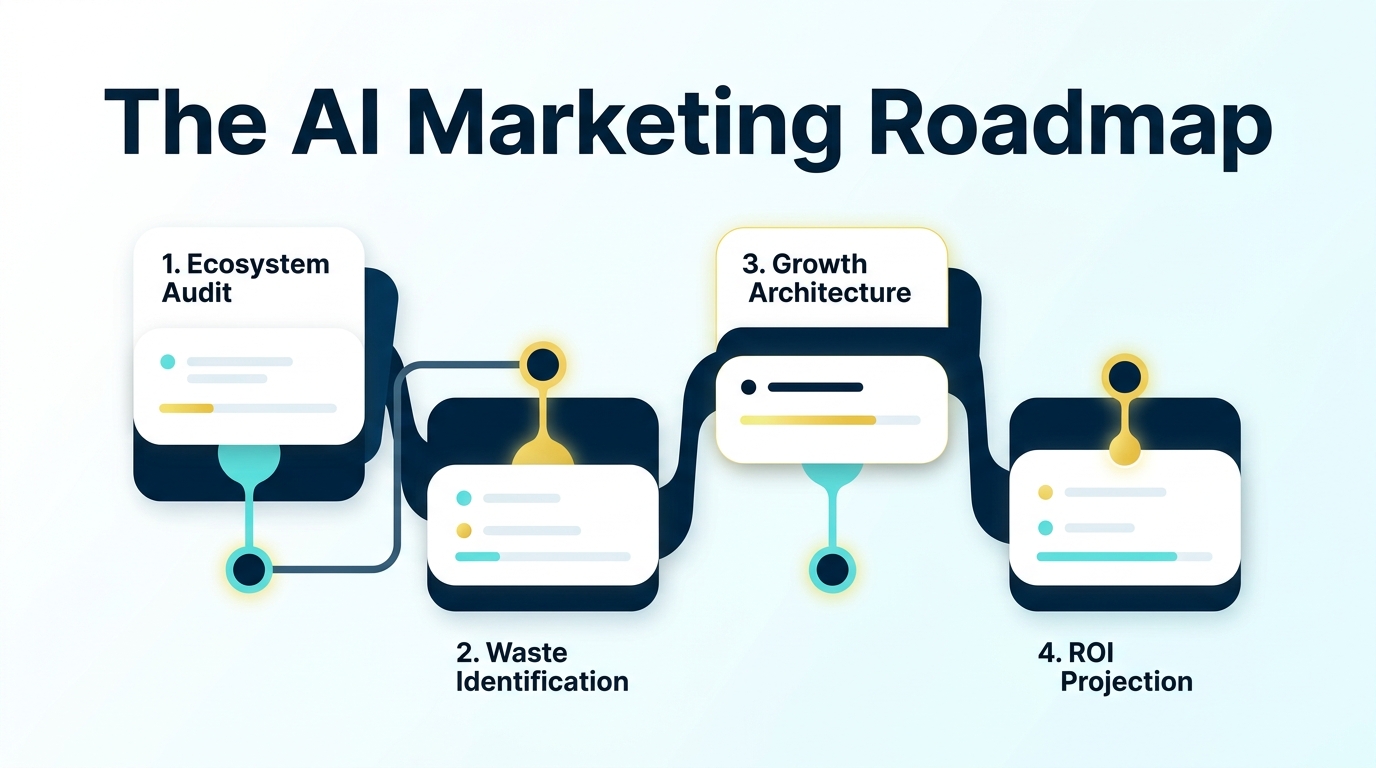
The "Tool Graveyard" Phenomenon: Why Random AI Adoption Fails
Take a close look at the monthly expense reports of a typical mid-market company or digital agency. You will likely find a sprawling list of disconnected subscriptions. There is a ChatGPT Plus account for the copywriters, a Midjourney subscription for the design team, and perhaps a standalone scheduling tool for the social media manager.
This scenario is what industry professionals refer to as the Tool Graveyard. Businesses purchase these applications with the best intentions, searching for a magic bullet to solve their bandwidth issues. However, without a centralised system to govern them, these tools lead to zero compounding value. They operate in complete isolation.
The reality of this approach is stark. Research suggests that 72% of AI investments are destroying value rather than creating it, largely because teams adopt tools without a strategy. According to Graph Digital, a useful AI roadmap is not a technology wishlist: it is a sequence of commercial decisions that starts with what you already have and identifies where AI creates measurable leverage.
Tool Sprawl Creates Five Distinct Failure Modes
- • No Compounding Asset: You generate outputs, but you do not build an engine. Each piece of content is a one-off project. Nothing feeds back into a central knowledge base.
- • Brand Voice Drift: Multiple tools across multiple people produce inconsistent tone and positioning. The more you publish, the more fragmented the brand becomes.
- • Workflow Fragmentation: Technology gets bolted onto existing manual processes. Instead of removing steps, it adds steps. People spend time prompt engineering and editing, then still have to publish manually.
- • Measurement Gaps: If you cannot connect an automated activity to a measurable outcome, you cannot defend the spend. Many teams can tell you how many posts they produced, but not whether it changed lead quality or sales velocity.
- • Ownership and Bandwidth Collapse: When managing these platforms becomes everyone's job, it becomes no one's job. Tools end up underused because there is no accountable operator.
To escape this trap, leaders must initiate a fundamental shift in mindset. You must stop asking your team which new tool they want to buy. Instead, you must ask which specific business workflow requires optimisation. Technology must serve the strategy, not the other way around.
Defining the AI Marketing Roadmap: From Sprawl to Strategic Growth Architecture
If random tool adoption is the problem, the solution requires a disciplined, architectural approach. A true roadmap is a comprehensive AI ecosystem audit that transitions a business from software sprawl to a Strategic Growth Architecture. This architecture is a bespoke system where every application, data source, and human operator works in perfect synergy.
Building this architecture requires a deep analysis of your current operations. The roadmap must identify exactly where your traffic and conversion bottlenecks lie. It involves auditing your team's bandwidth to uncover which manual tasks are draining their creative energy. It also requires a financial review to pinpoint wasted spend on redundant SaaS subscriptions.
Ultimately, this process acts as a sequence of commercial decisions based on leverage and confidence of return, ensuring that every pound invested in technology directly contributes to revenue generation. To achieve this, the roadmap is broken down into three distinct phases.
Phase 1: Foundation (Audit & Goals)
The foundation phase is a rigorous discovery process. Before writing a single line of code or deploying a single agent, we must understand the unique DNA of your business. This involves extracting your historical marketing data, analysing your most profitable customer segments, and defining your precise brand voice.
During this phase, we map out your existing inefficiencies. We look at how long it takes your team to research a topic, draft an article, and distribute it across social channels. We document the exact cost of these manual processes. Setting clear, measurable goals is the final step, establishing baseline metrics for traffic, lead generation, and customer acquisition costs.
Phase 2: Implementation (AEO & Automation)
Once the foundation is secure, the roadmap transitions from audit to action. The focus here shifts heavily towards multi-agent workflows and advanced search visibility techniques like Answer Engine Optimisation (AEO). AEO is critical because traditional search is changing: users are increasingly receiving direct answers from generative models rather than clicking through to websites.
We achieve this by setting up automated marketing engines. For example, an SEO engine might utilise a research agent to analyse competitor gaps, a writing agent trained strictly on your brand voice, and an optimisation agent to format the schema markup. This completely replaces the manual grind, allowing your human experts to focus purely on strategy.
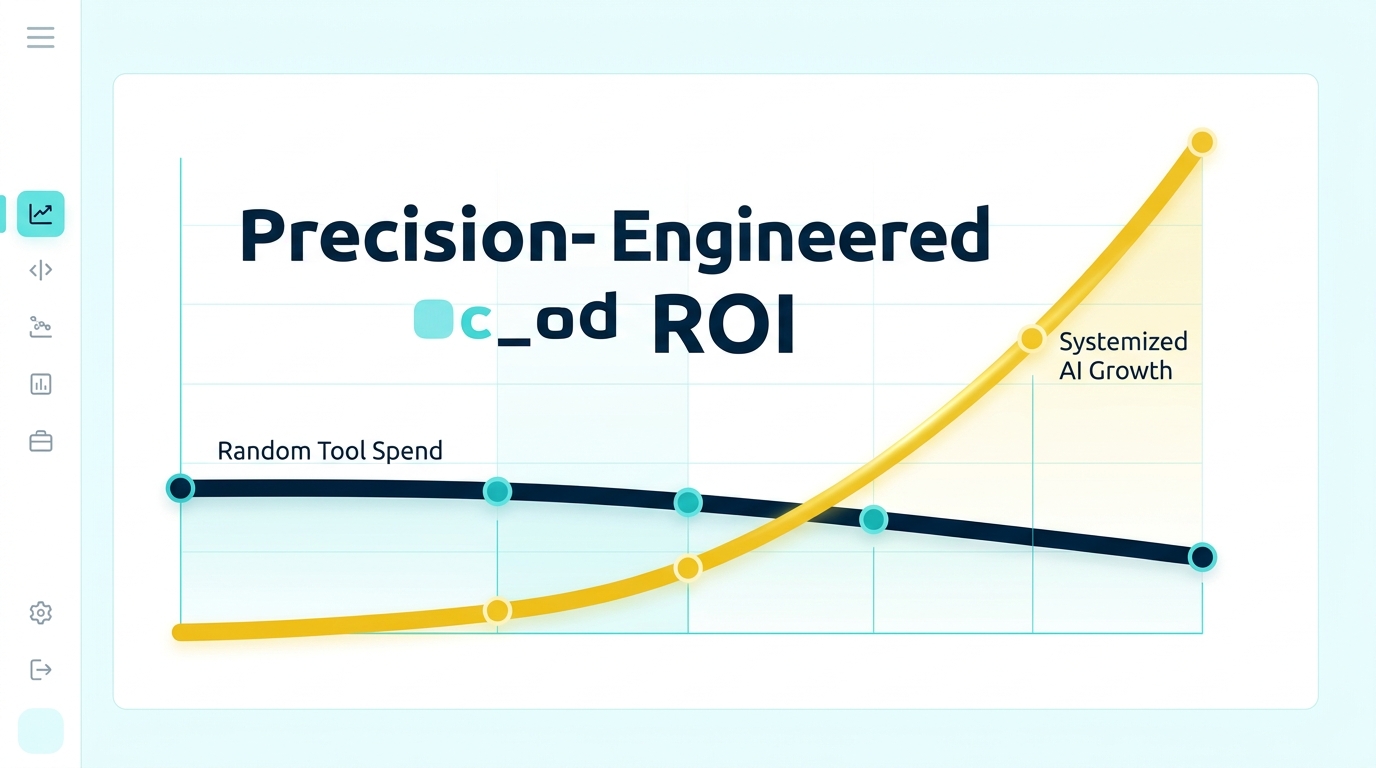
Phase 3: Scale (ROI Analysis)
The final phase of the roadmap dictates how you scale your new capabilities. Once the foundation is laid and the automated engines are proven to work, the objective is to increase output without sacrificing quality. This is the exact point where most amateur setups fail: they scale the volume of content, but the quality degrades into robotic spam.
A proper roadmap prevents this through continuous ROI analysis. We monitor the performance of the automated systems against the baseline metrics established in Phase 1. If a specific multi-agent workflow is generating high-quality leads at a lower cost than manual methods, we allocate more resources to that specific engine.
Overcoming Bottlenecks with a 90-Day Implementation Framework
The digital landscape is shifting at an unprecedented speed. Search algorithms are being rewritten to accommodate new models, and social media platforms are heavily favouring automated, high-volume content creators. Businesses that hesitate to implement a structured system will find themselves rapidly outpaced by more agile competitors.
Because of this urgency, a theoretical strategy is not enough. You need a highly structured AI implementation framework to ensure rapid time-to-value. According to Digital Applied, a comprehensive roadmap typically follows a phased approach to ensure stability and measurable ROI over a 90-day period.
- • Month 1: Audit and Architecture Design. Mapping existing workflows, identifying redundant tools, and setting baseline KPIs.
- • Month 2: Engine Build and Internal Testing. Connecting agents to secure data sources and rigorously testing outputs for brand safety and AEO performance.
- • Month 3: Deployment and Team Upskilling. Systems go live, and we begin measuring the initial ROI against historical benchmarks while training your team to manage the new systems.
This structured timeline solves specific problems that plague founders and agency owners. It prevents the initiative from stalling in the planning phase. By adhering to a strict schedule, businesses can successfully overcome creative bottlenecks that previously limited their output. Research from High Peak SW notes that 59% of teams report creative bottlenecks that block growth: a structured plan ensures AI spend addresses these gaps without diluting brand consistency.
The Paid Diagnostic vs. The "Free Strategy Call" Illusion
If you have spent any time looking for marketing support, you are intimately familiar with the standard agency playbook. You are invited to book a "free 30-minute strategy session." While this sounds appealing, it is a fundamentally flawed model for businesses seeking serious integration.
These free calls are rarely strategic. They are thinly veiled sales pitches designed to diagnose you as quickly as possible so the agency can sell you a pre-packaged, generic retainer. The person on the other end of the line is usually a salesperson, not a systems architect. They cannot possibly understand the nuance of your data architecture or your workflow bottlenecks in half an hour.
Serious businesses should actively want to pay for a rigorous diagnosis. Consider the medical field: you would never allow a surgeon to operate on you without first paying for a thorough MRI and blood work. The same logic applies to your business infrastructure. You should not allow an external party to rebuild your marketing workflows without a paid, deep-dive analysis.
A paid diagnostic separates the professionals from the amateurs. It requires the consulting team to dedicate hours of focused analytical work to your specific business model. The deliverable is a tangible, high-value strategy document: a comprehensive blueprint detailing exactly how to build your architecture. Even if you decide never to work with the consulting agency again, you walk away with a prioritised implementation plan.
How the Clarity Roadmap Works (And the £750 Credit-Back Mechanism)
At AI for Marketing, we recognised that the industry was failing mid-market businesses. Founders were being forced to choose between buying cheap, generic software that failed to deliver, or hiring enterprise consulting firms that charged exorbitant fees just to write a proposal. We built a specific solution to bridge this gap and eliminate the financial risk of adoption.
We invite our clients to start their journey with our bespoke Clarity Roadmap. This is our version of the paid diagnostic. It is a rigorous, intensive audit of your entire digital marketing ecosystem.
For a flat fee of £750, our team of expert marketers and systems architects will analyse your current operations. We will identify the tools you need to cancel, the workflows you need to automate, and the exact multi-agent engines required to scale your traffic and conversions. We deliver a comprehensive blueprint that is precision-engineered for your business strategy.
We understand that investing in strategy can feel like a delay in execution. To completely de-risk this process for our clients, we implemented the Credit-Back Mechanism. The mechanism is simple and transparent: the roadmap is a £750 paid diagnostic. However, if you review the custom blueprints we provide and decide to proceed with having AI for Marketing build your bespoke Content Engine, that full £750 is credited back toward the build cost.
This means the diagnostic effectively costs you nothing if we partner on the implementation. It ensures that we are financially incentivised to provide a strategy that actually works, and it protects you from paying for a strategy that you cannot execute. It is time to stop buying random software subscriptions and start investing in a precision-engineered blueprint that will turn your marketing department into a compounding asset.

Frequently Asked Questions (FAQs)
What exactly is an AI marketing roadmap? An AI marketing roadmap is a strategic blueprint that outlines how a business will integrate artificial intelligence into its operations. It moves beyond simple software recommendations, providing a comprehensive audit of workflows, data sources, and team bandwidth to build a custom, automated marketing architecture.
How long does it take to build a strategic AI growth architecture? A proper architecture is typically built using a 90-day implementation framework. Month one focuses on auditing and design, month two involves building and testing the AI agents, and month three is dedicated to deployment, ROI analysis, and upskilling your internal team.
Why should I pay for an AI strategy diagnostic instead of doing a free consultation? Free consultations are usually disguised sales pitches that lack depth. A paid diagnostic involves hours of rigorous data analysis and workflow mapping by experts. It results in a highly valuable, custom blueprint that you can use to build your systems, ensuring you do not waste money on the wrong tools.
What happens if I buy the Clarity Roadmap but decide to implement it myself? You keep the entire strategy document. The Clarity Roadmap is designed to be a standalone, actionable blueprint. If you have the internal engineering and marketing resources, you can take our precise architectural plans and build the multi-agent workflows entirely in-house.
How does an AI roadmap prevent "Tool Sprawl"? It prevents sprawl by shifting the focus from software acquisition to workflow optimisation. The roadmap audits your current subscriptions, identifies redundant applications, and consolidates your operations into a unified system. This eliminates isolated data silos and ensures every tool serves a specific, measurable commercial goal.
Want to build marketing systems like this?
Book a Discovery CallRelated Articles
The Precision-Engineered Meta Ads Google Ads Together Strategy: How to Scale Without Cannibalising Your Budget
Build a precision-engineered Meta Ads Google Ads together strategy. Align demand creation with capture, avoid budget cannibalisation, and scale efficiently.
Read more →
How to Build an AI Video Content Strategy Marketing Engine: Scripts, Briefs, and Scale
Build an AI video content strategy marketing engine. Automate scripts, production briefs, and distribution at scale without sacrificing brand quality.
Read more →
How to Calculate the True ROI of Hiring an SDR vs Building an AI Outbound System
Discover the true SDR vs AI outbound system ROI. Compare fully loaded human headcount costs against custom AI automation for scalable B2B lead generation.
Read more →