How to Build an AI Video Content Strategy Marketing Engine: Scripts, Briefs, and Scale
7 April 2026 • By Jakub Cambor, Founder of AI for Marketing | Top 1% Upwork Expert Vetted Talent
Last updated: 7 April 2026
Video is no longer a secondary channel for modern businesses. It is the primary environment where attention consolidates, brand trust is built, and complex B2B buying decisions are shaped. Because of this shift, an effective AI video content strategy marketing system has moved from an experimental concept to an absolute operational priority for founders and marketing directors. These leaders require consistent, high-quality output without the financial burden of ballooning their internal headcount.
The pressure to adapt is only increasing. Cisco provides a clear projection: video will account for 82% of all internet traffic by 2026. If your marketing department is still treating video production as an occasional campaign asset rather than a continuous operational engine, the gap between your brand and competitors who publish weekly will widen rapidly. Businesses that fail to adapt to this reality are actively surrendering market share.
The core problem is rarely a lack of ambition or creative ideas. The problem is execution. Most teams hit the exact same wall. Production takes far too long, quality becomes inconsistent across different platforms, and the promise to "do more video next month" turns into a permanent backlog. When you audit the traditional production workflow, one specific step reliably creates the most significant bottleneck: scripting. The delay is not in the filming or the editing. Scripting is the anchor because it requires deep strategic alignment, structural planning, brand nuance, and the discipline to think in visual sequences rather than just written words.
Artificial intelligence fundamentally changes this equation when it is deployed as a comprehensive system rather than a standalone toy. Forward-thinking teams are moving from sporadic output to predictable, high-volume publishing cycles by using AI to standardize their planning phases, generate production-ready scripts, and automate their distribution workflows. This precise engineering is capable of slashing production time from 22 days to just 2.3 hours when the entire process is mapped end-to-end.
This guide details exactly how to build that engine. You will learn how to automate scripts, format production briefs, and manage distribution at scale, all while keeping your human experts in complete control of the overarching strategy, brand quality, and commercial messaging.
The Core of an AI Video Content Strategy Marketing Plan
An effective AI video content strategy marketing plan is a far cry from typing a generic request into a public chatbot and hitting record. That amateur approach produces generic output, inconsistent pacing, and content that feels entirely disconnected from your premium market positioning.
A true ecosystem looks like a precision-engineered workflow with clear handoffs between human intelligence and machine efficiency. This relies on the principle of augmentation, not replacement. Your human strategists remain the architects of your brand narrative, while the artificial intelligence acts as the execution engine.
Consider the distinct layers of a highly functional system:
- • Strategy Inputs (Human-Led): Your team defines the audience pain points, the core product truths, the brand voice guidelines, the commercial priorities, and the unique point of view your business wants to own in the market.
- • AI Acceleration (System-Led): The technology handles topic clustering, outline generation, drafting word-for-word scripts, creating shot lists, suggesting b-roll, writing platform-specific hooks, and formatting captions.
- • Quality Control (Human-Led): Marketing directors review the outputs for messaging integrity, compliance, claim verification, tone accuracy, and final sign-off.
- • Operational Scale (System-Led): The system generates templated briefs, manages repeatable production cycles, automates the scheduling calendar, and aggregates performance feedback loops.
This is the "bionic marketer" model in practice. Your team stays responsible for the high-level thinking and the creative taste. The AI handles the heavy lifting that traditionally consumes entire work weeks, such as reformatting a single message for four different platforms, producing multiple script variants for A/B testing, and generating consistent creative direction for the videography team.
The key mindset shift is understanding that AI does not replace your marketing function. It drastically reduces the cost and time of iteration. Instead of debating a single script direction for a week, your director can generate three distinct narrative angles in minutes, review them with a strategic eye, and immediately refine the best option for production.
Step-by-Step Framework: Executing Your Video Production
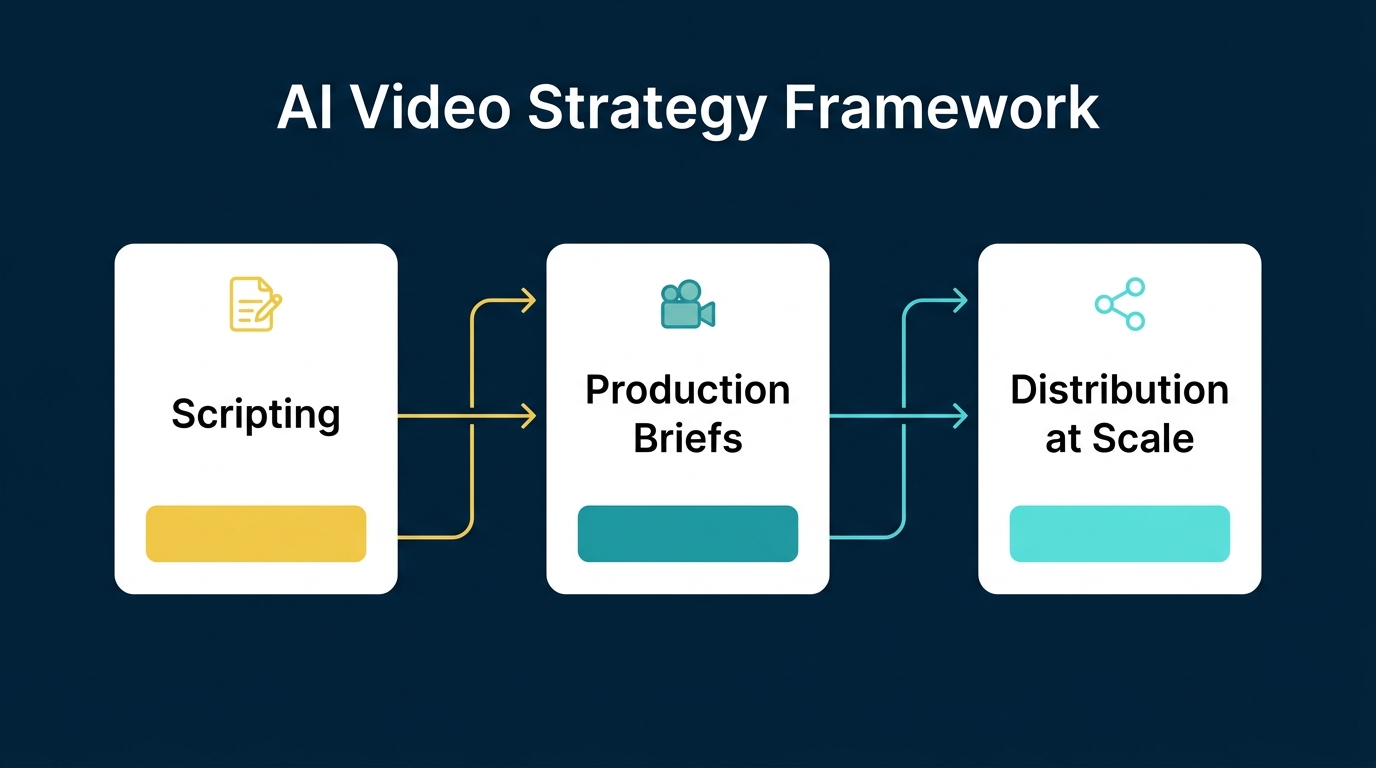
Building a high-output video engine requires a systematic approach. The following framework details how to construct a reliable, automated pipeline that moves from raw concept to a shoot-ready production brief. The steps are intentionally sequential because speed comes from removing decision friction and creating repeatable operational standards.
Step 1: Ideation and the 'Drop Anything' Approach
Most video content calendars fail before the cameras ever turn on because ideation is treated as a moment of sudden inspiration rather than a process of structured research. Relying on manual keyword research and gut feeling is no longer sufficient for a high-volume content engine.
Artificial intelligence is incredibly valuable in this phase because it can rapidly scan large digital surfaces. It can process competitor content gaps, analyze audience psychographics, review YouTube search suggestions, and cross-reference your own customer support transcripts. The goal is not simply to generate "more ideas." The goal is to generate higher-quality ideas that are mathematically positioned to convert viewers into buyers.
A strong ideation process uses AI to answer four specific questions:
- • What does our target audience need to believe about their problem before they are ready to buy our solution?
- • What specific concepts are our competitors failing to explain clearly?
- • What sales objections appear repeatedly in our CRM data?
- • What structural formats (teardowns, myth-busting, behind-the-scenes) currently hold the highest retention rates in our industry?
To scale this ideation phase without losing commercial relevance, modern agencies utilize operational rules similar to the 'Drop Anything' framework to process raw inputs. This methodology involves creating a dynamic system where you can input any variable: a new product launch, an industry news article, or a sudden market shift. The AI processes this input against your brand parameters and outputs a structured matrix of viable video concepts. Ideas are then scored quickly based on their commercial proximity, specificity, proof potential, and distribution fit.
Step 2: Overcoming the Scripting Bottleneck with AI
Once a topic is selected and scored, the most critical phase begins: drafting the script. This is where strategy must translate into spoken language, and language must translate into visual motion.
Advanced AI becomes genuinely transformative when it produces word-for-word scripts that are fully production-ready, rather than just delivering a high-level outline. A sophisticated system acts as a comprehensive pre-production assistant. The difference between a generic output and a production-ready asset is the inclusion of precise formatting:
- • Visual Direction: The script must include suggested b-roll footage, on-screen text overlays, graphic placements, specific camera angles, and moments designed for visual pattern interrupts.
- • Audio Cues: The output should detail music bed changes, emphasis beats, sound effect notes, and pacing guidance to maximize viewer retention.
- • Delivery Notes: The text must guide the presenter on where to pause, where to punch a specific line, and where to slow down for dramatic effect.
- • Edit Notes: The document should provide the post-production team with jump cut suggestions, chapter markers, and cutaway timing.
This level of detail is also where brand risk becomes apparent if you rely on generic, public-facing tools. The system needs to know exactly what your brand sounds like, what specific claims you are legally allowed to make, what terminology you strictly avoid, and which case studies are credible to reference.
For businesses looking to implement this exact level of precision without building the underlying technology from scratch, utilizing a dedicated Video Scripting Agent provides a seamless solution. A purpose-built agent is designed to generate scripts that match your exact tone, structural preferences, and compliance requirements, while embedding the vital production cues your editor and videographer actually need to do their jobs efficiently.
The output of this step is a standardized "production brief." This document prevents filming days from drifting off schedule. It eliminates rework, reduces uncertainty on set, and ensures your post-production editing remains completely consistent with the original strategy.
Step 3: Platform-Native Structuring
A fundamental rule of modern distribution is that pasting a single, unedited script across every social platform is not a strategy. It is a shortcut that actively trains algorithms and audiences to ignore your brand. Platform-native structuring means the exact same core idea is expressed differently based on the unique consumption behavior of each network.
YouTube (Long-Form, Search-Led, Retention-Led)
YouTube operates as a hybrid of a content platform and a search engine. Your AI must structure these scripts around high-retention storytelling. The script requires a clear, compelling promise within the first fifteen seconds. It needs a strong mid-video structure utilizing chapters and clear signposting. The AI should build in retention mechanics like open loops and pattern interrupts, ensuring the narrative aligns perfectly with topics your audience is actively searching for.
TikTok and Instagram Reels (Short-Form, Attention-Led)
Short-form video is not simply a truncated version of a YouTube video. It operates closer to a headline that moves. The AI must prioritize aggressive hooks within the first three seconds. The pacing must be incredibly fast, utilizing short sentences and immediate specificity. The visual rhythm requires constant text overlays, rapid cuts, and dynamic b-roll to prevent the user from scrolling past your content.
LinkedIn (Native, Credibility-Led, Relationship-Led)
The professional network rewards clarity and authority without unnecessary theatricality. Scripts generated for LinkedIn should focus on a practical insight tied directly to business outcomes. The delivery notes should emphasize a calm, authoritative tone with clear signposting. The AI will actively avoid the frantic jump cuts typical of short-form platforms, favoring a polished delivery that builds trust with B2B decision-makers.
The Multiplier Effect: Repurposing and AI-Driven Workflows
To truly achieve scale without burning out your creative team, marketing departments must adopt the "Master Video" methodology. The fastest way to scale video output is not to film more frequently. It is to extract significantly more value from the footage you have already captured.
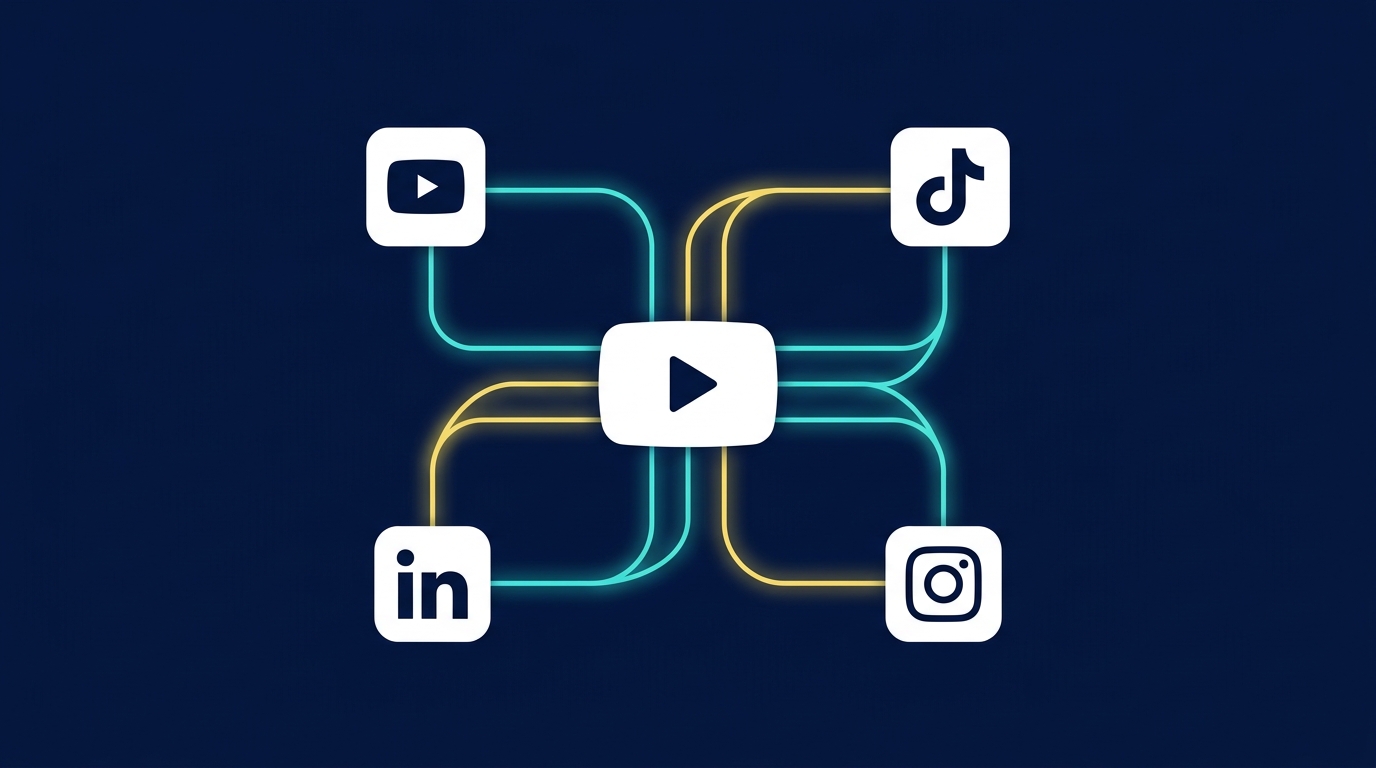
The process begins by shooting one core, long-form pillar piece of content. This master video captures your full explanation, story, or framework. It could be a ten-minute YouTube video, a twenty-minute podcast recording, a segment from a recent webinar, or a founder-led point of view on a major market shift.
From that single recording session, your system should produce five platform-specific edits without forcing the narrative. A highly optimized repurposing set typically includes:
- • The YouTube long-form master video.
- • One to two YouTube Shorts optimized for discovery.
- • One to two TikTok or Instagram Reels featuring a reworked, hook-first opening.
- • A LinkedIn native clip featuring calmer pacing and stronger professional context.
- • A teaser cut designed specifically for paid retargeting campaigns or email newsletter embeds.
Artificial intelligence makes this multiplier effect practical by accelerating the most time-consuming parts of post-production. Intelligent tools can automatically scan the long-form footage, analyze the transcription, and identify the moments with the strongest signal based on keyword density and vocal inflection. The system handles hook rewriting so the short clips function perfectly as standalone assets. It generates captions with exact brand formatting and performs multiple aspect ratio exports while checking safe-zones for text placement.
When your workflow is engineered properly, you completely avoid the "Frankenstein repurpose" problem where social clips feel random or disconnected. Modern technical ecosystems are increasingly built around these AI-driven workflows, where scripting, storyboarding, and asset generation become seamlessly integrated. The strategic advantage is not the software itself, but the operating model it enables: one master asset yields multiple derivatives, ensuring consistent distribution and a rapid weekly learning loop.
Automating Distribution at Scale
Creating exceptional video assets is only half the battle. Most teams drastically underestimate how much time disappears after the final video file is exported. Distribution is the second major bottleneck that causes implementation fatigue.
The manual grind of distribution includes writing unique captions that match each platform's distinct tone. It requires generating SEO-optimized YouTube titles and detailed descriptions. Teams must create thumbnail concepts, research hashtag sets, schedule posts across multiple channels at optimal times, and manually build UTM parameters to track commercial performance. This administrative burden often prevents great content from ever reaching its intended audience.
AI agents remove a massive portion of this manual grind by turning distribution into a checklist-driven, automated workflow. The operational standard you want to achieve is simple: once a final video is approved, the system automatically produces all the necessary publishing assets and routes them to a human manager for a final, one-click review.
A robust automated distribution layer will generate search-led and curiosity-led title variants. It will populate description templates with consistent calls to action. It will format platform-native captions and interface directly with your scheduling software to place content in your historical high-engagement windows.
When you connect your ideation, scripting, repurposing, and distribution into one continuous pipeline, you stop "doing video" as a series of isolated tasks and start operating a true video engine. By upgrading to a fully integrated Content Engine, businesses can consolidate these fragmented administrative tasks into one unified system. The output becomes entirely repeatable because the underlying process is built for repeatability.
Conclusion: Precision-Engineered Mastery for Your Brand
Scaling your video presence is not about working harder, hiring more writers, or forcing your founders to film more often. It is about systematically removing operational bottlenecks with an infrastructure that turns high-level strategy into repeatable, daily output.
When you build an AI video content strategy marketing engine that standardizes your scripting, formats your production briefs, maximizes your repurposing, and automates your distribution, you achieve massive scale without ever sacrificing your brand quality. Stop letting the production bottleneck dictate the pace of your growth. If you are ready to transition from marketing complexity to streamlined mastery, book a Strategy Session with the expert marketers at AI for Marketing. We will map your specific content goals, design your end-to-end process, and implement the bespoke AI layer required to make your video output predictable, measurable, and highly profitable.
Frequently Asked Questions (FAQs)
What is an AI video content strategy marketing plan? It is a structured, automated workflow that uses artificial intelligence to streamline pre-production, scripting, repurposing, and distribution. It replaces manual brainstorming and formatting with precision-engineered systems to increase output volume while human strategists retain complete control over brand messaging and quality.
Will AI-generated video scripts sound robotic or off-brand? They will only sound robotic if the AI lacks brand context and a human review process. When a bespoke system is trained specifically on your company's historical data, target audience, and unique tone of voice, it acts as a high-speed drafting layer rather than a generic voice replacement.
How does AI help with video distribution and repurposing? Intelligent tools automatically scan a long-form master video, identify the most engaging moments, and slice them into multiple platform-specific clips. The system then generates the accompanying SEO titles, native captions, and metadata required to schedule those assets across various social platforms automatically.
Can AI generate visual and audio cues for my production team? Yes. Advanced scripting agents format professional production briefs that include explicit instructions for b-roll placement, camera angles, on-screen text overlays, pacing notes, and sound design. This reduces ambiguity on set and saves videographers and editors significant time during production.
Want to build marketing systems like this?
Book a Discovery CallRelated Articles
The Precision-Engineered Meta Ads Google Ads Together Strategy: How to Scale Without Cannibalising Your Budget
Build a precision-engineered Meta Ads Google Ads together strategy. Align demand creation with capture, avoid budget cannibalisation, and scale efficiently.
Read more →
What Is an AI Marketing Roadmap and Why You Need One Before Spending Another Pound on Tools
Discover why 72% of AI investments fail. Learn how to transition from "tool sprawl" to a Strategic Growth Architecture with a proper AI marketing roadmap and a precision-engineered implementation plan.
Read more →
How to Calculate the True ROI of Hiring an SDR vs Building an AI Outbound System
Discover the true SDR vs AI outbound system ROI. Compare fully loaded human headcount costs against custom AI automation for scalable B2B lead generation.
Read more →