How to Measure the ROI of an AI Marketing System: The Two Value Layers Framework
7 April 2026 • By Jakub Cambor, Founder of AI for Marketing | Top 1% Upwork Expert Vetted Talent
Last updated: 7 April 2026
The promise of Artificial Intelligence in marketing is often sold as a magic wand. We’ve all seen the headlines: "10x your leads in 30 days" or "Replace your entire marketing department with a single prompt." For the pragmatic business leader, these claims don't just sound too good to be true—they sound dangerous.
At AI for Marketing, we believe that if you cannot measure it, you shouldn't build it. The challenge is that traditional ROI calculations often fail when applied to AI. Why? Because they attempt to force a non-linear, compounding technology into a linear spreadsheet. To solve this, we developed the Two Value Layers Framework.
This guide will demystify how to calculate the ROI of an AI marketing system, moving past the "hype" and into the hard metrics that matter to your bottom line.
1. Why Most AI ROI Calculations are Dishonest
The "10x in 30 days" myth is the primary reason many AI initiatives fail. When a business expects immediate, explosive revenue growth from an AI tool, they often overlook the Total Cost of Ownership (TCO) and the Implementation Gap.
Most generic ROI claims are dishonest because they ignore:
- • The Learning Curve: The time it takes for your team to actually adopt and master the system.
- • Data Readiness: The reality that AI is only as good as the data it is trained on.
- • The Human Element: AI doesn't replace strategy; it amplifies it. If your strategy is flawed, AI will simply help you fail faster.
According to a recent MIT study, 95% of enterprise AI initiatives fail to deliver measurable ROI because they focus on "tools" rather than "systems." To avoid this, you must look at value through two distinct lenses.
2. Introducing the Two Value Layers Framework
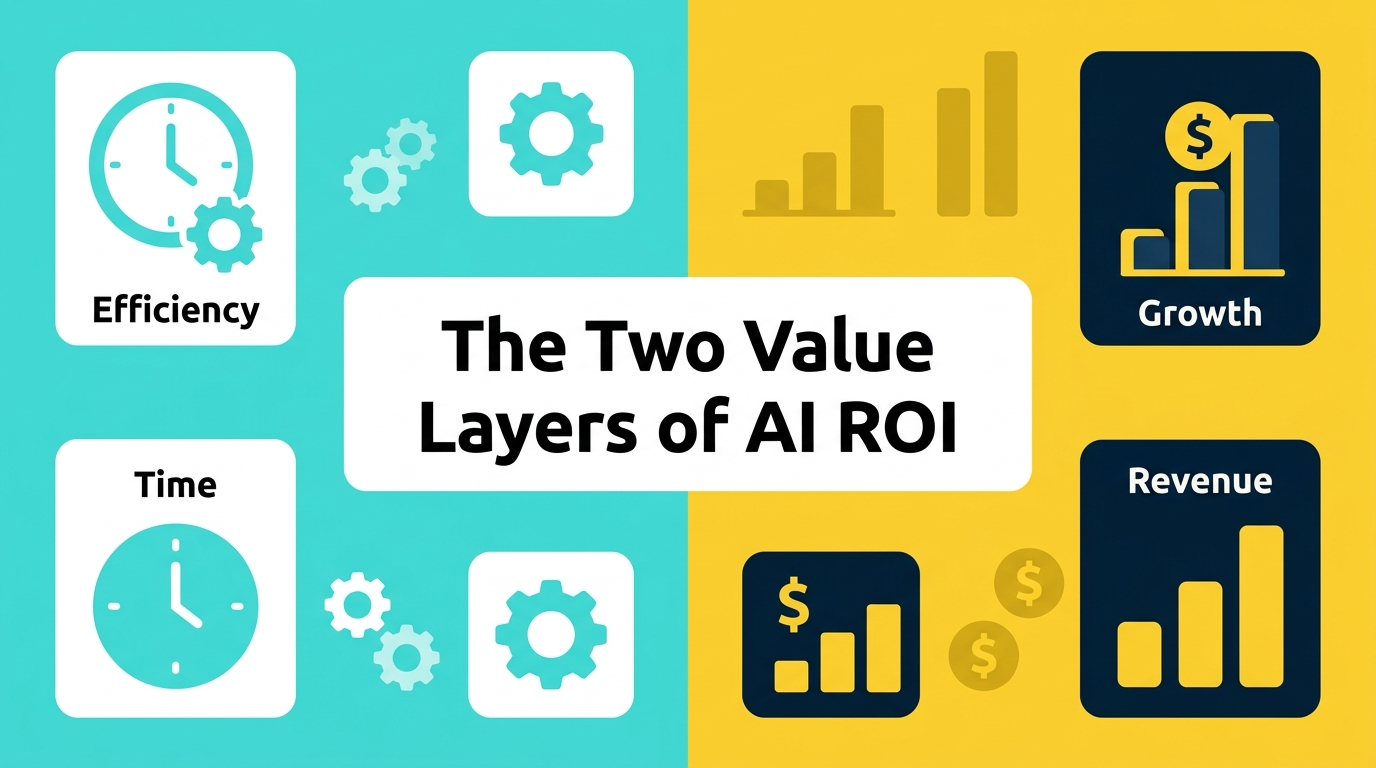
To accurately measure the ROI of an AI marketing system, we divide the return into two layers: Efficiency (Layer 1) and Growth (Layer 2).
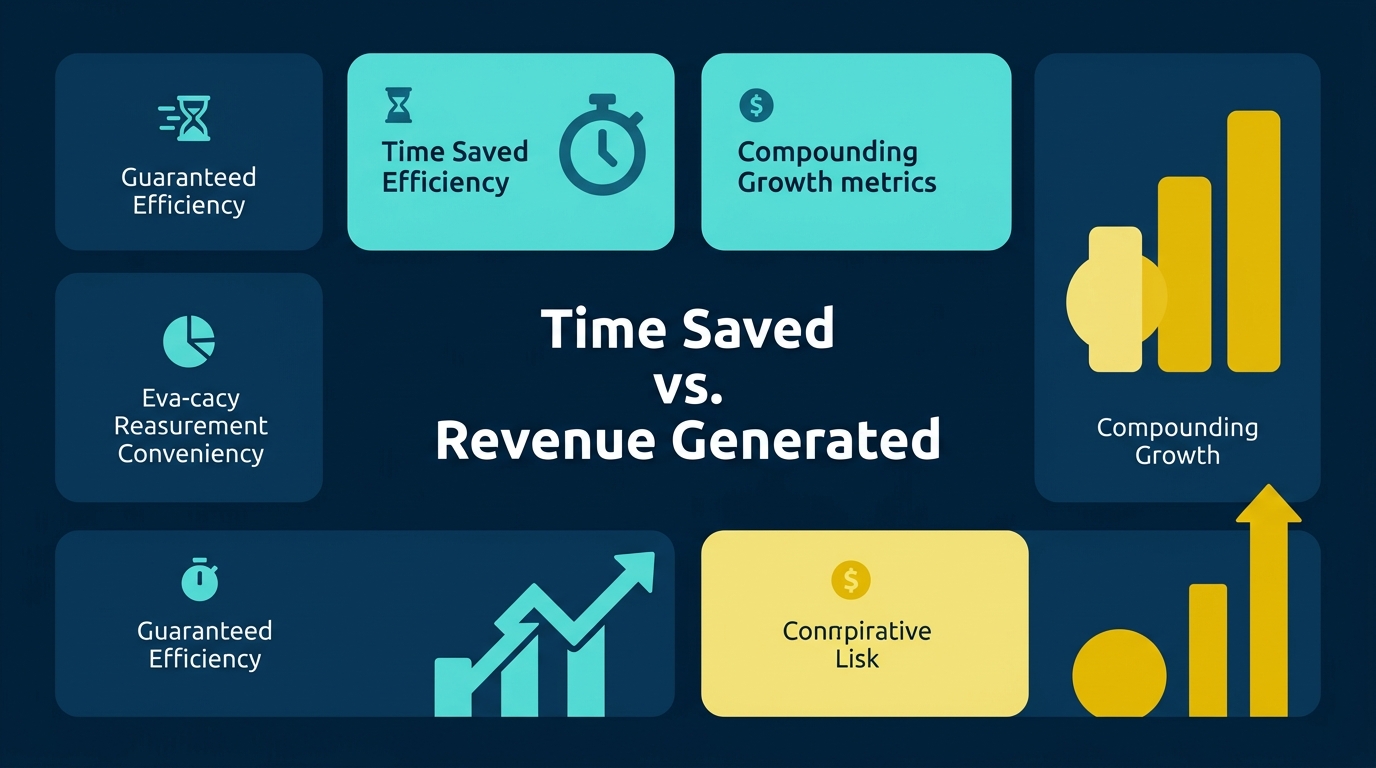
Layer 1: Time Saved (The Efficiency Layer) is quantifiable from day one. It is the "guaranteed" return. It measures the reduction in manual labor and the acceleration of workflows.
Layer 2: Revenue Generated (The Growth Layer) is the compounding return. It is tracked through reporting and attribution, typically maturing over 3 to 6 months as the AI system optimizes toward your specific business outcomes.
3. Layer 1: Time Saved (Guaranteed Efficiency)
In professional services and high-growth SMEs, your most expensive asset is human time. Layer 1 ROI is calculated by identifying the "manual grind" tasks that an AI system can automate or augment.
This isn't about firing staff; it's about reclaiming the 80% of time spent on data collection, formatting, and basic drafting, and reallocating it to high-level strategy and client relationships. This is what we call the "Bionic Marketer" approach.
The Formula for Layer 1 ROI: (Hours Saved per Week × Fully-loaded Hourly Rate × 52 Weeks) - Annual System Cost = Net Efficiency Gain.
4. Layer 2: Revenue Generated (The Growth Layer)
While Layer 1 pays for the system, Layer 2 builds the business. This layer focuses on Realized ROI—the hard numbers that appear on your P&L statement.
This includes:
- • Pipeline Value: The increase in qualified leads generated by AI-driven outreach.
- • Organic Traffic: The compounding value of SEO-optimized content that ranks higher and stays there.
- • Conversion Lift: Using AI to personalize messaging, which typically leads to a 15-30% increase in conversion rates.
Layer 2 requires patience. As noted in our Clarity Roadmap, the first 30 days are for calibration; the real revenue acceleration begins once the system has enough data to identify winning patterns.
5. ROI Breakdown by Engine
At AI for Marketing, we build "Engines"—perpetual systems designed for specific outcomes. Here is how the ROI typically breaks down for each:
The Content Engine
- • Efficiency: Saves 60-120 hours per month. Instead of a writer spending 8 hours on a single long-form article, the AI system produces a high-quality "first-and-a-half" draft in minutes, leaving the human to focus on brand voice and expert insights.
- • Growth: Increases content velocity by 4x, leading to faster keyword dominance and organic traffic growth.
The Lead Gen Engine
- • Efficiency: Replaces the manual prospecting of a full-time SDR (40 hours/week). The system identifies, researches, and initiates contact with high-intent prospects.
- • Growth: Increases lead-to-opportunity conversion rates by ensuring no lead is ever "cold" when a human finally steps in.
The Paid Ads Engine
- • Efficiency: Saves 20-40 hours in setup and creative testing alone. AI can generate hundreds of ad variations and headlines based on historical performance data.
- • Growth: Optimizes ROAS (Return on Ad Spend) in real-time, often reducing Cost Per Acquisition (CPA) by 20% or more.
6. The Revenue Side: Pipeline, Traffic, and ROAS
To move from "efficiency" to "revenue," you must track three core metrics:
- • Marketing Efficiency Ratio (MER): Total Revenue divided by Total AI/Marketing Spend. A healthy target for an AI-driven system is 5.0x.
- • Customer Lifetime Value (CLV) Lift: Using AI to identify cross-selling opportunities within your existing database.
- • Sales Cycle Length: AI-driven lead scoring often reduces the sales cycle by 25-40% by prioritizing leads that are ready to buy now.
7. Simple ROI Calculator Methodology
If you are evaluating an ROI AI marketing system, use this simplified methodology to see if the investment makes sense:
- • Step A: The Baseline. Document your current costs. How many hours does your team spend on SEO, LinkedIn, and Email per month? What is the cost of those hours?
- • Step B: The Efficiency Offset. Apply a conservative 50% time-saving to those tasks. Does the value of those saved hours exceed the monthly cost of the AI system? If yes, the system is "free" from an operational standpoint.
- • Step C: The Growth Multiplier. Estimate a 10% increase in lead volume or conversion rate. This is your "Layer 2" upside.
8. Honest Framing: Inputs, Outputs, and Outcomes
We are often asked: "Do you guarantee results?"
The honest answer is that we guarantee the Input (the precision-engineered system) and track the Output (the content, the leads, the data). We then optimize toward the Outcome (the revenue).
Any provider promising a guaranteed revenue "outcome" without knowing your product-market fit is being dishonest. Our role is to provide the "Exoskeleton"—the technology that makes your marketing team faster, stronger, and more precise. The ROI comes from the synergy of our system and your business strategy.
9. Calculate Your Specific ROI
Every business is unique. A law firm in Bristol will have a different ROI profile than a global SaaS company. This is why we don't offer "off-the-shelf" tools.
The first step in our process is the Clarity Roadmap. During this phase, we don't just look at technology; we perform a deep-dive audit of your current marketing efficiency. We provide you with a custom ROI Calculator that uses your actual labor costs and conversion data to forecast exactly when your AI system will break even and begin to compound.
Stop guessing and start engineering your growth. If you are ready to move past the hype and build a measurable ROI AI marketing system, let's start with a strategy session.

Want to build marketing systems like this?
Book a Discovery CallRelated Articles
The Precision-Engineered Meta Ads Google Ads Together Strategy: How to Scale Without Cannibalising Your Budget
Build a precision-engineered Meta Ads Google Ads together strategy. Align demand creation with capture, avoid budget cannibalisation, and scale efficiently.
Read more →
How to Build an AI Video Content Strategy Marketing Engine: Scripts, Briefs, and Scale
Build an AI video content strategy marketing engine. Automate scripts, production briefs, and distribution at scale without sacrificing brand quality.
Read more →
What Is an AI Marketing Roadmap and Why You Need One Before Spending Another Pound on Tools
Discover why 72% of AI investments fail. Learn how to transition from "tool sprawl" to a Strategic Growth Architecture with a proper AI marketing roadmap and a precision-engineered implementation plan.
Read more →