The E-E-A-T Framework for AI Content: How to Prove Experience, Expertise, Authority, and Trust at Scale
6 April 2026 • By Jakub Cambor, Founder of AI for Marketing | Top 1% Upwork Expert Vetted Talent
Last updated: 6 April 2026

Marketing directors and business founders are currently navigating a highly complex paradox. On one side, there is the undeniable pressure to adopt artificial intelligence for scale, speed, and cost reduction. On the other side is a profound fear of publishing robotic, generic content that damages brand equity and triggers algorithmic penalties. This tension creates implementation fatigue, leaving many businesses paralyzed between the fear of missing out and the fear of making a catastrophic marketing error.

It is time to clarify a fundamental misunderstanding: Google does not penalize artificial intelligence. The search engine algorithms are indifferent to how text is generated. What Google aggressively targets is scaled content abuse: mass-produced pages that add little value, recycle the same internet consensus, and exist primarily to manipulate rankings. The difference is not the tool. The difference is the system behind it.
That is why an E-E-A-T AI content strategy has become the practical filter for visibility in 2025 and 2026. E-E-A-T (Experience, Expertise, Authoritativeness, and Trustworthiness) is not a checklist you bolt on at the end. It is the operational standard that ensures AI-supported production results in content that is accurate, differentiated, and credible.
As specialists at AI for Marketing, we understand that treating automation as a complete replacement for human intellect is a critical error. Instead, mastering the intersection of E-E-A-T and AI is the absolute baseline for digital survival. The goal is no longer to hide your use of technology, but to elevate it through precision-engineered human oversight so every page earns its place in the index.
Deconstructing the Framework: What E-E-A-T Means in the Age of LLMs
Large Language Models are remarkable prediction engines. They can synthesize vast amounts of data, structure arguments, and generate grammatically flawless text in seconds. What they cannot do is live your customer reality, run your campaigns, test your messaging, or make the judgment calls that separate "correct" from "useful." E-E-A-T is the framework that turns AI from a text generator into a production layer inside a quality-controlled marketing ecosystem.
Experience: The Proof of Lived Reality
Experience is the most misunderstood component in AI-assisted content. Many teams interpret it as sounding conversational or adding anecdotes. That is not enough. In an AI context, experience is evidence. It is the tangible proof that someone has actually interacted with the subject matter. A language model can describe how to change a car tire, but it cannot explain the frustration of dealing with a rusted lug nut in the freezing rain.
To prove experience at scale, your content ecosystem must integrate proprietary inputs before the text generation phase. This means feeding your models with original case studies, specific client failure stories, and unique operational data. When generating an article, the prompt architecture must mandate the inclusion of these real-world anchors. Furthermore, supporting the text with original media, such as custom photography or UI screenshots, signals to search engines that the content is rooted in physical reality, not just scraped data.
Expertise: The Nuanced "Why"
While experience is about lived reality, expertise is about deep, theoretical knowledge and the ability to make complex judgment calls. Artificial intelligence is exceptional at providing the "what" and the "how." However, human experts are required to provide the "why."
Demonstrating formal expertise requires a documented history of accurate, insightful analysis. A strong E-E-A-T AI content strategy treats AI as the drafting layer and uses humans to add the nuance behind recommendations. You achieve this by building comprehensive topical clusters that cover a subject exhaustively, proving to the algorithm that your domain is a definitive resource rather than a shallow aggregator.
Authoritativeness: Building Industry Reputation
Authority is what happens when other credible entities treat your brand as a reliable source. You cannot write your way into authority purely on-page. Authority is the compound effect of content quality plus distribution, citations, and mentions. An effective strategy uses automation to accelerate the creation of linkable assets, such as original research reports or data studies, which then fuel digital PR campaigns to earn high-quality backlinks.
Trustworthiness: The Foundational Pillar
Trust is the bedrock of the entire framework. In an era where misinformation can be generated at scale, search engines prioritize safety and accuracy. Establishing trust is the center of the framework, demanding absolute transparency. This includes clear author biographies, accessible contact information, and rigorous fact-checking workflows. Trust is the part of E-E-A-T most likely to break at scale, which is why operational controls are non-negotiable.
"Information Gain": The New Gold Standard for AI Content
Search engines are facing a crisis of infinite supply. To combat this, algorithms have shifted their focus toward Information Gain. This is the measure of net-new value a piece of content adds to the existing index. If an article merely summarizes what the top ten results already say, its Information Gain score is zero, and it will not rank.
This is exactly why generic chat prompts fail. Out-of-the-box models are designed to find the mathematical consensus of their training data. To achieve high Information Gain, you must deliberately break this consensus by injecting proprietary company data, contrarian viewpoints, or highly specific operational tactics that an LLM cannot synthesize from public data alone.
Technical E-E-A-T: Schema, Entities, and AI Overviews (AEO)
Proving your credentials to a human reader is only half the battle. You must also prove them to the machines. This requires a transition from traditional keyword optimization to precision-engineered technical architecture:
- • Schema.org Markup: Use JSON-LD tags like Person, Organization, and ReviewedBy to explicitly state that a qualified human expert has verified the automated draft.
- • Entity Reconciliation: Establish your brand as a recognized entity within the Knowledge Graph through consistent data and active participation in industry databases.
- • AI Engine Optimization (AEO): Secure placements within generative AI summaries by prioritizing semantic authority and structured data.
The Solution: The "Human-in-the-Loop" Content Engine
Software alone is easily commoditized. To build a defensible advantage, you need a system that blends cutting-edge technology with elite marketing strategy. This is the philosophy behind our productized service model at AI for Marketing.
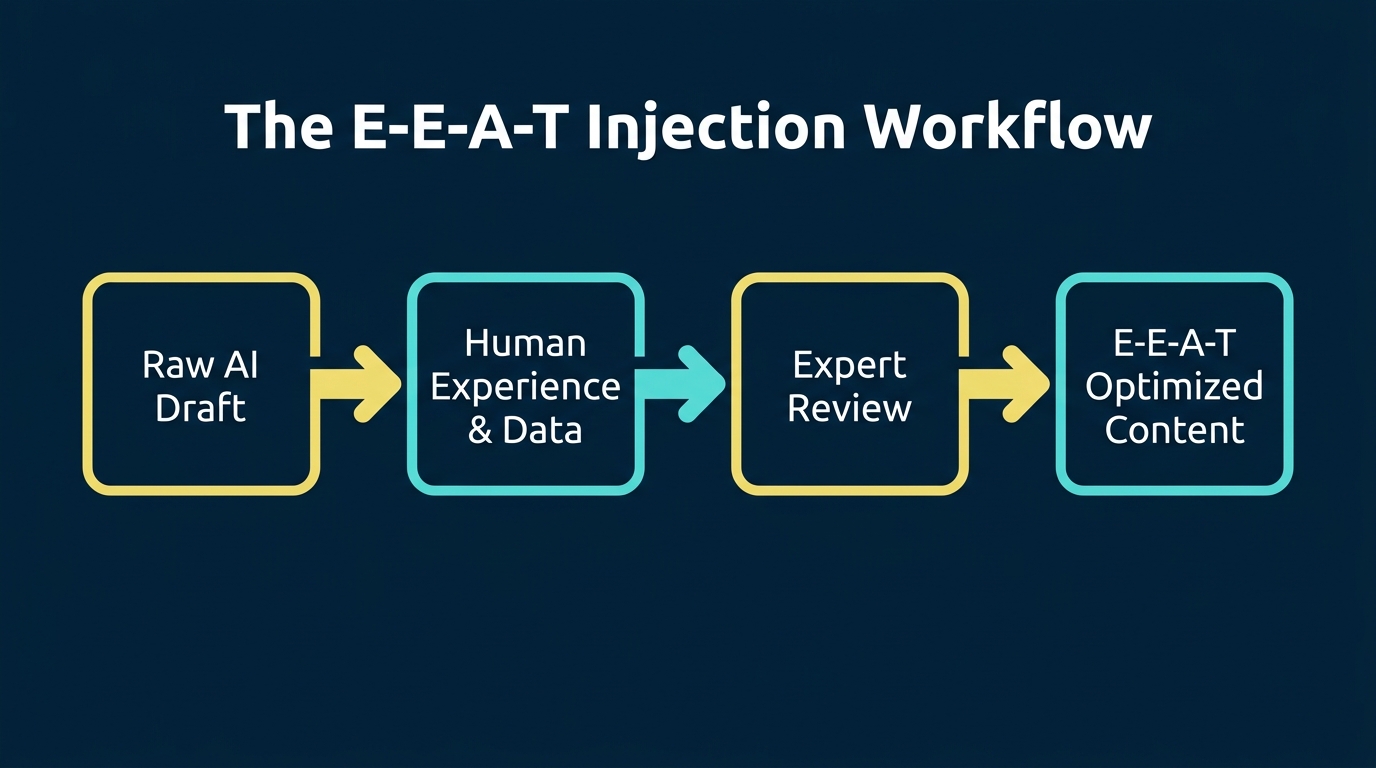
The core of this infrastructure is our bespoke Content Engine. This workflow is the literal mechanism that injects E-E-A-T into your digital presence. Our human-in-the-loop approval process ensures that while AI handles the heavy lifting of research and drafting, a dedicated human expert performs the final validation. They fact-check assertions, refine the brand voice, and ensure the narrative aligns with your broader business strategy.
This process guarantees that every piece of content published under your name is precision-engineered for performance. We eliminate the operational friction of managing multiple APIs and subscriptions, providing you with a predictable, high-ticket implementation that leaves generic templates behind.

Conclusion: Future-Proofing Your SEO with Bionic Marketing
The landscape of digital visibility has fundamentally shifted. Success now requires a sophisticated E-E-A-T AI content strategy that prioritizes Information Gain, technical precision, and verifiable human expertise. By treating automation as an augmentation layer rather than a replacement, you can scale your operations and dominate your industry search results without ever compromising your brand integrity.
Stop relying on generic prompts that dilute your authority. It is time to implement a system that validates your expertise and protects your digital footprint. Book a Strategy Session with our team today, and let us build a precision-engineered content ecosystem tailored specifically to your business goals.
Frequently Asked Questions (FAQ)
Does Google penalize AI-generated content? No, Google does not penalize content simply because it was generated by AI. However, it aggressively penalizes "scaled content abuse"—publishing massive amounts of low-quality, unedited text designed solely to manipulate rankings.
How do I prove Experience in an AI-written article? You must integrate first-hand observations, original case studies, and specific examples from your daily business operations. The technology should be used to structure and polish these human experiences, not invent them.
What is the difference between standard SEO and AEO? Standard SEO focuses on ranking in blue links. AEO (AI Engine Optimization) focuses on being cited as a source within generative AI summaries like Google's AI Overviews.
How does a human-in-the-loop system actually work? It integrates human decision-making at critical junctures. In our Content Engine, humans set the strategy and perform the final editorial pass, while AI handles the initial research and drafting at scale.
Want to build marketing systems like this?
Book a Discovery CallRelated Articles
Google AI Overviews Optimisation: A Business Guide to the New Search Era
Master Google AI Overviews optimisation business strategies. Learn the content structures, E-E-A-T principles, and technical SEO to capture high-intent traffic.
Read more →
How to Automate Client Onboarding with AI: From Payment to Kickoff in Under 3 Minutes
Learn how to transform your manual onboarding bottleneck into a 3-minute automated engine that increases client retention by 50%.
Read more →
How to Use Trigger Events to Build a Smarter B2B Prospecting List with AI
Discover how trigger events B2B prospecting AI replaces static lists with dynamic targeting. Learn to configure Apollo and Clay for precision outreach.
Read more →