How to Automate Client Onboarding with AI: From Payment to Kickoff in Under 3 Minutes
6 April 2026 • By Jakub Cambor, Founder of AI for Marketing | Top 1% Upwork Expert Vetted Talent
Last updated: 6 April 2026
Winning a new client is a moment of triumph. It validates your strategy, your pitch, and your agency's value proposition. Yet, for many founders and marketing directors, that initial high is immediately followed by administrative dread. The reality of onboarding sets in: the manual grind of chasing intake forms, setting up CRM records, creating folder structures, and drafting kickoff documents. The work is necessary, but it is rarely strategic.
First impressions dictate long-term client retention, but most agencies rely on a fragmented, manual process that drains resources and delays time-to-value. When a client hands over a significant retainer, they expect immediate momentum. If they are met with 48 hours of silence while your team scrambles to build digital workspaces and format presentation slides, buyer's remorse begins to creep in. Clients expect a premium experience from the very first interaction, while delivery teams are simultaneously trying to scale without adding unnecessary headcount.
We are demystifying this process by pulling back the curtain on our own internal systems. We will show you exactly how to automate client onboarding AI workflows to reduce friction, eliminate manual bottlenecks, and get your team to the strategic work faster. The goal is not to remove the human touch, but to precision-engineer your operations so your human talent can focus purely on relationship building and high-level strategy. By treating your onboarding sequence as a unified ecosystem rather than a series of disconnected tasks, you can transform administrative fatigue into a competitive advantage.

The Hidden Bottleneck: The True Cost of Manual Onboarding
Manual onboarding is rarely measured accurately, which is why it quietly becomes the most expensive invisible process in an agency. As businesses grow, they inevitably confront the scale versus quality paradox. You cannot infinitely scale manual administrative tasks without eventually sacrificing the bespoke quality of your service or damaging your profit margins through over-hiring.
To understand the necessity of an AI onboarding pipeline, we must first audit the hidden costs of the traditional approach. Industry research and internal time-tracking reveal that manual onboarding takes an average of 11 hours per client. This is not a single block of time, but a fragmented series of tasks spread across multiple team members. It includes two hours of formatting folders and assigning permissions, three hours of reading intake forms to summarize the client's brand voice, four hours of building the strategic kickoff deck, and two hours of internal alignment meetings.
These hours compound as you grow. Every extra client multiplies the exact same administrative burden. If your agency onboards ten new clients a month, that is 110 hours of high-value team bandwidth wasted on low-value data entry. It is the equivalent of a full-time employee dedicating three weeks entirely to copying and pasting information between platforms.
The financial drain is equally severe. When factoring in the hourly rates of account managers, strategists, and administrative staff, the cost of manual onboarding typically ranges between $500 and $800 per client. Conversely, when you automate client onboarding AI systems take over the heavy lifting, dropping this operational cost down to between $150 and $250 per client once the engine is built and governed.
The most critical metric is not just time or initial cost, but lifetime value. Organizations that strategically deploy customer onboarding automation experience a 50% higher customer retention rate, proving that speed, structure, and a frictionless first impression directly influence how long a client stays with your agency. A delayed onboarding process signals operational chaos to the client. A precision-engineered onboarding sequence signals competence, safety, and mastery.
The AI for Marketing Approach: A Case Study in Disguise
Most teams start automation by connecting basic tools. That helps slightly, but it rarely solves the underlying problem: onboarding is not one action, it is a chain of dependent actions. If any link in that chain is slow or incomplete, the entire experience feels manual again.
At AI for Marketing, we position ourselves as the adults in the room. We do not rely on generic templates, basic chat interfaces, or disjointed software subscriptions that create a fragmented wrapper economy. We build bespoke, precision-engineered ecosystems.
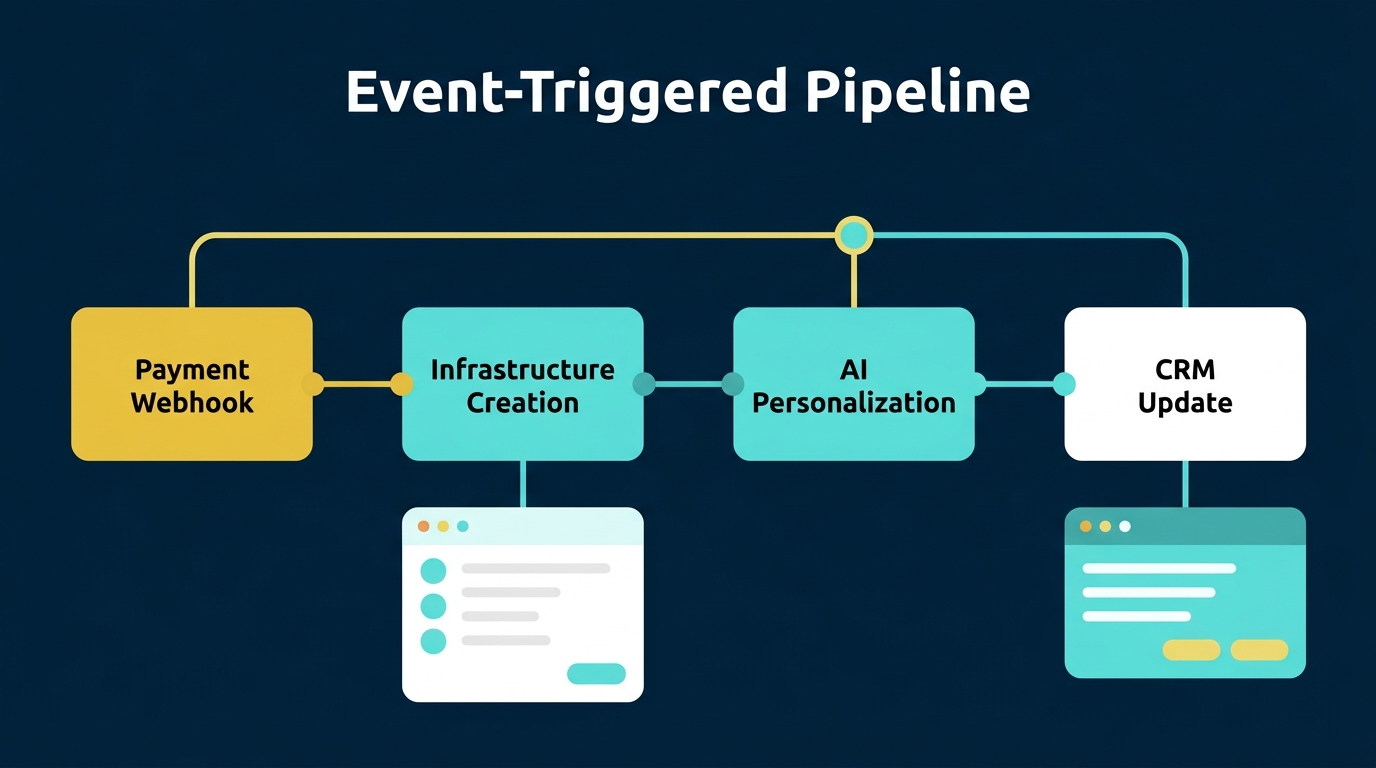
Our internal onboarding system is built on the concept of the event-triggered AI workflows. This is a sequence of automated actions that occur sequentially the exact moment a specific condition is met. We are not replacing our dedicated account managers. Instead, we are providing them with a bionic exoskeleton, allowing them to operate with unprecedented speed and accuracy.
Agencies looking to successfully automate client onboarding must move beyond basic integrations that simply pass raw text from one software to another. True automation requires intelligent data synthesis. When executed correctly, the results are staggering. Real-world benchmarks, such as the systems deployed by Pure Media & Marketing, have successfully reduced the onboarding window from a sluggish 30 minutes down to just 2 minutes.
Here is exactly how we structure this event-triggered AI workflow to achieve those exact results.
Step 1: The Trigger & Data Synthesis (NLP)
The entire ecosystem remains dormant until the catalyst occurs. The moment a payment is processed via Stripe or a master service agreement is signed via DocuSign, the system wakes up. This trigger sends a secure webhook to our central AI architecture, initiating the pipeline. It eliminates the failure point of waiting for a human to notice that a sale has closed.
The first immediate action is data synthesis. Traditional automation would simply take the client's answers from an intake form and paste them into a document. That is data routing, not data intelligence. Our system utilizes advanced Natural Language Processing (NLP) models to instantly read the client's intake form and synthesize the information.
The AI analyzes the client's stated goals, extracts their primary competitors, defines their target audience psychographics, and establishes their brand voice guidelines. It turns raw, unstructured answers into a highly structured, strategic brief without a single human keystroke. This guarantees that before an account manager even opens their laptop, a comprehensive understanding of the client is already documented, categorized, and ready for review.
Step 2: Technical Provisioning (The Workspace)
The most universally despised aspect of agency onboarding is folder fatigue. Creating digital workspaces, assigning the correct permissions, and ensuring naming conventions are followed is a tedious process highly prone to human error. A misspelled folder name or a forgotten permission setting can cause massive operational headaches weeks down the line.
Our event-triggered pipeline eliminates this entirely. Following the data synthesis phase, the AI automatically provisions the technical infrastructure. It communicates with the workspace API to generate a master client folder. Within that master folder, it creates standardized sub-folders for design assets, reporting dashboards, strategy documents, and financial contracts. Every folder is perfectly named using the exact syntax required by our internal systems.
Simultaneously, the system provisions the communication channels. It creates a dedicated, private Slack channel for the client, invites the specific account manager and strategists assigned to the project, and pins the newly generated strategy brief to the top of the channel. Finally, it updates the CRM, moving the client from prospect to active, logging the contract value, and setting up the automated billing cycles.
This stage is also where security and data hygiene are engineered into the process. Role-based permissions, automatic redaction of sensitive fields, and clear audit trails ensure that the system remains secure and compliant at all times.
Step 3: AI Agents & The Automated Kickoff Deck
This is the phase where operational efficiency transitions into client-facing magic. With the technical workspace provisioned and the data synthesized, the system deploys custom AI marketing agents.
These agents are programmed with specific marketing logic. They take the synthesized NLP data and automatically populate bespoke kickoff presentation decks. Deploying specialized agents to automate client onboarding with AI allows for deep personalization at scale, ensuring the output is highly relevant rather than robotic.
The AI agent builds out the executive summary slide based on the intake form. It scrapes the web for the competitors listed by the client and populates a preliminary competitor landscape slide. It outlines a 90-day strategic roadmap based on the specific services the client purchased.
By the time the account manager logs in, the entire kickoff deck is heavily drafted. The client feels heard immediately because their specific pain points, goals, and industry nuances are already mapped out in a polished presentation before the first strategy session even takes place.
The 10-20-70 Rule: Balancing Automation with the Human Element
A common fear among risk-averse buyers and agency founders is that implementing AI will make their business feel cold or impersonal. They worry that by automating the process, they are removing the premium service that justifies their pricing.
This is a fundamental misunderstanding of how professional AI ecosystems function. We believe in the strict synergy of human creativity and AI efficiency. To maintain this balance, we operate on the 10-20-70 Rule.
In our onboarding pipeline, 10% of the process is entirely autonomous. This covers the administrative tasks: creating folders, setting up Slack channels, updating the CRM, and routing contracts. These are tasks that clients do not see and do not care about, provided they are done correctly.
Another 20% of the process is AI-assisted. This involves the AI agents drafting the kickoff deck, synthesizing the intake data, and pulling preliminary competitor research. The AI acts as a highly capable junior strategist, preparing the raw materials and compressing the time-to-clarity.
The remaining 70% is strictly human-led. Because the account manager has been freed from the manual labor, they can dedicate all of their energy to the human elements of the onboarding process: relationship building, strategy validation, empathy, and nuanced problem-solving.
This philosophy aligns perfectly with the 5 C's of Onboarding: Compliance, Clarification, Culture, Connection, and Check-back.
- • Compliance: This is system-led with safeguards. Automation improves compliance because it is strictly consistent. The AI handles data handling rules, access control, and audit trails instantly and flawlessly.
- • Clarification: This is AI-assisted, then human-confirmed. AI can quickly summarize inputs into a usable brief, but humans must confirm the key decisions during the kickoff call to preserve accountability.
- • Culture: This is entirely human-led. Culture is the tone of the partnership: how you work, how you communicate, and how you handle feedback. Automation simply removes distractions so your team has the bandwidth to demonstrate your agency's culture early on.
- • Connection: This is human-led, supported by context. Connection is built through relevance and empathy. AI helps by ensuring you walk into the kickoff already informed, but the human still leads with curiosity and presence.
- • Check-back: This utilizes system-led reminders and human-led conversations. The system can schedule check-ins and track outstanding items, while the human owns the actual conversation.
When teams ask how to automate client onboarding AI ecosystems without losing the human element, the answer is better boundaries, not less automation.
Building Your Engine to Automate Client Onboarding AI Pipelines
The gap between AI-driven businesses and those relying on manual administration is widening every single month. However, attempting to build this infrastructure using off-the-shelf SaaS tools often leads to frustration. Businesses do not need more disjointed tools or separate API subscriptions: they need a unified, done-for-you engine.
Off-the-shelf software creates a fragmentation problem. You end up with one tool for forms, another for signatures, another for tasks, and another for your CRM. You spend your time managing the wrappers instead of managing the actual workflow. A bespoke onboarding engine orchestrates events, synthesizes data, and produces assets consistently.
If you are experiencing operational friction but are unsure exactly where your manual bottlenecks lie, the best first step is to start with a Clarity Roadmap to systematically analyze your current workflows. This strategic deep-dive audits your process end-to-end, identifying areas of administrative bloat and blueprinting a custom automation strategy tailored to your specific agency model.
For businesses that already understand their bottlenecks and are ready to deploy a precision-engineered system immediately, you need a partner who understands marketing logic, not just code. Partner with our experts for a Custom Solution where we build, test, and implement the exact three-minute event-triggered pipeline discussed above, directly into your existing business infrastructure.
Stop forcing your highest-paid talent to do data entry. It is time to treat your onboarding process as a highly engineered asset.
Conclusion: Precision-Engineered First Impressions
Marketing complexity often overshadows your agency's true potential. When your team is bogged down by the manual grind of setting up new clients, your growth is artificially capped. Onboarding is where trust becomes tangible. When it is manual, fragmented, and slow, even great delivery later has to work harder to recover momentum.
By implementing an event-triggered pipeline, you eliminate folder fatigue, synthesize data instantly, and generate highly personalized kickoff materials in under three minutes. This is the synergy of human creativity and AI efficiency in its purest form. Do not let administrative dread ruin the triumph of winning a new client. AI for Marketing is here to bridge the gap, turning your operational bottlenecks into precision-engineered mastery.
Frequently Asked Questions (FAQ)
How does AI improve the client onboarding experience? AI improves onboarding by compressing time-to-clarity and removing repetitive administrative tasks. By automating folder creation, CRM updates, and data synthesis, the client experiences a frictionless, highly organized onboarding sequence that builds immediate trust and showcases your agency's competence.
Is it safe to use AI for handling sensitive client onboarding data? It is safe when the ecosystem is precision-engineered with enterprise-grade security. Professional AI pipelines utilize secure webhooks, role-based access, data minimization, and private API connections that do not use your client's proprietary data to train public language models, ensuring total confidentiality and compliance.
Can AI completely replace human account managers during onboarding? No, and it should not. AI is designed to complement the human element by acting as an exoskeleton for the account manager. The technology handles the administrative burden and data synthesis, which frees up your human talent to focus entirely on building relationships, validating strategy, and providing premium service.
What tools are required to automate client onboarding with AI? A bespoke onboarding engine typically requires a payment or contract trigger, a central automation hub, Natural Language Processing models for data synthesis, and custom AI agents connected to your workspace tools via secure APIs. The exact stack depends on your existing systems and governance requirements.
Want to build marketing systems like this?
Book a Discovery CallRelated Articles
Google AI Overviews Optimisation: A Business Guide to the New Search Era
Master Google AI Overviews optimisation business strategies. Learn the content structures, E-E-A-T principles, and technical SEO to capture high-intent traffic.
Read more →
How to Use Trigger Events to Build a Smarter B2B Prospecting List with AI
Discover how trigger events B2B prospecting AI replaces static lists with dynamic targeting. Learn to configure Apollo and Clay for precision outreach.
Read more →
AI Marketing for B2B SaaS: How to Automate Content, Outbound, and Ads Without a Full Marketing Team
Learn how lean teams use AI marketing B2B SaaS engines to automate content, outbound, and ads. Scale revenue and reduce CAC without increasing headcount.
Read more →