How to Use Trigger Events to Build a Smarter B2B Prospecting List with AI
6 April 2026 • By Jakub Cambor, Founder of AI for Marketing | Top 1% Upwork Expert Vetted Talent
Last updated: 6 April 2026
If your revenue team is still building outbound campaigns around static Ideal Customer Profile (ICP) lists, you are operating with a severe structural disadvantage. Business environments are fluid. Executives change roles, companies reorganize, budgets move, and priorities shift daily. The buyer you researched six months ago is often no longer in the same position, or their company is no longer facing the same operational challenges.
The hard truth is that B2B contact data degrades at a pace most organizations underestimate. Relying on static spreadsheets guarantees a high failure rate because traditional databases simply cannot keep pace with market reality. The statistics confirm this fundamental flaw: research on data decay and AI-driven prioritization indicates that B2B contact data rots at a staggering 25 to 35% annually. By the time a sales representative reaches the bottom of a purchased list, a third of the information is entirely obsolete.
The most sophisticated teams have recognized this and shifted to trigger events B2B prospecting AI. This methodology replaces the outdated "build a list once and sequence forever" model with dynamic targeting that refreshes itself based on live market signals.
Modern marketing requires a paradigm shift. Instead of asking, "Who fits our target profile?" businesses must ask, "Who is experiencing a problem we can solve right now?"
The results of this shift are quantifiable. Outbound fails more often due to poor timing than poor copywriting. Standard cold outreach reply rates currently hover between a dismal 1% and 3%. However, when outreach is anchored to a verifiable reason to talk now, the numbers change dramatically. Trigger-based outreach regularly reaches 15 to 25% reply rates. Prospects are exhausted by generic pitches, but they are highly receptive to precise solutions offered at the exact moment of operational friction.
Artificial intelligence is what makes this shift operational. It acts as an always-on monitoring layer that identifies signals, enriches context, prioritizes accounts, and supports sales with messaging that sounds like a human who did their homework.
What Are Trigger Events in B2B Prospecting?
A trigger event is a specific, observable occurrence within a target account that signals a newly formed pain point, a shift in strategy, or a sudden buying intent. It is the catalyst that moves a company from the status quo into an active buying cycle. It is not a demographic attribute like "company size 200 to 500 employees." It is a moment in time that creates urgency.
Consider the difference between pitching an IT security service to a random Chief Information Officer versus pitching that same service to a CIO whose company just announced a major international acquisition. The first approach relies entirely on luck. The second approach leverages a trigger event: the integration of two distinct IT infrastructures, which historically creates massive security vulnerabilities. The timing transforms the pitch from a nuisance into a timely, consultative intervention.
When analyzing the comparison of reply rates between cold pitching and timing-based outreach, it becomes clear that relevance dictates success. If you reach out when a prospect is actively trying to solve a problem, your message is viewed as a resource.
Historically, tracking these triggers was a manual, labor-intensive process. Sales representatives would spend hours scouring news feeds, press releases, and social media updates to find a handful of actionable signals. It was effective but impossible to scale. This is where AI bridges the gap. AI acts as a sophisticated monitoring infrastructure, simultaneously tracking thousands of accounts for specific digital footprints. It processes unstructured data from across the internet, categorizes it, and alerts your team the moment a relevant event occurs. This capability enables dynamic B2B targeting at a scale that human operators could never achieve alone.
The 6 Major Trigger Event Categories for AI Prospecting
To engineer a predictable pipeline, you must train your systems to look for the right signals. While every industry has niche indicators, there are six universal trigger event categories that reliably indicate B2B buying intent.
1. Funding Rounds and Financial Milestones
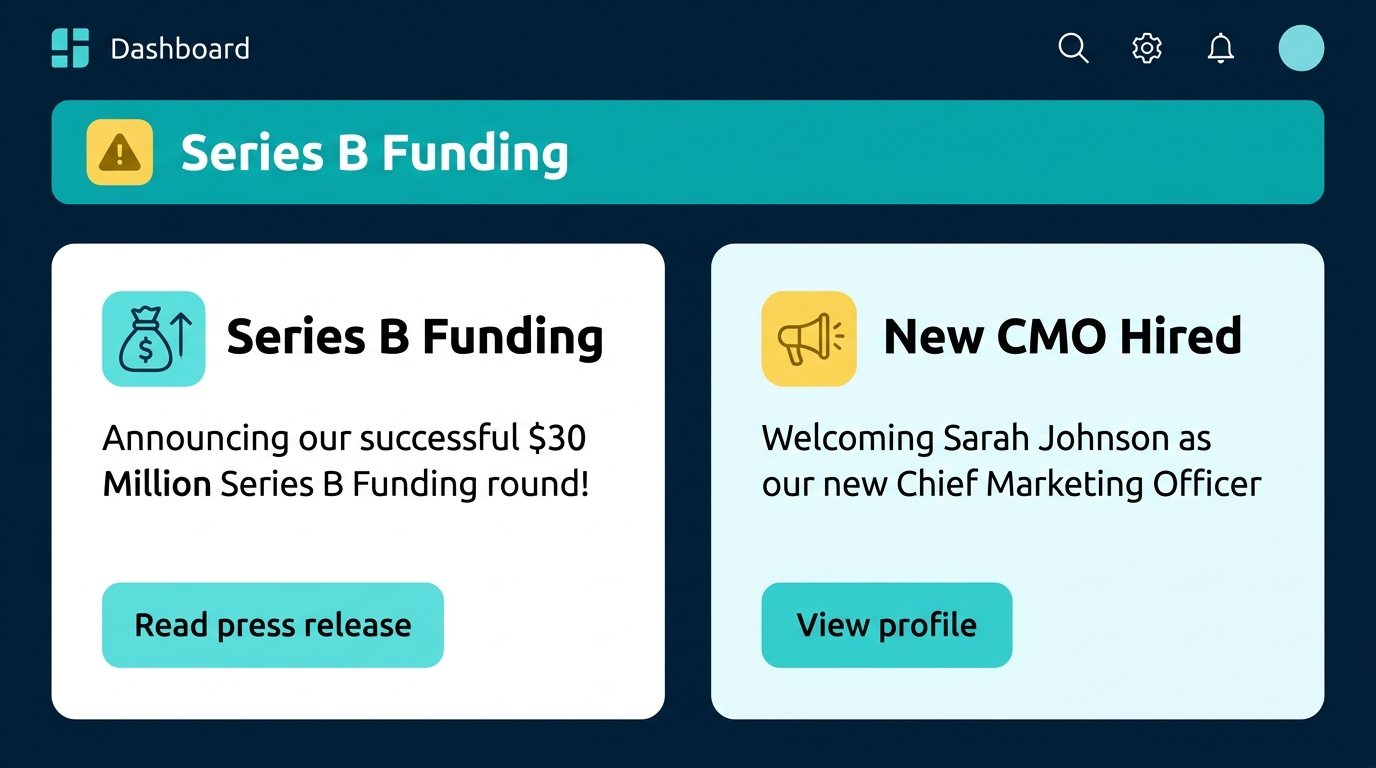
Capital injection is one of the most powerful indicators of imminent spending. When a company successfully raises a Series A, B, or C funding round, two things happen immediately. First, they have an influx of liquid capital. Second, they face immense pressure from their investors to accelerate growth, scale operations, and capture market share quickly.
A newly funded company cannot rely on the scrappy, manual processes that got them through their seed stage. They need enterprise-grade software, robust consulting, new marketing infrastructure, and upgraded internal systems.
By configuring your AI to monitor financial databases and press releases, you can automate outreach to founders and executives within days of a funding announcement. However, a funding-trigger email should never be a generic "Congrats on the raise." That wastes the trigger. The messaging should connect the funding event to a predictable operational bottleneck: increased pipeline targets, rising reporting expectations, or the pressure for consistent acquisition.
2. Job Postings and Hiring Trends
A company's hiring roadmap is a public declaration of its strategic priorities. Job descriptions are incredibly detailed documents that reveal exactly what internal problems a business is trying to solve. Hiring is a forward-looking signal: companies hire in anticipation of new goals.
If a target account suddenly opens three roles for Sales Development Representatives, they are actively trying to scale outbound revenue. Consequently, they will soon need lead generation software, CRM optimization, and sales training. If a company is hiring a Vice President of Marketing, a complete strategic overhaul is imminent.
AI scraping tools can monitor specific career pages and job boards, parsing the text of new listings to identify the exact technologies required or the specific departmental goals mentioned. Instead of saying "we help B2B companies grow," your AI-assisted message becomes "you are hiring for X, which usually breaks Y, and here is how we fix it."
3. Tech Stack Changes and Adoptions
In the modern B2B landscape, software adoption signals operational maturity and budget allocation. Tracking when a company installs or uninstalls a specific technology provides critical context for your sales messaging. Tool changes create project windows. There is a period during adoption where teams must re-architect workflows, rebuild reporting, migrate data, and retrain users. That window is painful, budgeted, and time-sensitive.
For example, if an organization transitions its website infrastructure from a basic platform to an enterprise solution like Adobe Experience Manager, it signals a massive increase in their digital marketing budget. If a company moves from HubSpot to Salesforce, it signals a shift toward enterprise sales motions.
AI monitoring tools can detect these underlying code changes on target websites, alerting you to a technological transition before the prospect even begins searching for vendor support. A tech-trigger email should focus on implementation outcomes: clean data flows, lead routing, and playbooks that reps actually follow.
4. Leadership Changes and Executive Moves
A change in leadership almost always triggers a change in vendor relationships. When a new Chief Marketing Officer, Chief Revenue Officer, or Head of RevOps takes the helm, they are expected to make an immediate impact. Research consistently shows that new executives spend up to 70% of their initial budget within their first 100 days in office.
New leaders want to build their own tech stacks and bring in their preferred agency partners. They are highly motivated to audit existing systems and replace underperforming assets. Even if the company already has a vendor, new leadership often means the vendor is re-audited.
AI tools can monitor LinkedIn updates and corporate press pages to track executive movements in real-time. Reaching out to a new decision-maker on day fifteen of their tenure with a strategic audit offer or a quick benchmark report is exponentially more effective than cold-emailing the previous executive who was comfortable with the status quo.
5. Expansion Signals (New Markets, M&A)
Corporate expansion creates operational chaos, and chaos requires external solutions. When a company announces a merger, an acquisition, or the opening of a new international office, they face immediate logistical hurdles. Messaging fragments. Data becomes inconsistent. Sales teams need new territories, new lists, new positioning, and new processes.
Expanding into a new geographic market requires localized marketing, new legal compliance software, and expanded HR infrastructure. Mergers require the consolidation of distinct IT systems, payroll platforms, and corporate cultures. AI systems can track regulatory filings, news mentions, and corporate blogs to identify these expansion signals.
6. Content Signals and Intent Data
Not all buying intent is announced via press releases. Often, the strongest signals are silent. Content consumption and B2B intent data signals reveal what a prospect is researching before they ever fill out a contact form. If multiple employees from a target account are reading articles about marketing automation implementation or downloading whitepapers on CRM data hygiene, they are clearly in the educational phase of a buying cycle.
Configuring the Data Engine: Apollo, Clay, and Beyond
Understanding trigger events is only the theoretical foundation. The true competitive advantage lies in the infrastructure: the ability to capture, process, and act upon these signals automatically. We are currently operating in a "wrapper economy," where the most successful businesses are those that aggregate fragmented APIs into a unified, seamless workflow.
Buying access to data providers is simple. Configuring them to communicate flawlessly without generating endless API errors is an engineering challenge. A robust architecture requires specific tools performing specialized functions within a broader ecosystem.
Apollo serves as an excellent foundational layer for raw contact data and baseline company information. However, raw data is insufficient for trigger-based outreach. This is where platforms like Clay become indispensable. Clay acts as the orchestration layer, allowing you to build complex waterfall logic for data enrichment.
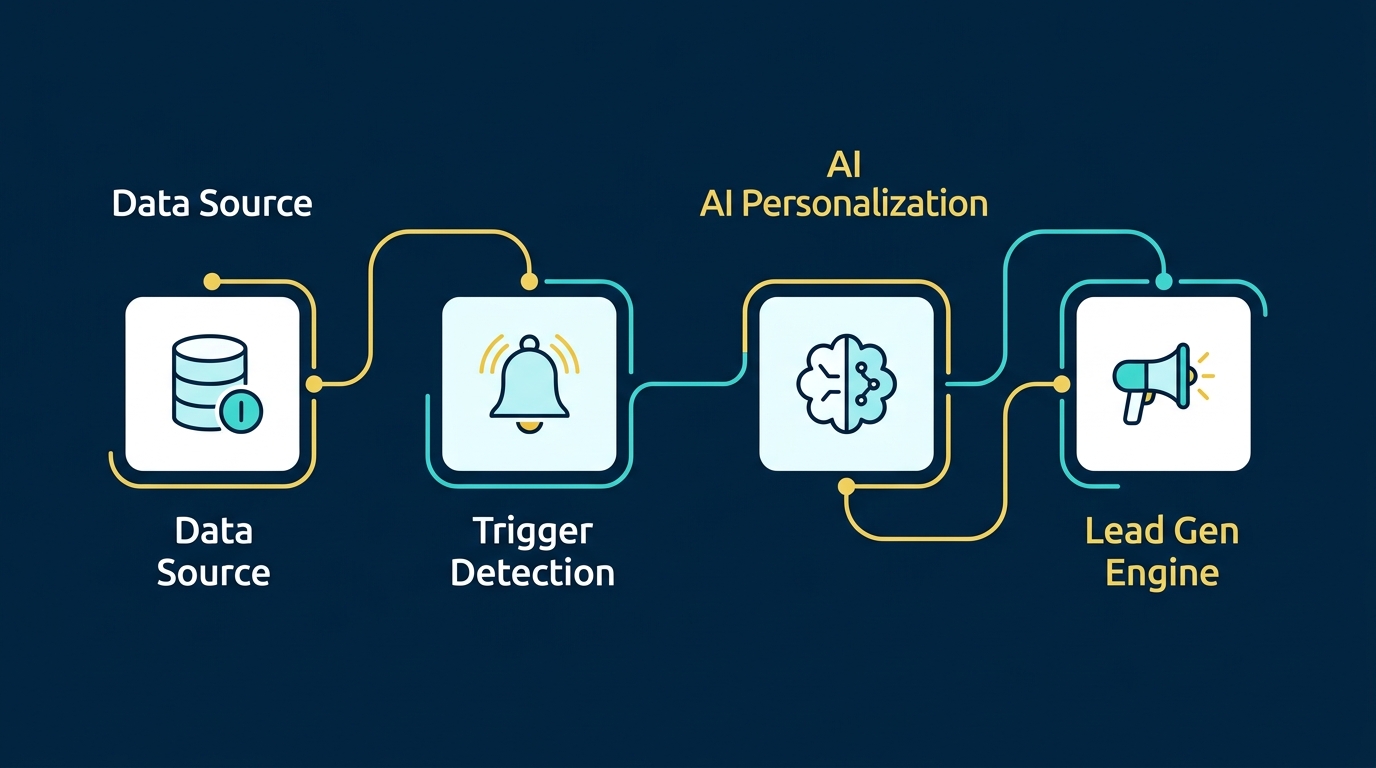
A well-architected Apollo and Clay integration workflow operates in sequential logic. The system identifies a company that just raised funding. It then queries Apollo to find the VP of Sales. Next, it uses a secondary API to verify the email address. Finally, it scrapes the VP's recent LinkedIn activity to find a personalized hook. The operational impact is clear: AI reduces account research time by 85%, allowing your team to focus entirely on strategy and closing rather than manual data entry.
The Personalisation Agent: Crafting AI-Driven Messaging
Data without effective communication is useless. Once your data engine has identified a trigger event and enriched the prospect's profile, the next critical phase is the output. This is where AI Agents take the raw, structured data and synthesize it into hyper-personalized, human-sounding communication.
It is vital to leave generic ChatGPT prompts behind. The market is currently flooded with lazy AI outreach that reads exactly like a robot wrote it. A message that simply states, "Congratulations on your recent Series B funding, do you need marketing services?" is not personalization. It is just a mail-merge with a slightly better variable.
True AI sales outreach automation requires precision-engineered prompting. The Personalisation Agent must be trained to synthesize three critical inputs: trigger context, account context, and persona context. A well-built AI agent produces outreach that references the trigger with restraint, makes a plausible inference tied to operational outcomes, and offers a specific, low-friction next step.
Implementation: Setting Up Your Lead Generation Engine
Understanding the mechanics of trigger events B2B prospecting AI is one thing. Building, testing, and maintaining the infrastructure is a completely different endeavor. Most teams do not fail because they lack tools. They fail because the system is fragmented. Apollo lists are built once and decay. Clay tables exist but are not operationalized. Signals are collected but not routed to the CRM.
Setting up complex workflows, managing API limits, verifying domains to protect email deliverability, and prompting custom AI Agents requires deep technical expertise. For most businesses, attempting to build this internally results in severe implementation fatigue and wasted resources.
Marketing complexity should not overshadow your potential for growth. AI for Marketing operates as your strategic architect, bridging the gap between advanced artificial intelligence and practical business application. We do not just sell access to tools; we build comprehensive, custom solutions tailored to your specific sales cycle.
By removing the friction of fragmented software subscriptions and technical troubleshooting, we allow you to focus on what you do best: closing deals and running your business. Our team handles the entire orchestration process through our dedicated Lead Generation Engine. We provide unified billing, a dedicated account manager, and a system designed for predictable scale.

Conclusion: Stop Guessing, Start Triggering
The landscape of B2B sales has permanently shifted. The gap between businesses leveraging AI-driven infrastructure and those relying on manual, static lists is widening every single day. Continuing to blast generic emails to decaying databases is a waste of brand equity and operational resources.
You have a choice: you can continue to guess who might be ready to buy, or you can build a system that alerts you exactly when a prospect needs your help. By harnessing the power of trigger events, enriching your data through sophisticated integrations, and deploying personalized AI agents, you transform your outbound pipeline into a predictable, precision-engineered asset.
Stop letting marketing complexity hold your revenue back. Book an ICP Definition kickoff for the Lead Generation Engine today. We will audit your current outbound process, identify your missed opportunities, and design a bespoke system that works tirelessly in the background to fuel your business growth.
Want to build marketing systems like this?
Book a Discovery CallRelated Articles
Google AI Overviews Optimisation: A Business Guide to the New Search Era
Master Google AI Overviews optimisation business strategies. Learn the content structures, E-E-A-T principles, and technical SEO to capture high-intent traffic.
Read more →
How to Automate Client Onboarding with AI: From Payment to Kickoff in Under 3 Minutes
Learn how to transform your manual onboarding bottleneck into a 3-minute automated engine that increases client retention by 50%.
Read more →
AI Marketing for B2B SaaS: How to Automate Content, Outbound, and Ads Without a Full Marketing Team
Learn how lean teams use AI marketing B2B SaaS engines to automate content, outbound, and ads. Scale revenue and reduce CAC without increasing headcount.
Read more →