The Death of the Marketing Agency Retainer: Why One-Time System Builds Are the Future
30 March 2026 • By Jakub Cambor, Founder of AI for Marketing | Top 1% Upwork Expert Vetted Talent
Last updated: 30 March 2026
If you are still paying a monthly retainer, you are probably not buying marketing. You are renting it. The traditional marketing agency model is facing a structural collapse. For decades, businesses have accepted a fundamental compromise: paying substantial monthly fees for temporary access to external talent, tools, and strategies. This model is fundamentally broken. When analyzing the marketing agency retainer vs one-time build debate, the conclusion becomes unavoidable. Smart, forward-thinking brands are no longer willing to rent their marketing capabilities. They are choosing to own them.
This shift is a permanent correction in how businesses acquire and deploy marketing infrastructure. The concept of "rented marketing" relies on a dependency loop. You pay a monthly fee, the agency executes the work, and if you stop paying, the execution stops. You are left with nothing but historical reports. The intelligence, the workflows, and the strategic momentum remain the property of the agency. We are entering the era of precision-engineered, AI-driven marketing ecosystems where the alternative to the endless retainer is the custom system build.
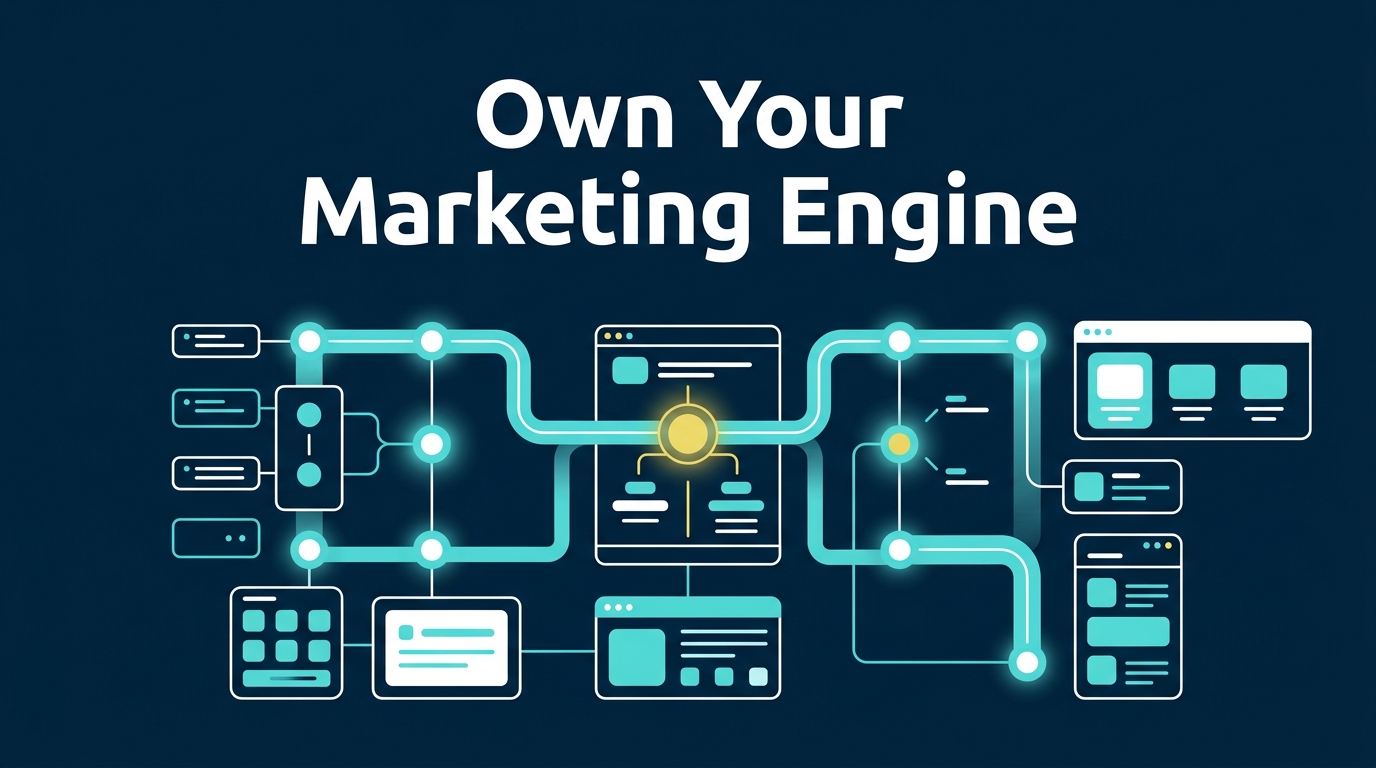
Section 1: The Retainer Trap (The "Rented" Marketing Problem)
To understand why the shift toward one-time system builds is accelerating, we must first dissect the traditional agency model flaws. The retainer model is built on an inherent conflict of interest. Your goal as a business is maximum output and revenue growth. The agency's goal is maximum margin and minimal resource expenditure per account. This leads to the "Black Box" effect.
Agencies have mastered the art of obfuscation. They frequently use complex, seemingly proprietary dashboards to hide the reality of their workflows. These dashboards are heavily weighted toward vanity metrics: impressions, reach, and top-of-funnel engagement. They are designed to show a graph moving up and to the right, regardless of whether those metrics translate into actual commercial value. The dashboard serves as a tool for retention rather than transparency. Behind the scenes, a campaign that took three hours to configure is stretched across a 30-day billing cycle to justify the ongoing fee. You get outputs, but you never get the logic or the "brain" behind the work.
Section 2: Misaligned Incentives (The Client Concentration Trap)
The internal mechanics of a traditional agency dictate a toxic cycle of resource dilution. When an agency pitches your business, they bring their senior partners and chief strategists. Once the contract is signed, the reality of agency economics takes over. To maintain profit margins, agencies cannot afford to keep senior talent on day-to-day execution. They are forced into the "Client Concentration Trap."
If an agency charges a £5,000 monthly retainer, they must maintain high margins to cover overhead. This leaves a small fraction for actual labor, meaning the bulk of the work is pushed down to entry-level employees. You are paying premium rates for junior execution wrapped in senior branding. This leads to the "blind leading the blind" scenario, where complex B2B accounts are handed to juniors juggling eight other clients. This structural failure is exactly why retainer-based agencies are a dying business model. The market has realized that paying for human hours to execute robotic tasks is a fundamental misallocation of capital.
Section 3: The Ownership Question (IP, Data, and Agent Logic)
The most profound advantage of the one-time build model is technical ownership. When you work with a traditional agency, you are renting their intellectual property. When you commission a bespoke AI marketing system, you are building your own. This includes owning the "Agent Logic" and the "Prompt Libraries."
An AI agent is a piece of software designed to perform specific tasks autonomously. When we build an AI Multi-Agent Engine for your business, the logic that dictates how it researches, drafts, and optimizes becomes your proprietary asset. Professional prompt engineering encodes what your best marketers know into a permanent digital format. If your agency owns that prompt library, you are renting your own competitive advantage back from them every month. With a custom build, if you terminate a contract, the "brain" of your marketing operation remains intact on your servers.
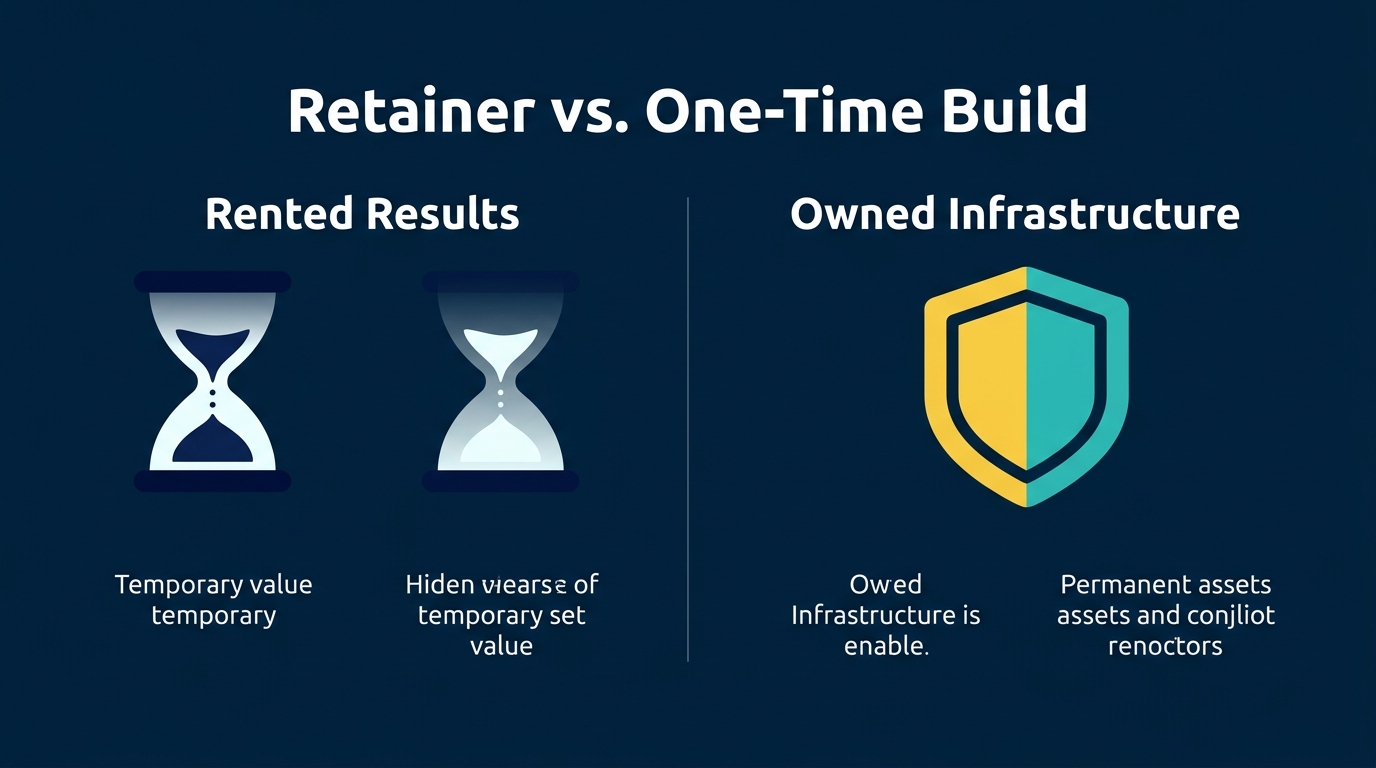
Section 4: The Economics of System Ownership (OpEx vs. CapEx)
The financial argument is staggering. A retainer is an Operational Expenditure (OpEx)—a sunk cost that hits your ledger every month. Consider a £5,000/month retainer. Over five years, that is £300,000 spent with zero residual equity. If you stop paying in month 61, the marketing stops.
A one-time system build is a Capital Expenditure (CapEx). You are acquiring an asset. Imagine an upfront investment of £20,000 for a custom build, plus a £500/month System Health check.
- • Year 1: £26,000 (Saving £34,000 vs. Retainer)
- • Years 2-5: £6,000 per year
- • Total 5-Year Cost: £50,000 (Saving £250,000 vs. Retainer)
Financial experts are recognizing this structural advantage, outlining how businesses can build a more resilient business model by shifting toward owned automation. You are building enterprise value rather than paying for agency overhead.
Section 5: The Forrester 2025 Reality Check
This transition is not theoretical. According to the Forrester 2025 Report on Agency Trends, there is a projected 42% reduction in traditional retainers. The driver is "Adaptive Marketing." Markets move too quickly for rigid, 12-month contracts. Brands are demanding infrastructure that can pivot instantly—scaling content from 10 to 100 pieces a month without renegotiating a contract. The mandate is clear: automate the execution, own the strategy, and eliminate the middleman.
Section 6: The AFM Solution (Detailed Engine Breakdowns)
At AI for Marketing, we structure your ecosystem as a series of interconnected engines. Each is a one-time build designed for total autonomy:
- • LinkedIn Engine: Automates executive thought leadership. It uses voice cloning and industry scraping to draft posts and manage outbound networking in your specific tone.
- • SEO Engine: Performs AI-driven cluster mapping and auto-drafts long-form, authoritative articles at scale, bypassing the need for expensive freelance writers.
- • Paid Media Engine: Integrates with ad platforms to generate hundreds of creative variations and reallocate budget based on real-time ROAS data.
- • YouTube Engine: Automates scriptwriting, hook engineering, and video SEO based on competitor search gaps.
- • Research Engine: Continuously scrapes competitor sites and maps audience psychographics to build a living model of buyer motivations.
- • Reporting Engine: Replaces the account manager with unified Looker Studio dashboards, providing a single source of truth for your CPA and revenue pipelines.
Section 7: The Transition Roadmap (From Retainer to Ownership)
Transitioning is a phased, risk-mitigated process:
- • Audit Current Dependencies: Identify what you currently rent. Separate high-value strategy from the low-value manual labor your agency uses to justify their fee.
- • Identify Engine Priorities: Build where leverage is highest. If you spend most on content, start with the SEO Engine.
- • The Build Phase: Our engineers construct your bespoke system, integrate APIs, and train models on your proprietary brand data.
- • Internal Team Training: We create the "Bionic Marketer." We train your lean internal team to pilot the engines, shifting them from manual executors to strategic directors.
- • Retainer Termination: Once capability parity is reached, you issue the cancellation notice with total confidence.

Conclusion: The Future is Owned, Not Rented
The transition away from rented marketing is inevitable. Clinging to generic templates and bloated agency retainers is a guaranteed path to operational stagnation. By investing in a one-time system build, you secure a permanent competitive advantage, 10x your output, and reclaim your profit margins.
Complexity simplified. Strategy amplified. Stop renting your marketing execution. Step into the future and build your custom AI infrastructure with AI for Marketing today.
Frequently Asked Questions (FAQs)
What is the main difference between a marketing agency retainer vs one-time build? The core difference is ownership. A retainer is an ongoing expense for "rented" time; if you stop paying, the work stops. A one-time build is a capital investment in custom AI infrastructure that your business owns forever, including all prompt logic and automated workflows.
Will an AI marketing system replace my internal marketing team? No. It creates "Bionic Marketers." The system automates the manual grind, allowing your lean internal team to produce the output of a ten-person agency while focusing on high-level strategy and creative direction.
How much can a business save by switching to a system build? Over a five-year period, a business switching from a £5k/month retainer to a custom build can save upwards of £250,000, as ongoing costs drop to minimal API fees and maintenance rather than full agency overhead.
Want to build marketing systems like this?
Book a Discovery CallRelated Articles

AI Email Marketing: Beyond Drip Sequences
AI email marketing moves beyond basic rule-based automations to intelligent systems that personalise content, optimise send times, generate copy, and adapt sequences based on recipient behaviour in real time.
Read more →
AI Marketing Strategy Framework (2026)
An AI marketing strategy is a structured plan for integrating artificial intelligence into your marketing operations. This framework covers the maturity audit, prioritisation, the build sequence, KPIs, and common strategic mistakes.
Read more →
AI Content Creation: Scale Without Losing Quality
AI content creation is the use of artificial intelligence to research, draft, edit, and optimise marketing content. Learn how to scale production with quality gates, brand DNA frameworks, and workflows that keep the human where it matters.
Read more →