The Death of the Marketing Agency Retainer: Why One-Time System Builds Are the Future
27 March 2026 • By Jakub Cambor, Founder of AI for Marketing | Top 1% Upwork Expert Vetted Talent
Last updated: 27 March 2026
The traditional marketing agency model is structurally mispriced for what modern execution costs and structurally misaligned with how modern businesses need to operate. For decades, scaling your marketing efforts meant linearly scaling your costs. If you wanted more content, deeper data analysis, or faster campaign deployment, you paid for more human hours. This arrangement created a highly profitable ecosystem for agencies, but it left clients trapped in a cycle of perpetual renting.
Today, that model is collapsing under the weight of technological advancement. The marketing agency retainer vs one-time build debate is no longer a fringe discussion among tech enthusiasts; it is a boardroom imperative. According to a Forrester 2025 report, 42% of B2B companies have already reduced their agency retainers in favour of bringing in-house AI tools into their operations. This is not a temporary cost-cutting measure born of economic anxiety. It is a fundamental shift in how marketing is executed.
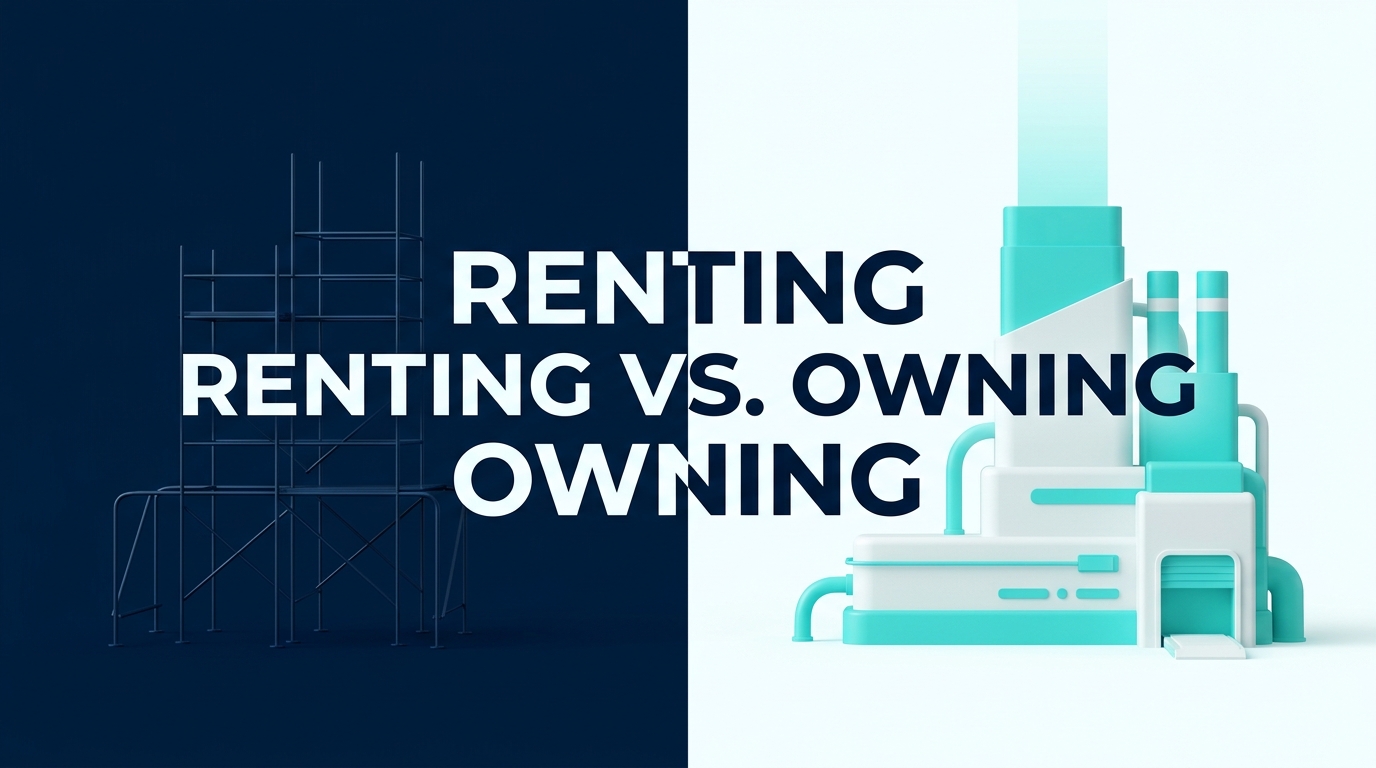
Artificial intelligence did not kill strategy. It killed the markup on repeatable work. The next era of marketing is not about producing more generic content; it is about engineering systems that produce, distribute, and optimize content with consistency, speed, and strict brand governance. Agencies that sell time will continue to shrink. Teams that build infrastructure will continue to compound their growth. The future belongs to businesses that own their marketing infrastructure, rather than renting an agency's time.
The 'Ownership vs. Renting' Metaphor: Why the Traditional Model is Collapsing
To understand why the traditional model is failing, we must examine the core flaw in how marketing services have historically been sold: you are paying for hours, not outcomes. A traditional retainer is a subscription to people. A one-time system build is an investment in a machine.
When you sign a standard agency agreement, you are effectively renting a team of workers month after month. You do not own the processes they use. You do not own the proprietary frameworks they apply to your brand. If you terminate the contract, the production stops immediately. You are left with a folder of past assets, but the mechanism of creation disappears. Retainers made sense when execution was scarce and expensive. If you needed copywriting, design, reporting, keyword research, competitor analysis, and ad iterations, you needed a small army. Agencies packaged that army behind a monthly fee, and the market accepted it because there was no alternative.
Now there is an alternative. A system build operates on a completely different economic principle. It is the equivalent of owning the factory that produces the work. Instead of paying a monthly fee for a team of junior copywriters to draft social media posts or conduct basic keyword research, you invest capital upfront to engineer an automated ecosystem that belongs entirely to your business.
The friction inherent in traditional agency relationships is becoming impossible to ignore. Turnaround times are measured in days or weeks because human bottlenecks restrict the flow of work. Waiting three days for minor copy changes is not a process issue; it is the hidden tax of an agency selling labour across too many accounts. Incentives are inherently misaligned. An agency billing by the hour has no financial motivation to complete a task in ten minutes. The easiest way for an agency to protect its margin is to create dependency: keep the process opaque, keep the know-how internal, and keep the client needing the retainer.
This structural inefficiency has led many industry leaders to publicly declare that retainer-based agencies are a dying business model. Clients are waking up to the reality that they are subsidizing bloated agency overheads. They are funding the agency's office space, their middle management layers, and their utilization targets. This realization is accelerating the death of the agency retainer as founders demand transparency, efficiency, and above all, asset ownership. They no longer want a vendor. They want infrastructure.
The AI Cost Collapse: From $30k/Month to a $400 Tech Stack
The catalyst for this shift is what we call the AI Cost Collapse. This is the reality many agencies avoid discussing because it exposes a critical vulnerability: the largest portion of many retainers was never strategic genius. It was manual throughput.
Historically, running a comprehensive marketing department required a substantial monthly investment. A mid-market company might pay an agency $15,000 to $30,000 per month. This retainer would cover a dedicated account manager, a strategist, a copywriter, an SEO specialist, and a data analyst. The agency would execute tasks like drafting weekly blog posts, enriching lead data, managing email sequences, and compiling monthly performance reports.
Today, the vast majority of that manual execution can be handled by a tightly integrated tech stack costing roughly $400 per month in API and software fees. By utilizing advanced Large Language Models via API integrations, businesses can process massive datasets, generate highly nuanced copy, and execute complex workflows without human intervention. A properly engineered stack can handle draft generation, variation testing, data enrichment, list hygiene, SEO clustering, and performance summaries. The cost of intelligence has plummeted. You are no longer paying a premium for basic cognitive tasks like summarizing competitor content or formatting data.
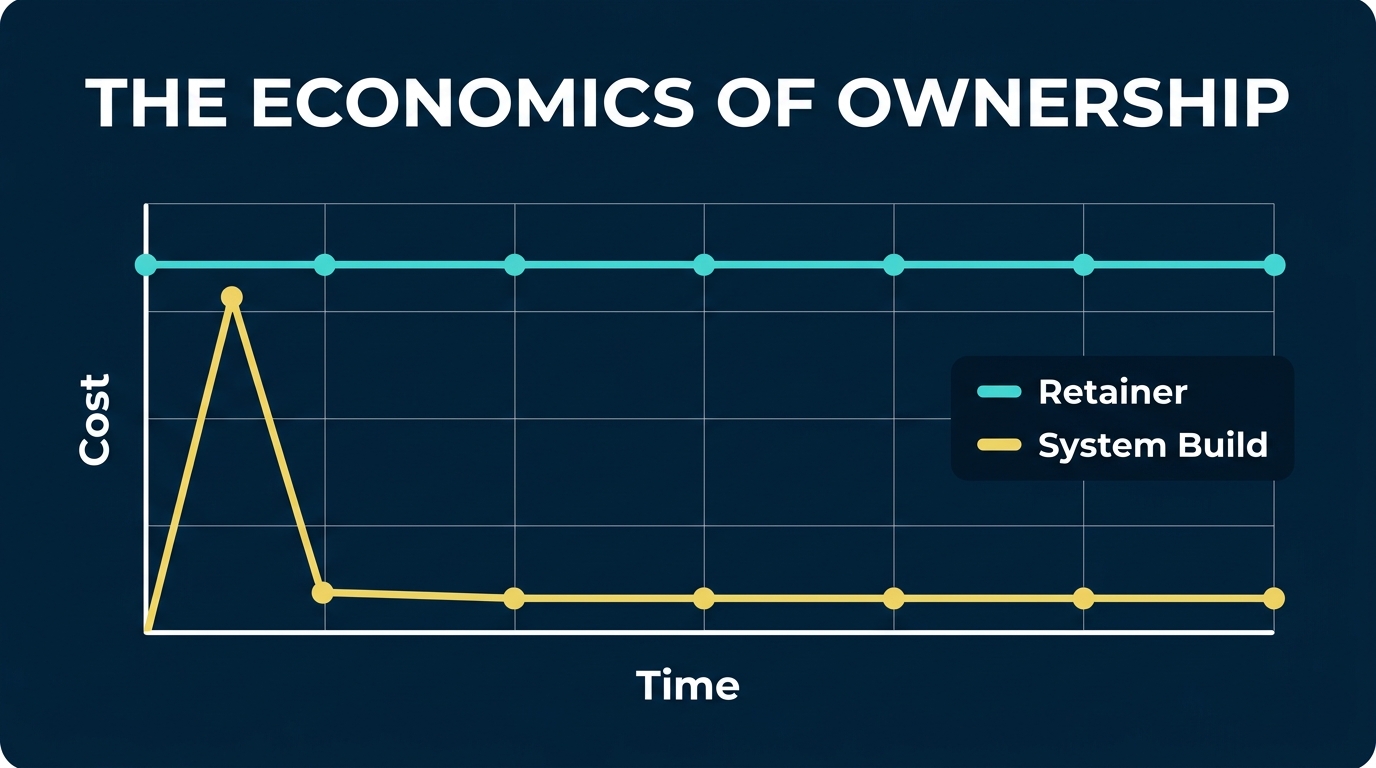
The savings are not theoretical. They show up in cycle time and output volume immediately. But the deeper impact is governance. When a system is engineered properly, it produces consistent work to a defined standard, and it does it on demand. It is vital to understand that this cost collapse is not about firing humans. It is an argument to replace marketing agency manual labor with AI capabilities for repeatable tasks, thereby reallocating human intellect. When you eliminate the massive monthly drain of manual execution, you free up capital and mental bandwidth. Human creativity can finally be directed toward high-level strategy, brand positioning, and messaging hierarchy. The AI handles the heavy lifting of production, while your core team handles the nuance of direction.
Defining the Future: What Exactly is a 'System Build'?
To navigate this transition, we must establish clear definitions. The terminology surrounding artificial intelligence is often clouded by generic hype, leaving business leaders confused about what they are actually buying.
- • System Build: The engineering of a custom, automated marketing infrastructure (targeting, enrichment, AI workflows) that is permanently owned by the client. It is a bespoke architecture designed specifically for your data, your brand voice, and your strategic objectives.
- • AI Marketing Infrastructure: The integrated ecosystem of AI agents, APIs, and data pipelines that automate marketing execution without human-intensive labor. This infrastructure connects your CRM, your content management system, and your analytics platforms.
This is the quiet distinction between dabbling with AI and operating an AI-driven business. Forward-thinking operators are already analyzing the shift toward productized marketing services that guarantee specific deliverables and infrastructure handovers rather than vague promises of billable hours. Buyers want defined outcomes and reusable assets, not open-ended hours.
A real AI system build for business typically includes several foundational layers. First, strategy is translated into technical specifications. Second, data foundations are established. Third, workflows and agents are deployed. Consider the mechanics of a bespoke Multi-Agent Engine. This operates as a Marketing Department in a Box. Instead of hiring a team of individuals, distinct AI agents are engineered. One agent is trained strictly on Research and data analysis. Another is trained on your specific brand tone of voice. A third agent is designed to orchestrate the workflow between the other two.
Finally, governance and guardrails are implemented. Approval steps, compliance checks, and escalation rules are hardcoded into the system because ungoverned automation is how brands end up with highly efficient mistakes. Once this engine is built and deployed into your ecosystem, it runs perpetually. You own the prompts, the logic, and the institutional knowledge.
Marketing Agency Retainer vs One-Time Build: A Head-to-Head Comparison
The marketing agency retainer vs one-time build debate is not a philosophical discussion. It is a practical comparison across cost, speed, control, and risk. When evaluating the two approaches, the contrast in business value becomes stark.
Cost Structure and Capital Allocation
The traditional retainer is a perpetual monthly drain on your profit margins. You keep paying to keep the machine moving because the machine is made of people. Over a twelve-month period, a $10,000 monthly retainer extracts $120,000 from your business, leaving you with no tangible assets other than the completed campaigns. A one-time build requires a higher-value upfront investment. You are paying for the architectural design, the API integration, and the prompt engineering. However, once the build is complete, your ongoing costs drop to near zero, consisting only of minimal API usage fees and light oversight.
Speed and Scalability
Traditional agencies are bound by human limitations. Every task competes with other client tasks. Even great agencies operate with queues and internal reviews. If you need a sudden pivot in strategy, you wait days for a copywriter to draft the new messaging. An AI system build offers instant, limitless scalability. Once the workflows are implemented, drafts, variations, and repurposes can be generated immediately. Speed is not just convenience; speed is iteration. And iteration is how marketing becomes a performance system instead of a monthly deliverable.
Asset Ownership and Intellectual Property
This is the most critical distinction. When you work with an agency, they own the process. They keep the operating knowledge, the frameworks, and the internal prompts. If you decide to bring your marketing in-house, you start from scratch. With a system build, you own the IP. You own the custom scripts, the automated workflows, and your institutional marketing memory. For example, rather than paying an agency a recurring fee to write blog posts, you can commission a custom SEO Engine. This infrastructure automatically researches keyword gaps and generates optimized content at scale. The engine belongs to you forever.
This ownership extends across all channels. Whether it is a LinkedIn Engine for executive presence, a Paid Media Engine for ROAS optimization, or a YouTube Engine for video SEO, the logic remains in your hands. That ownership is resilience. It reduces vendor risk and allows you to swap components without rebuilding your entire operation.
System Builders vs. Labor Sellers: Making the Transition
The market is currently splitting into two distinct categories of service providers: System Builders and Labor Sellers. This is the dividing line for the next five years. Labor Sellers are the traditional agencies fighting to protect their billable hours. They view AI as an internal tool to increase their own margins while continuing to charge clients the same premium rates. System Builders engineer automated marketing systems, transfer ownership, and leave clients with an asset that compounds.
Many founders have already tried to build this internally. They bought a few tools, tested a few prompts, and wired up basic automation. Then reality hit: the outputs were inconsistent, the brand voice drifted, and workflows broke when a single API changed. This failure occurs because AI marketing infrastructure is an integration problem. It sits across data, tooling, process design, and brand governance. This is where you need the adults in the room. Business leaders do not want to become prompt engineers; they need a builder who understands both marketing outcomes and technical constraints.
The post-build phase is remarkably straightforward. Once your custom infrastructure is deployed, you do not need a massive retainer to keep basic output flowing. What you need is monitoring and optimization as platforms change. Smart businesses handle this by transitioning to low-cost System Health checks. You maintain what you own: you do not keep re-buying what you already built. This is supported by transparent Reporting that proves the ROI of the system itself, not just the individual campaigns.
Conclusion: Stop Renting, Start Owning Your Growth
The uncomfortable truth is that the retainer model is not failing because agencies became worse; it is failing because the economics underneath it changed. The gap between AI-driven businesses and those still funding manual execution is widening quietly. It widens through compounding speed, compounding learnings, and compounding output quality driven by precision-engineered systems.
If you keep paying for a monthly workflow that could be engineered into infrastructure, you are choosing recurring cost over compounding capability. Staying tied to an outdated model of renting labor is an active choice to remain slow, expensive, and inefficient. So revisit the real question behind the marketing agency retainer vs one-time build debate: are you buying marketing, or are you building an operating system for marketing?
A one-time system build gives you ownership of the workflows, the playbooks, and the data structure. Stop renting your marketing. Start owning your growth. Book a strategy session today to map the system build your business actually needs. We will identify the highest-leverage workflows to automate, the data required to keep quality high, and the governance required to keep your brand human, consistent, and credible.

Frequently Asked Questions (FAQ)
What is the main difference in a marketing agency retainer vs one-time build?
The primary difference lies in ownership and cost structure. A retainer requires you to pay a perpetual monthly fee to rent a team's manual labor, meaning you never own the underlying processes. A one-time build involves an upfront investment to engineer a custom, automated infrastructure that your business owns entirely, drastically reducing ongoing operational costs.
Will an AI marketing system build completely replace my human marketing team?
No, it complements and elevates them. A strong system build removes repetitive execution work like data enrichment, initial drafting, and reporting. This frees your human team from the daily grind, allowing them to focus entirely on high-level strategy, creative direction, and commercial decision-making while the system handles throughput.
How much does an AI marketing infrastructure cost compared to a traditional agency?
Traditional retainers often sit in the $10,000 to $30,000 per month range. An AI marketing infrastructure typically involves a higher upfront build investment, followed by relatively low ongoing tooling and API costs. Once built, the software fees to run your automated infrastructure typically cost only a few hundred dollars a month depending on volume.
Do I need technical skills to manage a system build once it is handed over?
You do not need to be technical to operate it day-to-day, as long as the system is built with clear documentation, dashboards, and guardrails. A professional system build is designed specifically to remove technical complexity for the end user. Most teams only need light oversight and periodic health checks to keep integrations up to date.
Want to build marketing systems like this?
Book a Discovery CallRelated Articles

AI Email Marketing: Beyond Drip Sequences
AI email marketing moves beyond basic rule-based automations to intelligent systems that personalise content, optimise send times, generate copy, and adapt sequences based on recipient behaviour in real time.
Read more →
AI Marketing Strategy Framework (2026)
An AI marketing strategy is a structured plan for integrating artificial intelligence into your marketing operations. This framework covers the maturity audit, prioritisation, the build sequence, KPIs, and common strategic mistakes.
Read more →
AI Content Creation: Scale Without Losing Quality
AI content creation is the use of artificial intelligence to research, draft, edit, and optimise marketing content. Learn how to scale production with quality gates, brand DNA frameworks, and workflows that keep the human where it matters.
Read more →