Building Your First Multi-Agent System: A Practical Guide
Building multi-agent systems for marketing is the exact point where artificial intelligence stops being a novelty and starts behaving like a dependable operational layer. The era of relying on a single, generic chat prompt to produce acceptable marketing materials is closing fast. This shift is not occurring because language models are weak, but because modern marketing is not a single task. It is a complex chain of decisions: research, positioning, messaging, search engine optimization, compliance, review, iteration, publishing, and measurement.

That chain breaks when you force one model, in one single chat interface, to act as the strategist, researcher, writer, SEO lead, editor, and brand guardian all at once.
The "Bionic Marketer" approach offers a completely different paradigm. In this model, humans remain strictly responsible for high-level strategy, judgment, and taste. Meanwhile, multi-agent systems handle the repeatable, high-volume execution work with precision, automated checks, and full traceability. This guide details what a marketing multi-agent system is, how the "Marketing Department in a Box" model functions, how frameworks like CrewAI, AutoGen, and LangGraph differ, and a step-by-step implementation path designed specifically for SMEs and agencies.
Moving Beyond Generic AI: Why Single Prompts Are Failing Marketers
Single-prompt marketing fails in highly predictable ways. If you have attempted to use a standalone chat window as your entire marketing team, you have likely experienced severe implementation fatigue. Founders and marketing directors are suffering from the realization that while the underlying technology is powerful, integrating it into a cohesive business strategy using basic prompts is incredibly frustrating.
When you rely on a single prompt to execute a multifaceted marketing task, the output almost always falls short. You will typically encounter three major problems:
- • Brand voice drift: The model starts confident, then slowly becomes generic, overly polished, or oddly casual, completely losing your corporate identity.
- • Weak factual discipline: Statistics, features, and claims get blended, approximated, or entirely invented to satisfy the prompt's request for length.
- • SEO shallowness: The output includes basic headings and keywords, but entirely misses search intent matching, internal linking logic, SERP patterns, and deep entity coverage.
Teams keep adding more instructions to the same prompt, hoping the model will eventually behave. It rarely does, because the underlying architecture is fundamentally flawed. Complex workflows require specialized roles and explicit handoffs. Precision-engineered AI marketing solves this problem by breaking down complex objectives into specialized, interconnected workflows. You are not simply prompting harder. You are building a highly structured system where focused agents do narrow tasks, audited by a critical review layer that enforces brand standards and risk constraints.
What is a Multi-Agent System (MAS) in Marketing?
A multi-agent system is a coordinated digital ecosystem where multiple specialized AI entities, known as agents, communicate, collaborate, and iterate on tasks together to achieve a common goal. Think of it as an internal marketing pod, but fully digital. One agent researches, another drafts, another optimizes, another reviews, and the system logs exactly what happened so human managers can approve the final asset quickly and confidently.
Each agent within this ecosystem has a defined role, a specific goal, and strict constraints. They can pass work between each other, challenge each other's outputs, and iterate until the deliverables meet a defined standard of excellence. For technical teams looking to understand the foundational architecture behind these collaborative networks, reviewing a beginner's guide to building your first multi-agent system provides essential context on how memory, tools, and language models interact to form these digital workers.
The 'Marketing Department in a Box' Concept
The most powerful application of this technology for SMEs and agencies is the "Marketing Department in a Box." This practical model orchestrates a team of specialized agents that perfectly mimic the structure of a real-world marketing team. Instead of hiring four more people to keep up with content demand, you deploy four specialist agents that behave like a coordinated unit.
When you initiate a campaign, the system activates a precise sequence of roles:
- • The Researcher Agent: This entity is responsible for data acquisition. It connects to search engine APIs to analyze current ranking pages, identifies keyword gaps, and studies competitor positioning. It does not write copy; it only gathers evidence.
- • The Writer Agent: Armed with the data from the Researcher, the Writer focuses entirely on narrative and persuasion. It is strictly constrained by your specific brand guidelines, ensuring the tone, vocabulary, and pacing align perfectly with your corporate identity.
- • The SEO Specialist Agent: Once the draft is complete, the SEO Specialist reviews the document. It optimizes header tags, adjusts keyword density, and ensures internal linking structures are logical.
- • The Critic Agent: This is the quality assurance layer. It checks brand safety, consistency, factual integrity, and compliance boundaries.
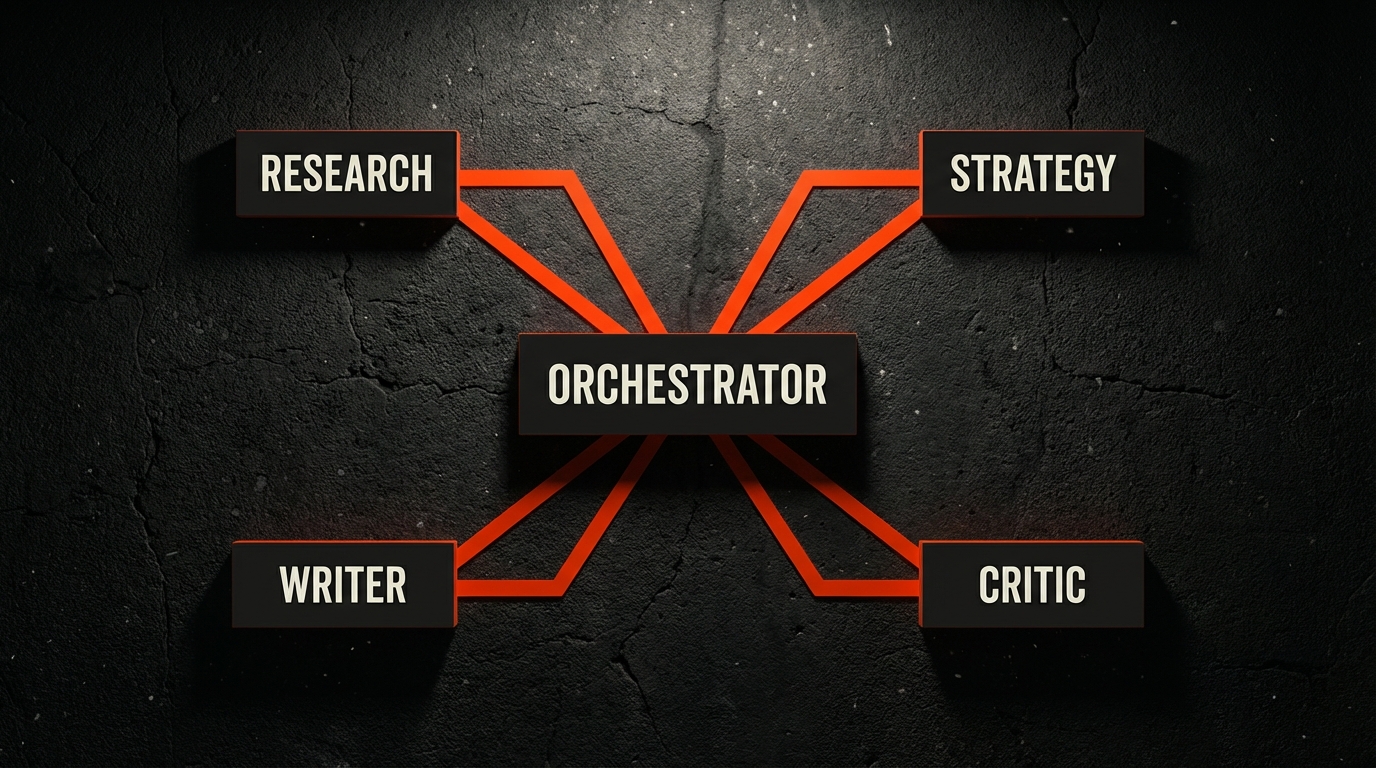
Orchestrating these roles transforms an erratic, manual process into a predictable, high-output machine. This level of orchestration is exactly how a custom-built Content Engine operates to scale your organic growth without sacrificing your standard of quality. You are no longer generating content; you are commissioning deliverables from a system with quality assurance built directly into the code.
Comparing Top Agentic AI Frameworks: CrewAI vs. AutoGen vs. LangGraph
Building these systems requires robust underlying infrastructure. The market currently offers several powerful frameworks, each with distinct advantages depending on your technical capabilities and marketing objectives. Understanding the differences between CrewAI vs AutoGen, alongside LangGraph, is critical for successful deployment.
CrewAI: Role-Based, Hierarchical Execution
CrewAI is rapidly becoming the framework of choice for marketing applications due to its intuitive, role-based structure. It allows developers to assemble agents into teams, or 'crews', enabling a more cohesive and goal-oriented development process. Each agent within a CrewAI system can be assigned specific roles, goals, and even backstories.
Why it works well for marketing:
- • Clear separation of responsibilities: The Researcher, Writer, SEO Specialist, and Critic roles map cleanly into the code.
- • Predictable pipelines: It is highly effective for repeatable deliverables like blog posts, landing pages, and email sequences.
- • Easier governance: When an output is wrong, you can easily identify which agent step caused the issue and adjust that specific prompt.
AutoGen: Conversational Collaboration and Code Execution
Developed by Microsoft, AutoGen takes a different approach. It is built around conversational programming, where agents interact through dialogue to solve complex problems. AutoGen is particularly powerful when data analysis or code execution is required.
Why it works well for marketing:
- • Data-heavy workflows: It excels at technical SEO checks, keyword clustering, and performance analysis.
- • Iterative ideation: Agent-to-agent debate can surface better angles and tighter positioning through simulated conversation.
- • Tool-driven workflows: It is ideal when you want agents to pull data from a database, run a Python script for analysis, and then write a report based on the evidence.
LangGraph: Stateful, Cyclic Workflows
LangGraph focuses on creating stateful workflows using nodes and edges. It is designed for applications that require deep memory and complex, multi-step iterations.
Why it works well for marketing:
- • Cycles and iteration: The loop of drafting, critiquing, revising, and approving is a natural fit for graph-based logic.
- • Stateful campaigns: The system can remember what has already been produced, what is scheduled, and what the performance data indicates.
- • Multi-channel orchestration: One central campaign state can drive blog, email, LinkedIn, and ad assets with perfectly consistent messaging.
Choosing the right framework dictates the scalability of your marketing operations. Technical teams evaluating these options often consult a developer's guide to agentic AI frameworks to align their specific use cases with the correct underlying code base.
Step-by-Step: How to Build Multi-Agent AI for Your Agency or SME
Transitioning from theory to practice requires a highly methodical approach. A working marketing multi-agent system is less about clever prompts and more about engineering discipline: inputs, constraints, handoffs, quality assurance, and measurement.
For organizations mapping out their digital transformation, understanding how to build multi-agent AI for business is the first step toward operational efficiency. Start with the workflow, then build the system around it, not the other way around.
However, many marketing directors quickly realize that developing, testing, and maintaining these frameworks internally drains resources. In these instances, partnering with specialists to implement bespoke Custom Solutions ensures you acquire a fully functional, revenue-generating system without the administrative burden of managing API keys and developer teams.
Step 1: Defining the Workflow & Agent Personas
The golden rule of automation is that you cannot automate a broken process. Before configuring any software, you must map out your exact human workflow on a granular level. Avoid the temptation to automate your entire marketing department at once. Start with one workflow that already makes money, such as SEO blog production for high-intent topics or weekly LinkedIn thought leadership.
Document your current human workflow in plain language, including the inputs, the steps, the output standard, and the failure modes. Then, translate that into agent personas. A generic prompt tells an agent to "write a blog post." A precision-engineered persona tells a Writer Agent: "You are a senior B2B copywriter with 15 years of experience. Your goal is to draft a 1500-word article based strictly on the provided research brief. You must use an authoritative yet accessible tone and avoid passive voice."
Step 2: The Crucial Role of the 'Critic' Agent
If you implement only one advanced component in your system, make it the Critic Agent. For SMEs and agencies, the Critic is the difference between scalable output and severe brand risk. It acts as the "adults in the room."
The Critic Agent does not create content. Its sole purpose is to ruthlessly evaluate the work produced by the other agents against a strict set of criteria. A well-designed Critic agent should check:
- • Brand safety: Does this sound like your company, or like the generic internet?
- • Factual verification: Are the statistics supported by the initial research brief? Are the product claims accurate?
- • Strategic alignment: Does the content map to your funnel stage? Is the call-to-action coherent with the offer?
When the Writer Agent finishes a draft, it passes the text to the Critic. If the Critic finds an error or a deviation from the brand voice, it rejects the draft and sends it back to the Writer with specific instructions for revision. This guarantees that no piece of content reaches human review without undergoing rigorous, automated scrutiny.
Step 3: Engineer the Handoffs
A marketing multi-agent system fails when agents pass vague work between each other. Your handoffs must be highly structured. Instead of passing a message that says "Optimize this draft for SEO," the handoff should function like an internal IT ticket. The handoff must include context, the deliverable format, acceptance criteria, and boundaries (what it cannot change).
Step 4: Add Tool Access Carefully
An agent is only as powerful as the data it can access. However, tool access increases complexity and risk. Start with read-only tools and add capability progressively. Good early tools include web search for competitor pages, access to your brand voice guide document, and a curated product fact sheet. A practical principle to follow: no agent should ever be able to publish directly to your live website or change paid media budgets without a final human approval step.
Step 5: Define QA Gates and Escalation Rules
Treat your system like a strict production line. Build explicit gates where work must be validated before moving forward. Escalation rules matter deeply for brand safety. If the Critic flags high-severity issues, such as legal claims or financial promises, the system must route the draft to a human reviewer automatically. This is how you scale output without merely hoping the language model behaves.
Step 6: Measure Outcomes and Retrain the Workflow
Most teams measure time saved and stop there. To truly build a dependable operational layer, you must measure efficiency, quality, and performance. Track the Critic pass rate, the factual error rate, and the brand voice compliance score. When outputs miss performance targets, identify which part of the chain failed and update the specific agent's instructions. That is how multi-agent AI implementation becomes an asset that compounds in value over time.
The Business Impact: Why SMEs Need Precision-Engineered AI
Multi-agent systems are not a gimmick. They are an operating model shift for marketing teams that want scale without hiring at the same rate. The traditional agency model forces a choice between scale and quality. Multi-agent systems eliminate this paradox entirely.
The business case shows up in three distinct areas:
- • Modernization Speed: Multi-agent systems can accelerate modernization timelines by up to 50% when compared with manual workflows. Campaigns that used to take weeks can be executed in days.
- • Operational Cost: These systems can reduce operational costs by more than 40%. By converting repeatable, manual work into a precision-engineered system, you solve the output problem without turning it into a headcount problem.
- • Quality and Accuracy: Accuracy rates for specialized agent tasks often exceed 90% compared to generic single-prompt outputs. Because each agent is policed by a Critic Agent, the resulting marketing materials are virtually indistinguishable from expert human creation.
For agencies, this technology becomes ultimate margin protection. For SMEs, it becomes a guarantee of marketing consistency without over-hiring. In both cases, the key is not automation for its own sake. It is precision: the right work, done the right way, with the right automated checks in place.
Ready to Build Your Custom AI Marketing Ecosystem?
Marketing complexity does not have to result in operational paralysis. The gap between businesses leveraging precision-engineered AI and those relying on outdated manual processes is widening every single day. Moving past the severe limitations of generic ChatGPT prompts and embracing a multi-agent architecture is the definitive step toward scalable, high-quality growth.

You do not have to navigate this highly technical landscape alone. Stop struggling with fragmented tools, unpredictable API costs, and mediocre content generation. Let expert marketers build a system tailored specifically to your business strategy and brand voice. Teams that are ready to move from experimentation to a dependable marketing operating layer typically start when they Book a Strategy Call with our experts so we can map your exact workflow, identify the highest ROI agent chain, and design the governance that protects your brand while scaling your output.
Frequently Asked Questions (FAQs) About Multi-Agent Marketing Systems
What is the difference between a single AI prompt and a multi-agent system? A single AI prompt relies on one generalist model to process a request in a single step, which often leads to generic or inaccurate results. A multi-agent system splits the workflow into specialized roles with structured handoffs and quality assurance. The result is a more consistent brand voice and better factual discipline.
Which is better for marketing: CrewAI or AutoGen? CrewAI is generally better suited for marketing teams because its role-based, hierarchical structure perfectly mirrors human marketing departments. AutoGen is highly capable but focuses heavily on conversational programming and code execution, making it better suited for technical, data-heavy analysis.
How do multi-agent systems protect my brand's unique voice? They protect your brand voice through the use of a dedicated Critic Agent. This agent is programmed strictly with your brand guidelines and acts as a gatekeeper, reviewing all content and forcing revisions if the tone or messaging deviates from your established corporate identity.
Do I need to know how to code to use a multi-agent marketing system? If you are building the infrastructure from scratch, coding knowledge is required. However, businesses can bypass this technical barrier by partnering with specialized AI marketing agencies that provide fully built, customized multi-agent systems as a managed service, requiring zero coding from the end user.
Want to build marketing systems like this?
Book a Discovery CallMore Insights
The Ultimate Guide to Retargeting AI Ad Creative That Converts
Discover how retargeting AI ad creative scales personalization, combats fatigue, and drives incremental lift with predictive audience segmentation and server-side tracking.
Read more →
How to Measure the ROI of AI Marketing Automation: Metrics, Frameworks, and Dashboards
Learn how to measure the ROI AI marketing automation provides. Discover the frameworks, metrics, and dashboards needed to scale revenue and save time.
Read more →
How to Reduce Your Cost Per Acquisition by 40% with AI-Powered Ad Creative
Discover how to reduce CPA with AI ad creative strategies. Shift to creative-led growth, accelerate platform learning, and cut acquisition costs by up to 40%.
Read more →