How to Automate Review Generation and Reputation Management with AI: The Ultimate Guide
27 March 2026 • By Jakub Cambor, Founder of AI for Marketing | Top 1% Upwork Expert Vetted Talent
Last updated: 27 March 2026
Scaling a business introduces a predictable set of operational bottlenecks. Founders and marketing directors quickly discover that while acquiring new customers can be systematised, capturing their positive feedback often remains a fragmented, manual grind. Marketing complexity often overshadows the fundamental truth of business growth: customer trust is your most valuable asset. When your team is stretched thin, asking for reviews becomes an afterthought. This leaves your brand vulnerable to a vocal minority of dissatisfied users while your silent, happy majority goes unnoticed.
This is where the paradigm shifts from manual effort to precision-engineered mastery. When you automate review generation AI steps in as a powerful extension of your marketing department. At AI for Marketing, we champion the concept of the "Bionic Marketer": utilising artificial intelligence to augment your team's capabilities, not replace the vital human touch. AI handles the heavy lifting of timing, drafting, and tracking requests, allowing your human talent to focus on high-level strategy and relationship building.
This guide demystifies the process of building a Review Automation Engine. We will break down exactly how to construct an automated system designed to capture, monitor, and respond to customer feedback at scale, ensuring your brand's digital reputation accurately reflects the quality of your services.

The Compounding ROI of Trust: Why Reviews Dictate Revenue
Before engineering the technical infrastructure, it is critical to understand the underlying business case. Online reviews are not merely digital vanity metrics; they are the financial engine of customer acquisition. Reviews operate on a compounding loop: more authentic reviews generate higher levels of consumer trust. This elevated trust directly reduces friction and increases conversion rates. More conversions create more customers, who in turn leave more reviews. When you automate review generation AI workflows, you are building an asset that continuously lowers your cost of acquisition.
The financial impact of this loop is staggering when quantified. Research indicates that jumping from a 3-star to a 4-star average rating can generate an 89% conversion lift across digital touchpoints. Furthermore, 35% of consumers apply strict filters when searching online, completely excluding businesses with anything less than a 4-star average. If your reputation management is left to chance, you are actively filtering yourself out of the consideration set for over a third of your total addressable market.
This reliance on peer validation is deeply ingrained in modern purchasing behaviour. A recent BrightLocal survey shows that a staggering 87% of consumers read online reviews before choosing a local business. Your digital reputation is often the very first interaction a prospect has with your brand. A robust, AI-driven review strategy ensures that this first impression is engineered for maximum trust and profitability.
The Manual Grind vs. The Bionic Marketer
Most businesses do not have a "review problem"; they have a consistency problem. The traditional approach to reputation management is fundamentally flawed because it relies on human memory and discretionary effort. In a manual setup, sales representatives or account managers only ask for reviews sporadically. They tend to request feedback exclusively from "safe" clients they know intimately, creating a skewed representation of the customer base. Worse, when negative reviews inevitably occur, they are often ignored or handled defensively days after the fact.
The AI solution transforms this chaotic process into a reliable, always-on ecosystem. Businesses that implement AI reputation management protocols shift from a reactive posture to a strategy. The technology listens continuously, requests feedback systematically, and drafts responses instantly. When analysing traditional vs AI reputation management, the stark difference lies in operational efficiency. AI does not forget to send a follow-up email, it does not let a 1-star review sit unaddressed over the weekend, and it does not suffer from fatigue. It applies your exact brand standards to every single customer interaction with perfect consistency.
How to Build Your 'Review Automation Engine' (Step-by-Step)
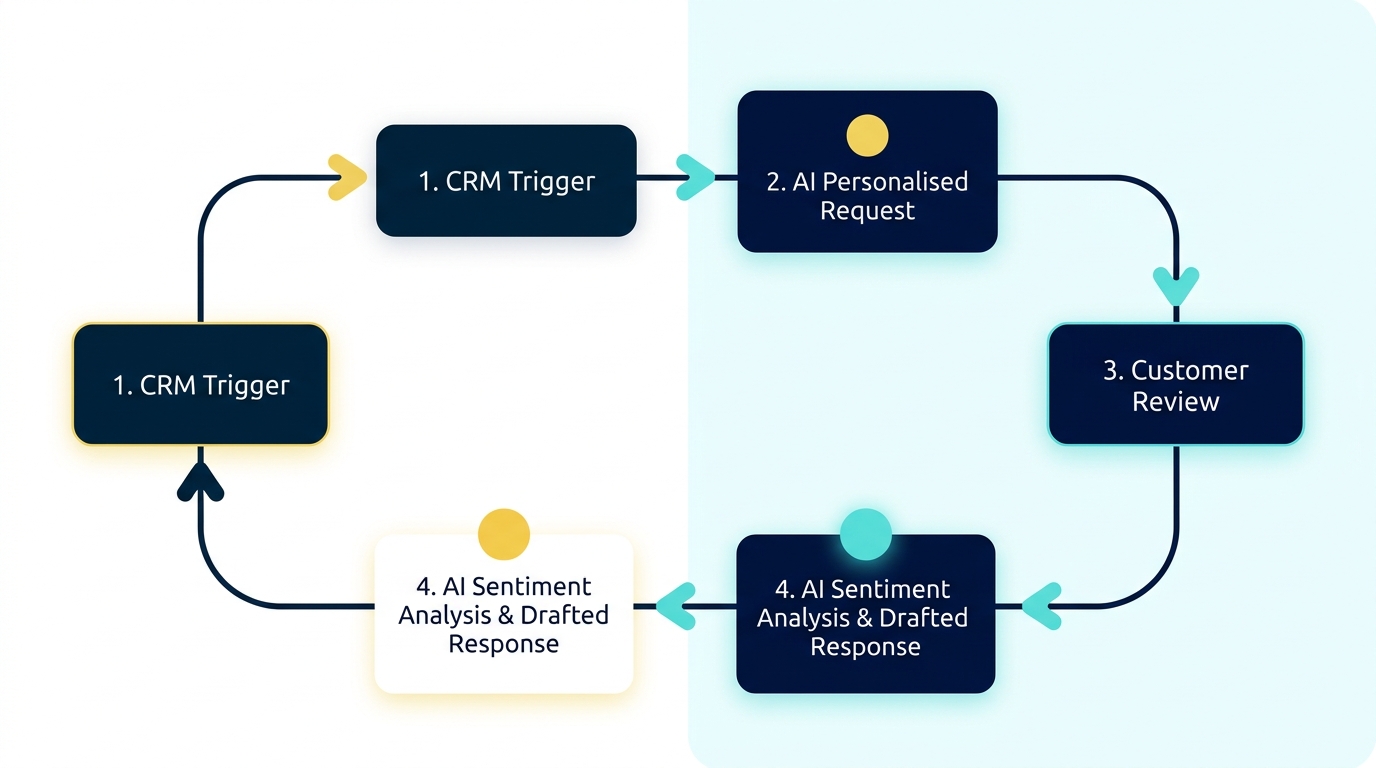
Building a Review Automation Engine requires moving beyond generic, off-the-shelf software. It demands a tailored infrastructure that aligns seamlessly with your existing tech stack. Here is the blueprint:
- • Define Your CRM Trigger Events: Identify the exact moments of highest satisfaction. These triggers could include the formal closure of a project, a positive feedback signal, or a specific milestone reached in a service contract.
- • Construct Automated Request Sequences: Build multi-channel communication pathways (Email/SMS) that follow up persistently but politely. The AI dynamically adjusts the messaging based on the data passed from the CRM.
- • Implement AI Monitoring Across Platforms: Use API integrations to scrape platforms like Google Business Profile and Trustpilot for new mentions. The AI evaluates sentiment in real-time using natural language processing.
- • Aggregate Data into Reporting Dashboards: Feed all incoming review data and sentiment scores into a unified dashboard (e.g., Looker Studio) to prove the ROI of your reputation efforts.
If configuring these complex API integrations and webhook triggers sounds overwhelming, our team specialises in engineering bespoke custom AI solutions tailored specifically to your operational infrastructure.
AI-Powered Response Generation: Handling the Good and the Bad
Response management is where reputation is either reinforced or quietly damaged. A response is not only for the reviewer; it is for every future buyer reading the thread. Industry data shows that 88% of consumers are more likely to use a business that replies to all its reviews.
An advanced AI review response generator is not just a basic text spinner. Large Language Models can be explicitly trained on your company's brand voice and specific product terminology. This allows the AI to draft highly contextual, nuanced replies:
- • For Positive Reviews: The AI generates varied, appreciative responses that reference specific details mentioned by the customer, reinforcing a personalized brand experience.
- • For Negative Reviews: The AI instantly drafts a de-escalating, empathetic response. However, instead of posting this automatically, the engine routes the draft to a human manager for review. This "human-in-the-loop" protocol ensures sensitive situations are handled with perfect emotional intelligence.
This level of responsive care is especially vital in the software space. Statistics show that 79% of users check app ratings and read developer responses before downloading. Implementing a system for managing app ratings and reviews with AI is a non-negotiable requirement for modern tech companies.
AI Search Visibility and the Future of Reputation
The landscape of SEO is undergoing a massive structural shift. Traditional search results are being replaced by AI-generated summaries. Google's AI Overviews and ChatGPT are no longer just providing links; they are actively reading your reviews and summarising your business reputation directly to the consumer.
This concept of AI Search Visibility means that your reviews are now the primary data source feeding these intelligent search engines. If your business lacks a high volume of recent, positive reviews, the AI will simply recommend your competitors. A pristine, actively managed reputation serves as the ultimate conversion multiplier. To maximize this synergy, businesses should integrate their reputation strategy with a powerful Lead Gen Engine to ensure every prospect driven to your site is met with overwhelming social proof.
Common Pitfalls to Avoid
While the capabilities of AI are vast, pragmatic implementation requires clear guardrails. The objective is augmentation, not total abdication of responsibility.
- • Avoid "Robot-Speak": Over-automation without human oversight leads to tone-deaf responses. Maintain the human-in-the-loop methodology for any review that falls below a certain sentiment threshold.
- • Never Use Fake Reviews: Strictly avoid using AI to write and post fake positive reviews. This practice destroys trust and can lead to permanent blacklisting from search engines.
- • Ignoring Critical Feedback: AI can spot problems, but it cannot fix them. If AI warnings about recurring technical issues are ignored, your ratings will inevitably tank regardless of how good your automation is.
Conclusion: Complexity Simplified, Strategy Amplified
In a world where marketing complexity often overshadows potential, the Review Automation Engine emerges as a critical pillar of your growth strategy. By automating the "manual grind" of review generation and response, you free your team to focus on high-level creativity while ensuring your brand's digital reputation remains an asset, not a liability.
The gap between AI-driven businesses and those that aren’t is only getting wider. Don't leave your reputation to chance. Build a system that scales trust automatically and positions your brand as the "Adult in the Room" for your industry.

Frequently Asked Questions (FAQs)
Can AI automatically reply to Google reviews?
Yes, AI can be integrated directly with your Google Business Profile via API to automatically draft and post replies. However, best practice dictates setting rules where positive reviews receive automated responses, while negative reviews are held for human approval.
How does an automated review generation system integrate with my CRM?
The system uses webhooks or native API connections to listen for specific data changes, such as a deal stage moving to "Closed Won." Once that trigger occurs, the AI engine initiates the targeted email or SMS review request sequence.
Will AI-generated review responses sound robotic?
Not if the model is configured correctly. By training the AI on your specific brand voice guidelines and industry terminology, the responses become highly contextual and conversational, avoiding generic phrasing.
Want to build marketing systems like this?
Book a Discovery CallRelated Articles

AI Email Marketing: Beyond Drip Sequences
AI email marketing moves beyond basic rule-based automations to intelligent systems that personalise content, optimise send times, generate copy, and adapt sequences based on recipient behaviour in real time.
Read more →
AI Marketing Strategy Framework (2026)
An AI marketing strategy is a structured plan for integrating artificial intelligence into your marketing operations. This framework covers the maturity audit, prioritisation, the build sequence, KPIs, and common strategic mistakes.
Read more →
AI Content Creation: Scale Without Losing Quality
AI content creation is the use of artificial intelligence to research, draft, edit, and optimise marketing content. Learn how to scale production with quality gates, brand DNA frameworks, and workflows that keep the human where it matters.
Read more →