How to Use AI to Write Proposals That Close: The System Behind High-Converting B2B Proposals
30 March 2026 • By Jakub Cambor, Founder of AI for Marketing | Top 1% Upwork Expert Vetted Talent
Last updated: 30 March 2026
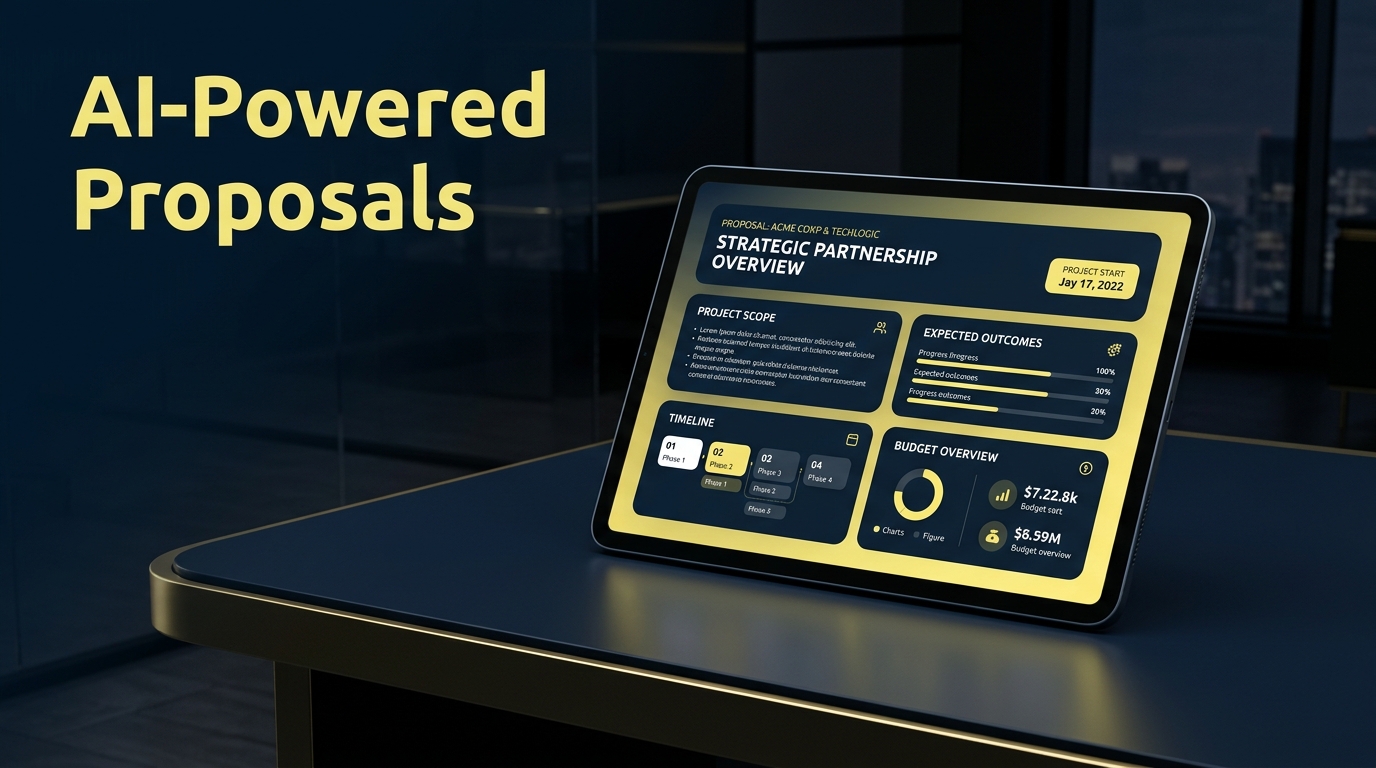
The B2B sales cycle is notoriously complex, and the ultimate bottleneck often sits squarely at the proposal stage. Sales directors and agency founders spend countless hours pulling unstructured data from discovery calls, formatting legacy Word documents, and chasing internal approvals. This manual grind limits scalability and drains the energy required for actual strategic thinking. The implementation of AI proposal writing B2B systems fundamentally changes this equation.
We are not talking about replacing the human strategist. Pure software is easily commoditized, and generic output damages brand reputation. Instead, AI acts as a cognitive exoskeleton for your sales team. It handles the heavy lifting of data aggregation, structural formatting, and initial drafting. This precision-engineered approach reduces proposal response times by 50 to 80 percent while simultaneously elevating the bespoke quality of the pitch.
This article breaks down the exact architecture required to build a winning proposal engine. We will examine the shift from manual drafting to agent-based workflows, the underlying psychology of high-converting B2B pitches, and the technical framework necessary to deploy these systems securely.
The Shift: From Manual Drafting to Agent-Based Systems
Historically, drafting a B2B proposal meant opening a previous client's document, stripping out their specific details, and pasting in new information. This legacy method is highly inefficient and creates a massive risk for error. Leaving another company's name in a multi-thousand-pound pitch is a fast way to lose trust. Furthermore, the mental fatigue of starting from a blank page or a fragmented template slows down pipeline velocity.
Agent-based AI systems completely rewrite this paradigm. Modern workflows do not rely on static templates. Instead, they utilize dynamic AI agents that actively pull context from your Customer Relationship Management (CRM) software, call transcripts, and email threads. These systems deliver initial drafts that are 75 percent complete the moment you open the file.
This fundamentally shifts the human role within the sales process. Your top performers are no longer typists. They become editors and strategists. They spend their time refining the nuance of the offer rather than formatting pricing tables. When you remove the friction of document creation, your business can scale its outreach exponentially. Industry data reveals that organizations utilizing structured systems to submit 52 more proposals per year on average experience a drastic increase in their pipeline without adding headcount.
This increase in volume does not require a drop in quality. In fact, quality improves because the AI ensures that all mandatory compliance criteria, brand guidelines, and product specifications are automatically included. Success in modern B2B sales requires understanding exactly how an AI proposal generator transforms the writing process by turning fragmented discovery notes into cohesive, highly targeted first drafts that anchor the buyer's specific needs.
Why Most B2B Proposals Fail (And How AI Fixes It)
To understand how to build a high-converting system, we must first analyze why proposals get rejected. The psychology of the B2B buyer is heavily rooted in risk mitigation. Decision-makers are terrified of making an expensive mistake. When a proposal triggers their internal alarms, they disengage. Most proposals fail due to four specific culprits:
- • They Are Entirely Generic: When a pitch reads like a copied-and-pasted template, the buyer assumes the resulting service will be equally generic. High-ticket clients want to feel understood. AI fixes this by ingesting the exact terminology and pain points used by the prospect during the discovery call.
- • They Are Far Too Long: Many agencies use proposals as an opportunity to boast about their own history. The client cares about their problem. AI can be prompted with strict token limits, forcing the narrative to remain concise and punchy.
- • They Lack Specificity: Vague promises kill conversions. AI agents excel at extracting hard data points from your initial research files and injecting them directly into the proposal text.
- • The Pricing is Buried: Making a decision-maker hunt for the final cost creates immediate friction. AI systems can be programmed to automatically generate clear, tiered pricing tables based on the specific scope of work discussed.
Before you can automate this process, you need a foundational strategy. AI amplifies whatever you feed it. If your core messaging is weak, your AI will simply generate weak proposals faster. We strongly recommend that businesses establish a Clarity Roadmap to ensure their AI agents are trained on the correct market positioning, brand voice, and historical data before full implementation. Strategy is the substrate: automation sits on top.
The Technical Framework: Discriminative vs. Generative AI
Building a bionic marketing and sales engine requires moving beyond basic consumer tools. Pasting a few bullet points into a public chat interface will not yield enterprise-grade results. You must construct a dual-layered technical architecture that leverages both Discriminative and Generative AI models.
Discriminative AI: The Researcher
Think of Discriminative AI as your analytical powerhouse. Its primary function is to classify, categorize, and extract meaning from existing data. In a proposal engine, this AI connects to your transcription software and your CRM. It analyzes the raw transcript of a 60-minute discovery call. It is programmed to identify specific triggers: budget mentions, timeline constraints, competitor frustrations, and core objectives. It filters out the small talk and compiles a highly structured brief of the client's actual situation.
Generative AI: The Writer
Once the researcher has structured the data, Generative AI takes over. This model is trained on your company's specific brand voice, previous winning proposals, and case studies via a process called Retrieval-Augmented Generation (RAG). It takes the bulleted brief from the Discriminative AI and expands it into persuasive, professional prose.
The Multi-Agent Ecosystem
The true power of this framework lies in "AI Agents" working in tandem. You can deploy one agent specifically to cross-reference the client's website for recent company news. A second agent calculates the pricing based on your internal margin requirements. A third agent drafts the actual copy. This modular approach ensures absolute precision and prevents the AI from hallucinating incorrect deliverables.
The Anatomy of a Winning B2B Proposal (AI-Powered Structure)
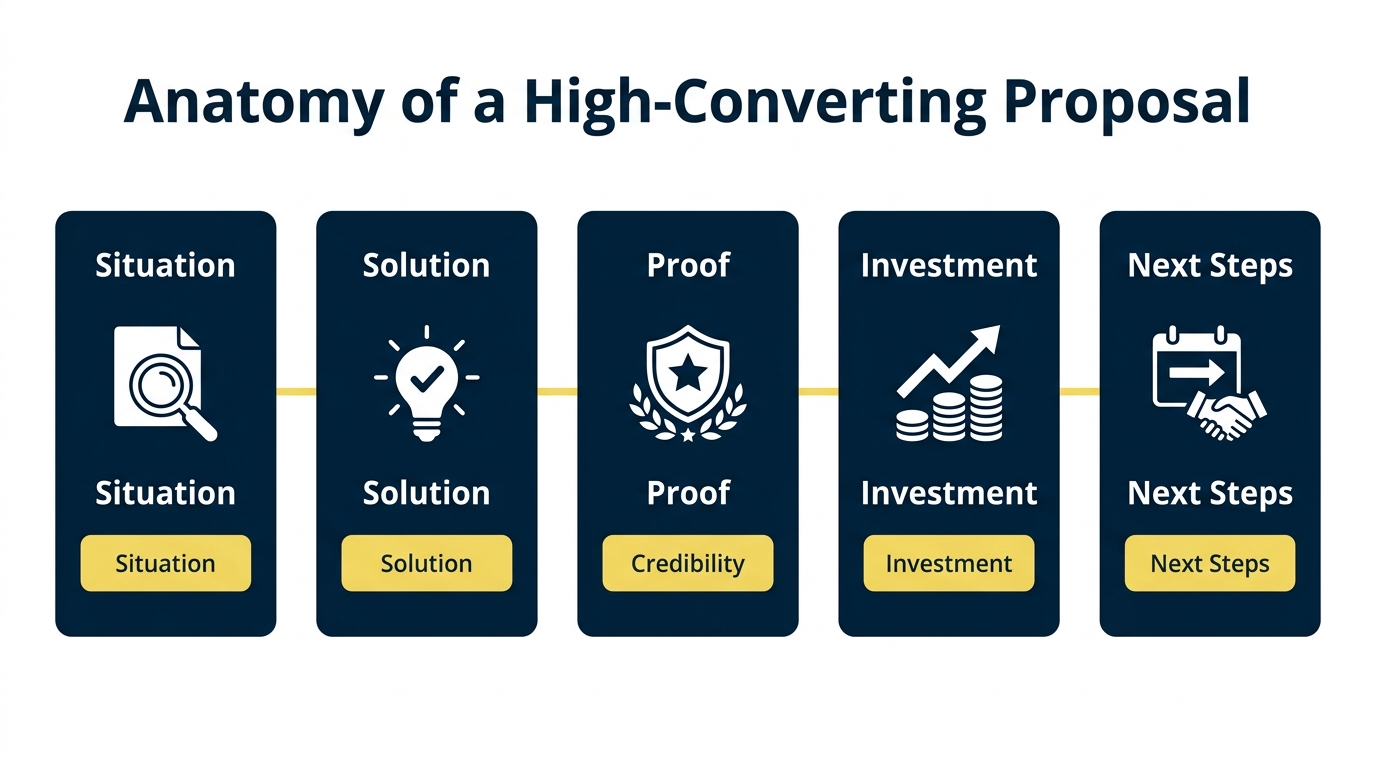
Structuring the document correctly is just as critical as the words on the page. You must prompt your AI to follow a strict, psychological progression. We utilize a proven 5-step framework designed to guide the buyer from problem recognition to immediate action.
Step 1: The Situation
Never start by talking about yourself. The opening page must mirror the client's exact problem back to them. Prompt your AI to summarize the current bottlenecks the prospect is facing using their own vocabulary. When a client reads an accurate diagnosis of their pain, they automatically assume you hold the correct prescription.
Step 2: The Solution
This section outlines your strategic intervention. It should bridge the gap between their current situation and their desired future state. Use AI to break down complex methodologies into easily digestible phases. Focus on outcomes rather than just listing technical features.
Step 3: The Proof
Claims require evidence. Your AI should be connected to a vector database containing all your past case studies and performance metrics. It can automatically pull the most relevant examples based on the prospect's industry. Narrative is vital here. Raw statistics are easily forgotten by decision-makers. Utilizing GenAI storytelling for B2B proposal wins increases message retention to 65 to 70 percent, compared to a dismal 5 to 10 percent for raw data alone. AI helps by matching the right proof to the right objection, rather than dumping every case study you have.
Step 4: The Investment
Avoid the word "Cost" or "Price." This is an investment in their growth. The AI must format this section with absolute clarity. Ambiguity kills deals. Present tiered options if applicable, but ensure the core offering is unmistakable.
Step 5: Next Steps
Assume the sale. Tell the client exactly what happens the moment they sign. The AI should generate a frictionless onboarding timeline. Tell them when the kickoff call will happen, what assets you need from them, and when they can expect the first deliverable.
A Note on Visual Presentation
While AI handles the data and the text, the final output must utilize premium design principles. A high-ticket proposal should look expensive. Implement dark mode interfaces, minimal aesthetics, and ample white space. The structural engineering of the text combined with a sophisticated visual wrapper signals immense value to the buyer.
Security, Review, and the "Human-in-the-Loop"
The most valid concern expressed by pragmatic business leaders regarding AI is data security. B2B proposals inherently contain highly sensitive information. You are dealing with a client's financial data, internal vulnerabilities, and proprietary intellectual property.
Pasting this level of confidential data into public, consumer-grade tools like standard ChatGPT is a catastrophic security risk. Anything entered into a public model can potentially be used to train future iterations of that software.
To protect your margins and your reputation, you must utilize enterprise-grade, SOC 2 compliant systems. These secure environments ensure that your API calls are encrypted and that your proprietary data is never retained or used to train outside models. Your proposal engine must operate within a walled garden.
Furthermore, technology should never operate entirely unchecked. We strongly advocate for the "Human-in-the-loop" methodology. AI is the engine, but the human is the steering wheel. We recommend implementing a military-style review process for high-ticket pitches:
- • The Pink Team Review: Before the full proposal is generated, a senior strategist reviews the AI-generated outline and core strategy. This ensures the foundational logic is sound.
- • The Red Team Review: Once the AI generates the complete draft, the Red Team steps in. This is the final human polish. The reviewer checks the brand tone, verifies the pricing calculations, and ensures the formatting is flawless.
The Follow-Up System: Turning Sent Proposals into Signed Contracts
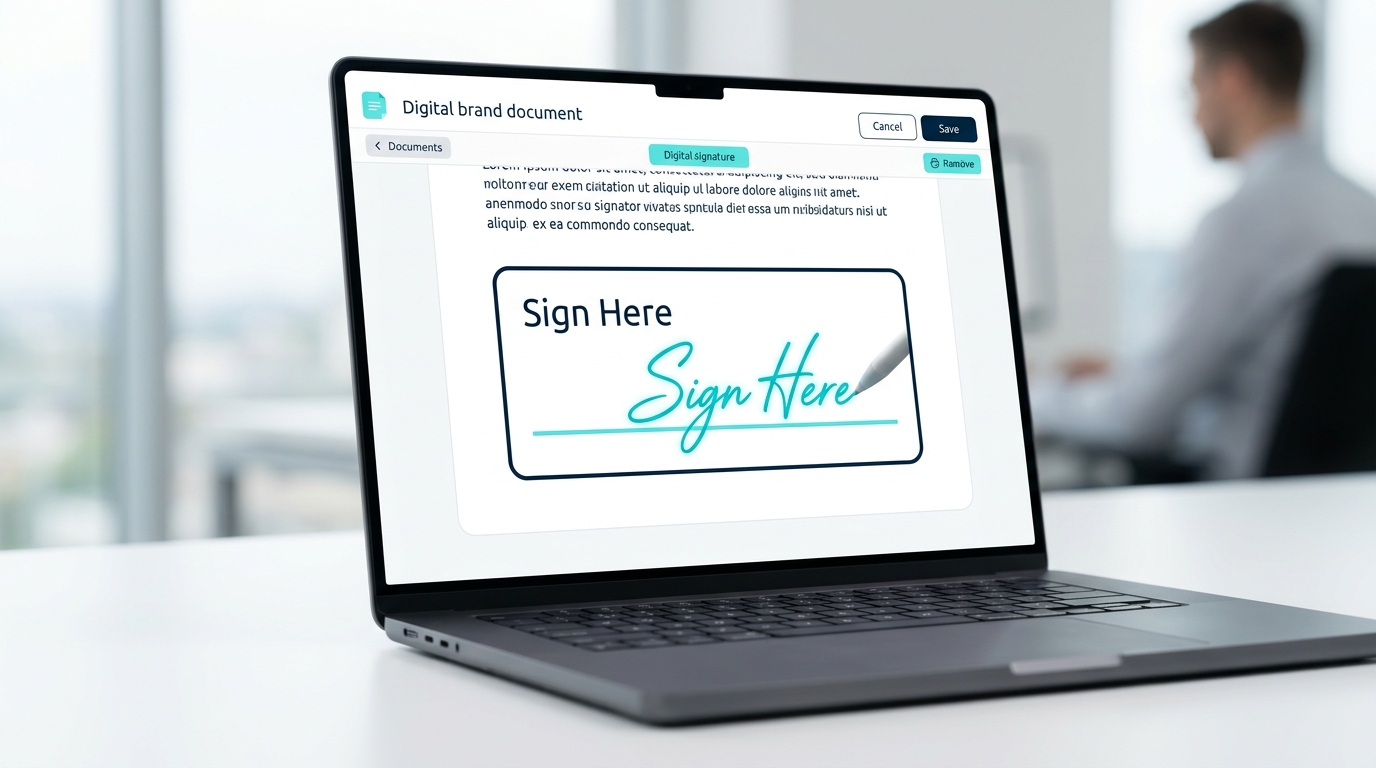
A beautifully engineered proposal is useless if it sits unread in an inbox. The sales process does not end when you hit send. It ends when the contract is signed and the invoice is paid. The follow-up system is where the actual revenue is realized, and AI plays a crucial role in closing this loop.
Modern proposal software integrates directly with your AI middleware. When a proposal is sent, the system tracks buyer behavior. It monitors when the document is opened, which specific pages the client spends the most time reading, and if the document is forwarded to other stakeholders.
Based on this telemetry data, your AI agents can draft automated, highly contextual follow-up sequences. If the client spends ten minutes staring at the pricing page but does not sign, the AI can draft an email offering a call to clarify the return on investment. If they haven't opened the document in 48 hours, the AI drafts a polite nudge highlighting a specific case study.
Building this level of interconnected infrastructure requires deep technical capability and marketing expertise. It is not a matter of simply buying a software subscription. It requires careful API integration, secure data siloing, and precise prompt engineering.
To achieve this state of automated efficiency without the implementation headache, businesses require a Custom Solution to handle the entire architecture. This is a comprehensive, done-for-you setup where expert marketers build a bespoke, secure proposal engine tailored exactly to your specific sales operations. We handle the complexity so you can focus on closing the deals. Mastering AI proposal writing B2B is not just about writing better paragraphs: it is about deploying a better operating system.
FAQs about AI Proposal Writing B2B
Is it safe to use AI for confidential B2B proposals?
Yes, provided you use the correct infrastructure. You must avoid public, consumer-grade AI tools that use your inputs for model training. Safe implementation requires enterprise-grade, SOC 2 compliant systems where your data is siloed, encrypted, and strictly protected by zero-retention policies through private API connections.
How much time does an AI proposal generator actually save?
Businesses utilizing properly integrated AI proposal systems report a 50 to 80 percent reduction in document creation time. By automating data extraction, structural formatting, and initial drafting, sales teams can bypass the blank page entirely, allowing them to focus solely on strategic refinement and client communication.
Will AI make my business proposals sound generic or robotic?
Not if the system is engineered correctly. Generic output is the result of generic prompting. By utilizing Retrieval-Augmented Generation (RAG), the AI is trained specifically on your brand voice, your past winning proposals, and the exact terminology used by the prospect during discovery calls, ensuring a highly bespoke and natural narrative.
Can AI pull data directly from my sales discovery calls?
Absolutely. Discriminative AI agents can integrate directly with transcription tools and your CRM. They analyze the raw text of your sales calls to identify budget constraints, specific pain points, and core objectives, automatically pulling those exact data points into the executive summary of your proposal.
Want to build marketing systems like this?
Book a Discovery CallRelated Articles

AI Email Marketing: Beyond Drip Sequences
AI email marketing moves beyond basic rule-based automations to intelligent systems that personalise content, optimise send times, generate copy, and adapt sequences based on recipient behaviour in real time.
Read more →
AI Marketing Strategy Framework (2026)
An AI marketing strategy is a structured plan for integrating artificial intelligence into your marketing operations. This framework covers the maturity audit, prioritisation, the build sequence, KPIs, and common strategic mistakes.
Read more →
AI Content Creation: Scale Without Losing Quality
AI content creation is the use of artificial intelligence to research, draft, edit, and optimise marketing content. Learn how to scale production with quality gates, brand DNA frameworks, and workflows that keep the human where it matters.
Read more →