How to Use Trigger Events to Find Buyers Before Your Competitors Do
27 March 2026 • By Jakub Cambor, Founder of AI for Marketing | Top 1% Upwork Expert Vetted Talent
Last updated: 27 March 2026
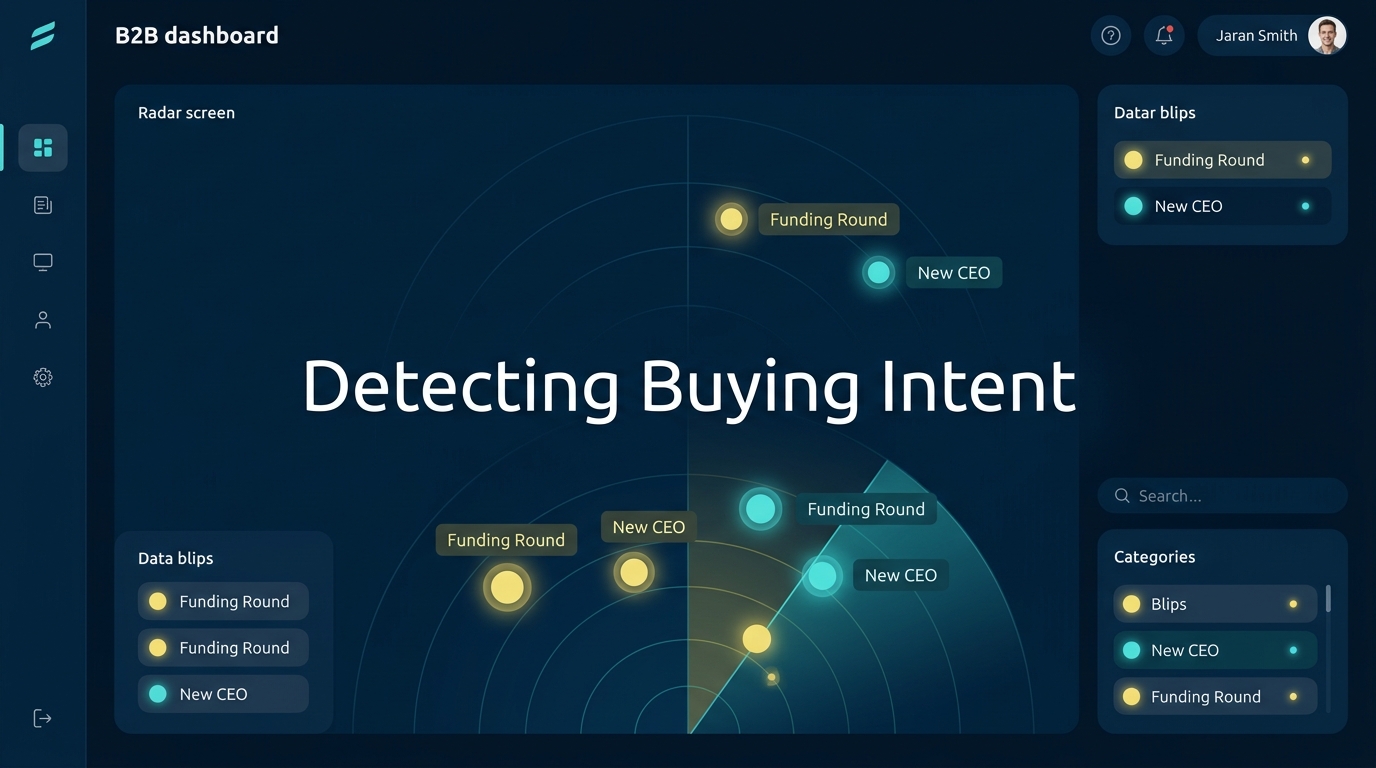
Most B2B sales teams are operating under a fundamental physics problem. The modern buyer is actively hiding, organizational inertia is at an all-time high, and traditional outbound methodologies are failing to generate meaningful momentum. The core issue is the scale versus quality paradox. Revenue teams are forced to choose between sending thousands of generic, ignored messages or spending hours researching a single prospect who may not even be in the market to buy.
This manual grind of static list-building is obsolete. The gap between businesses deploying precision-engineered systems and those relying on manual operators is widening exponentially. To survive and scale, revenue teams must bridge this gap by adopting a completely different methodology: they must master trigger event selling B2B AI.
This approach replaces guesswork with deterministic data. It is the foundation of modern "bionic marketing" strategies, where human creativity and strategic thinking are augmented by machine efficiency. Instead of shouting into the void, you position your brand to intercept demand the exact moment it materializes. You stop selling to static lists and start selling to dynamic situations.
What is Trigger Event Selling?
Trigger event selling B2B AI is the strategic use of artificial intelligence to monitor, detect, and act upon specific organizational changes that signal a sudden readiness to buy. These events act as catalysts, shifting a prospect from a state of passive observation to active evaluation.
To understand why this works, you must understand the physics of a B2B sale. Organizations naturally resist change. Buying new software, hiring new agencies, or overhauling internal processes requires capital, time, and political capital. Therefore, companies do not buy when they are stable. They buy when "unbalanced forces" break their organizational inertia. A trigger event is that unbalanced force. It creates a finite window of opportunity where priorities shift, budgets unlock, and new initiatives are aggressively pursued.
The most lucrative automated sales triggers fall into a few distinct categories:
- • Personnel Shifts: The hiring of a new C-level executive, VP, or Director. New leaders are typically given a 90-day mandate to audit existing systems and implement their own preferred tools and strategies.
- • Financial Milestones: Funding rounds (Series A, B, C), mergers, acquisitions, or initial public offerings. These events signal an immediate influx of capital and a mandate for rapid scaling.
- • Operational Expansion: Opening new regional offices, announcing new product lines, or aggressive hiring sprees in specific departments.
- • Negative Triggers: Poor quarterly earnings reports, regulatory fines, or highly publicized executive departures. These events signal a desperate need for turnaround solutions, efficiency drivers, or risk mitigation services.
The "Why": The Data-Driven Psychology Behind Trigger Events
The Hidden Buyer
The traditional B2B playbook assumes that buyers want to be educated by sales professionals. The data proves the exact opposite. Today, the B2B buyer is a hidden researcher. They are highly risk-averse, preferring to read peer reviews, analyze technical documentation, and consume "dark social" content long before they ever fill out a contact form.
By the time a prospect formally requests a demonstration, the decision is often already made. Industry research from Gartner confirms that modern buyers are 57% through the process before engaging with a vendor. If your first point of contact happens after they have defined their problem and evaluated your competitors, you are no longer a strategic consultant. You have been commoditized into a simple price comparison.
Entering the buying cycle early is a structural necessity. Trigger events provide the only reliable mechanism to intercept a buyer before they begin their formal vendor evaluation. When you reach out to a newly appointed VP of Marketing on day fourteen of their tenure, you are not interrupting them. You are arriving precisely when they are mapping out their strategic roadmap.
The ROI of Timing
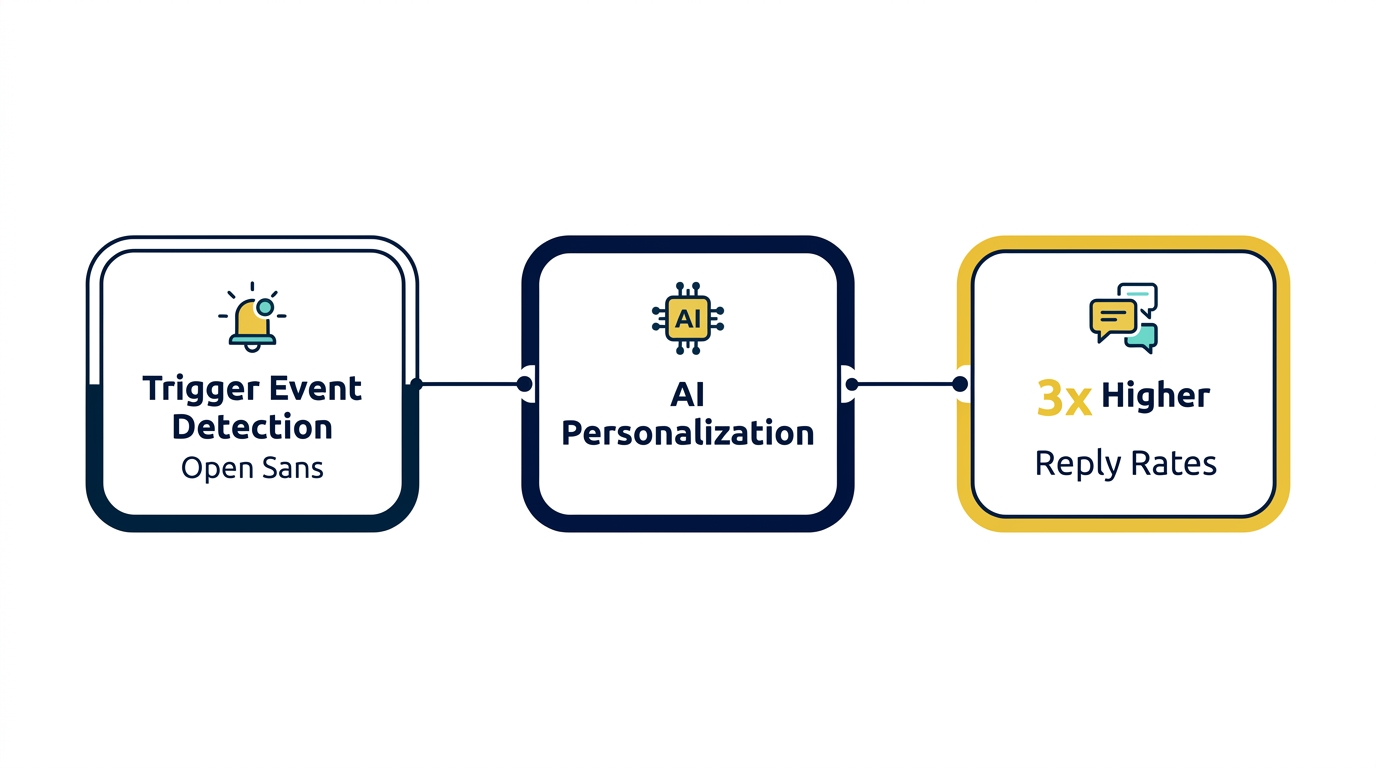
The return on investment for this timing is undeniable. Static outreach relies on volume to compensate for irrelevance, resulting in domain reputation damage and negligible conversion rates. Conversely, intent-based outreach fundamentally alters the conversion math. Data from Outreach.io confirms that trigger-based outreach yields 3x higher reply rates compared to standard cold outreach. This is a complete transformation of the outbound unit economics.
Trigger events create urgency, budget, and permission. Most deals stall due to status quo bias, competing priorities, procurement friction, and the risk of being wrong. Trigger events change the force field by introducing new goals, new constraints, new resources, or new risks. When these forces appear, decision-makers become highly receptive to external support, provided the support is directly relevant to the moment.
The "How": Scraping Logic and Automated Signal Detection
Understanding the psychology of B2B buying intent signals is only the first step. The operational challenge lies in execution. Tracking these signals manually is impossible at scale. A human researcher cannot monitor thousands of target accounts across press releases, job boards, and social platforms simultaneously. This is where sophisticated engineering replaces manual effort.
The engine behind this methodology relies on advanced B2B data scraping logic. This is not brute-force data mining. It is the deployment of precision-engineered scripts that monitor public data sources for highly specific textual patterns.
Step 1: Define the Signal for Your ICP
Scraping the internet without a sharply defined Ideal Customer Profile (ICP) creates noise. You will find events, but not the ones that correlate with a willingness to buy what you sell. Before building collectors, you must define the exact firmographic, technographic, and psychographic criteria of your ideal buyer. Establishing this foundation through a Clarity Roadmap is the critical prerequisite to dictate which signals are relevant and which are merely noise.
Step 2: Build a Source Map
Different triggers live in different places. A robust trigger system uses multiple sources so you are not dependent on any single platform's availability or formatting. Typical source categories include press releases, funding databases, company changelogs, professional networking platforms, job boards, and regulatory portals. The goal is total coverage for your chosen triggers.
Step 3: Deploy Specific Collection Methods
Scraping logic is a set of collection patterns tailored to the structure and stability of the source. Common patterns include:
- • RSS and Sitemap Polling: Best for newsrooms and blogs. This involves polling feeds daily to ingest new URLs and extract content. It is stable and lightweight.
- • HTML Scraping with CSS/XPath Selectors: Best for pages with consistent templates, such as leadership pages. The system fetches HTML, extracts specific fields like title and date, and normalizes the data.
- • SERP Monitoring: Best for catching mentions across the web. The system runs targeted queries, such as searching for a specific company name alongside terms like "appointed" and "Chief Revenue Officer".
- • Job Posting Parsing: Best for identifying initiatives hidden in hiring language. The system monitors job boards and extracts keywords indicating new initiatives, such as a requirement for "data warehouse expertise".
- • API-Based Enrichment: Best for enriching a detected event with firmographic context, improving scoring accuracy by pulling in company size, industry, and tech stack details.
The "AI": Precision-Engineered Personalization Agents
Detecting the trigger event solves the timing problem. Capitalizing on that event requires solving the relevance problem. According to Forrester research, only 22 percent of sales professionals effectively personalize their outreach. The remaining majority rely on superficial tactics, such as merging a first name and a company name into a static template.
This generic approach is actively damaging to brand equity. Modern executives are inundated with automated sequences. They have developed an acute sensitivity to robotic, templated language. When outreach lacks genuine context, it creates a severe trust deficit. The reality of the modern market is stark, as HubSpot reports that only 3% of buyers trust salespeople. Bridging this massive credibility gap requires a level of hyper-relevance that human teams cannot produce at scale.
This is the exact operational bottleneck that AI personalization agents are engineered to solve. We must draw a distinct line between generic AI usage and bespoke AI architecture. Amateurs paste a prospect's LinkedIn URL into a public chatbot and copy the output. Professionals build custom AI agents integrated directly into their data pipelines.
A precision-engineered personalization agent operates as an autonomous research analyst and copywriter. When the scraping logic detects a trigger event, the data payload is automatically routed to the AI agent. The agent then executes a complex, multi-step reasoning process:
- • Event Comprehension: The agent ingests the trigger object, including the evidence snippet and source URL. It outputs a plain-language summary of what changed and why it matters.
- • Account Context Build: The agent scrapes the prospect's recent social posts, the company website copy, and recent news to infer priorities and constraints.
- • Persona Alignment: The agent maps the specific responsibilities of the decision-maker's role to the trigger event, determining what this specific persona likely cares about.
- • Value Hypothesis Generation: The agent generates two or three credible hypotheses regarding the prospect's immediate urgency.
- • Constraint-Based Drafting: The agent generates a highly contextualized, concise message. It operates under strict constraints: mention the trigger early, include one specific observation, and offer one clear next step.
- • Human Review: The drafted message is presented to a human strategist. This is the "bionic" layer. The AI does the heavy lifting of research, while the human ensures judgment and brand integrity.
Building Your Bionic Marketing Ecosystem
Understanding the mechanics of trigger event selling is one thing. Building the infrastructure to execute it is entirely different. For most marketing directors and founders, the barrier to entry is not a lack of vision, but implementation fatigue.
The market is flooded with fragmented tools. Attempting to build this system internally usually results in a chaotic tech stack. You find yourself managing separate subscriptions for data scrapers, intent data providers, API connectors, and various language models. You pay for each token separately, manage multiple vendor relationships, and spend more time fixing broken integrations than actually closing deals.
The solution is not more software. The solution is a unified ecosystem where strategy seamlessly dictates execution. You need a centralized infrastructure where the scraping logic, the AI personalization agents, and the outbound delivery mechanisms are consolidated into a single, cohesive workflow.
By leveraging a custom-built Lead Generation Engine, businesses can bypass the technical friction entirely. This "Agency-as-a-Software" model provides the sophisticated infrastructure of an enterprise data science team without the administrative overhead. It allows your human talent to focus entirely on closing the high-intent conversations that the system generates, rather than managing the complex machinery running in the background.
Conclusion: Stop Chasing, Start Anticipating
The era of volume-based, generic outbound marketing is over. The businesses that will dominate the next decade are those that treat marketing as a precision engineering discipline.
Mastering trigger event selling B2B AI is the ultimate competitive advantage. It allows you to transition from a reactive posture to a proactive strategy. By identifying the unbalanced forces that drive organizational change, deploying sophisticated scraping logic to monitor the market, and utilizing AI agents to craft hyper-relevant messaging, you position your brand as the inevitable solution to your prospect's newly formed problem.
Stop chasing buyers who are not ready to engage. Start anticipating their needs before your competitors even know they exist. If you are ready to leave generic templates behind and build a bespoke, bionic revenue system tailored to your specific market, it is time to upgrade your infrastructure. Book a strategy session today to engineer your proprietary growth engine.

Frequently Asked Questions (FAQ)
What are the most common B2B trigger events to track? The most actionable triggers include executive leadership changes, recent funding rounds, mergers and acquisitions, office expansions, and the launch of new product lines. Negative triggers, such as poor quarterly earnings or regulatory shifts, also create urgent demand for efficiency and compliance solutions.
How does AI improve trigger event selling? AI transforms raw data into actionable context. While traditional software can flag a new hire, AI personalization agents analyze the prospect's background, the company's strategic goals, and the specific implications of the trigger to draft highly relevant, bespoke outreach that builds immediate trust.
Is scraping data for B2B sales legal and GDPR compliant? Yes, provided the scraping logic strictly targets publicly available professional data and adheres to regional privacy frameworks. Compliant systems focus on corporate intent signals and public API data rather than mining protected personal information, ensuring outreach is strictly business-to-business and contextually justified.
What is the difference between intent data and trigger events? Intent data tracks digital behavior, such as a prospect researching specific keywords or visiting your pricing page. Trigger events are structural organizational changes, like a funding round or a new executive hire. Combining both provides the ultimate signal of buying readiness.
How do I automate personalized outreach without sounding like a robot? The key is utilizing bespoke AI architectures rather than generic templates. By feeding specific trigger data and deep firmographic context into a custom-trained AI agent, the output becomes highly strategic. Always keep a human in the loop to review and refine the final message before sending.
Want to build marketing systems like this?
Book a Discovery CallRelated Articles

AI Email Marketing: Beyond Drip Sequences
AI email marketing moves beyond basic rule-based automations to intelligent systems that personalise content, optimise send times, generate copy, and adapt sequences based on recipient behaviour in real time.
Read more →
AI Marketing Strategy Framework (2026)
An AI marketing strategy is a structured plan for integrating artificial intelligence into your marketing operations. This framework covers the maturity audit, prioritisation, the build sequence, KPIs, and common strategic mistakes.
Read more →
AI Content Creation: Scale Without Losing Quality
AI content creation is the use of artificial intelligence to research, draft, edit, and optimise marketing content. Learn how to scale production with quality gates, brand DNA frameworks, and workflows that keep the human where it matters.
Read more →