How to Scale Meta Ads Creative Production with AI: From 5 Variations to 50 in Minutes
29 March 2026 • By Jakub Cambor, Founder of AI for Marketing | Top 1% Upwork Expert Vetted Talent
Last updated: 29 March 2026
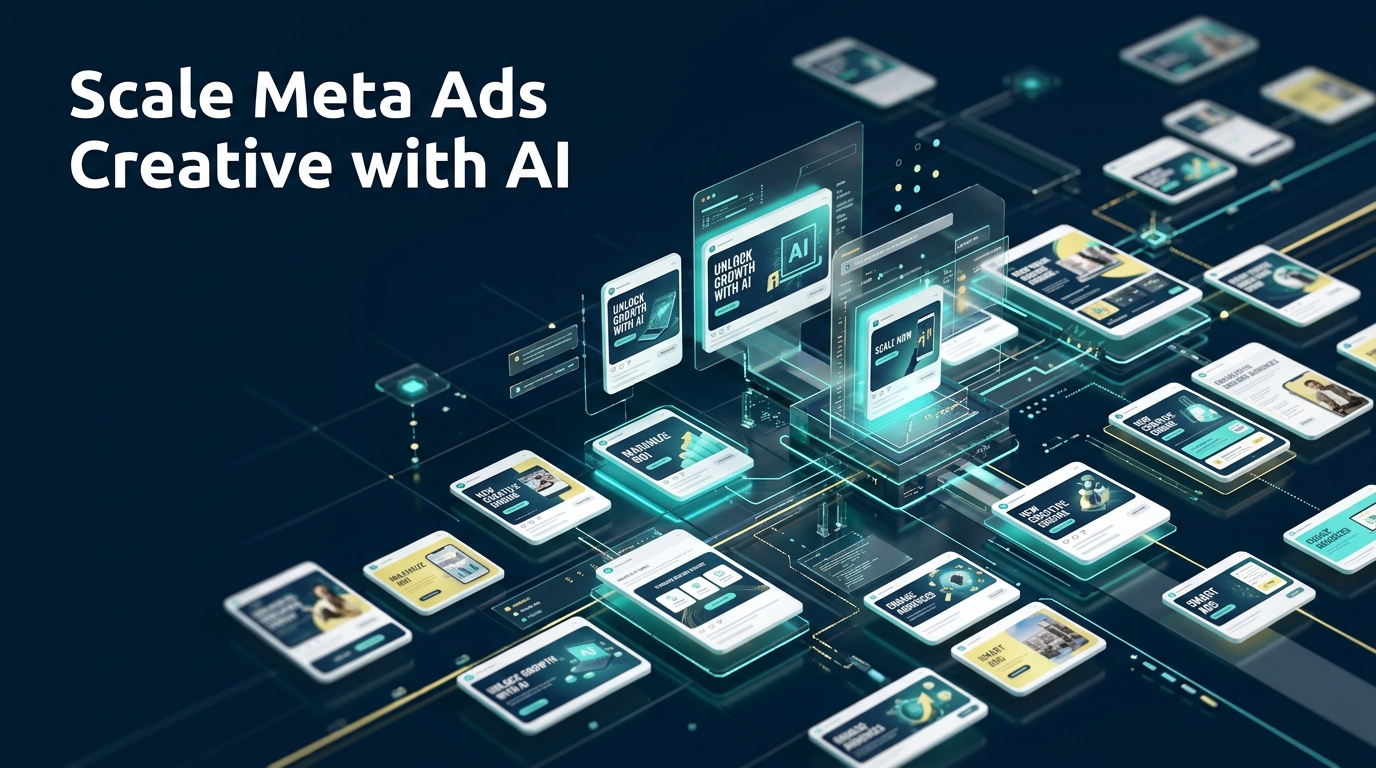
In the current landscape of digital advertising, the bottleneck is no longer the algorithm; it is the human capacity for production. Marketing directors and founders are frequently trapped in a cycle of "creative fatigue," where high-performing ads lose their efficacy within days, and the manual cost of replacing them erodes profit margins. The traditional workflow—briefing a designer, waiting for drafts, iterating on copy, and finally uploading to Ads Manager—is too slow for the modern auction.
To maintain a competitive edge, businesses must transition from manual asset creation to a precision-engineered scale Meta Ads creative AI strategy. This is not about replacing human creativity; it is about augmenting it. By adopting a "Bionic Marketer" approach, you can transform a single strategic brief into fifty high-converting variations in minutes, ensuring your campaigns never starve for fresh data signals.
Why Meta's Algorithm Rewards Creative Diversity
The fundamental architecture of Meta's ad delivery system has shifted. Historically, media buyers relied on granular interest targeting and complex lookalike stacks to find their audience. Today, Meta's machine learning is so sophisticated that the creative itself is the targeting. When you provide the algorithm with a diverse range of visuals and messaging, it uses those assets to "probe" different segments of a broad audience.
Broad targeting paired with a high volume of creatives consistently outperforms narrow targeting with limited assets. This is because the algorithm needs "creative diversity" to understand which psychological triggers resonate with which users. If you only test five variations, you are giving the machine a very narrow window to optimize. If you provide fifty, you allow the system to find the exact "hook-and-hold" combination for every sub-segment of your market.
Meta's own research confirms this: accounts that test 10 or more unique creatives per month see up to a 60% lower CPA compared to those that stick to a static set of assets. By scaling your creative volume, you are essentially lowering the "tax" you pay to the auction, as the algorithm rewards high-engagement, relevant content with lower costs and better placements.
The Creative Velocity Framework: How Many Ads to Test?
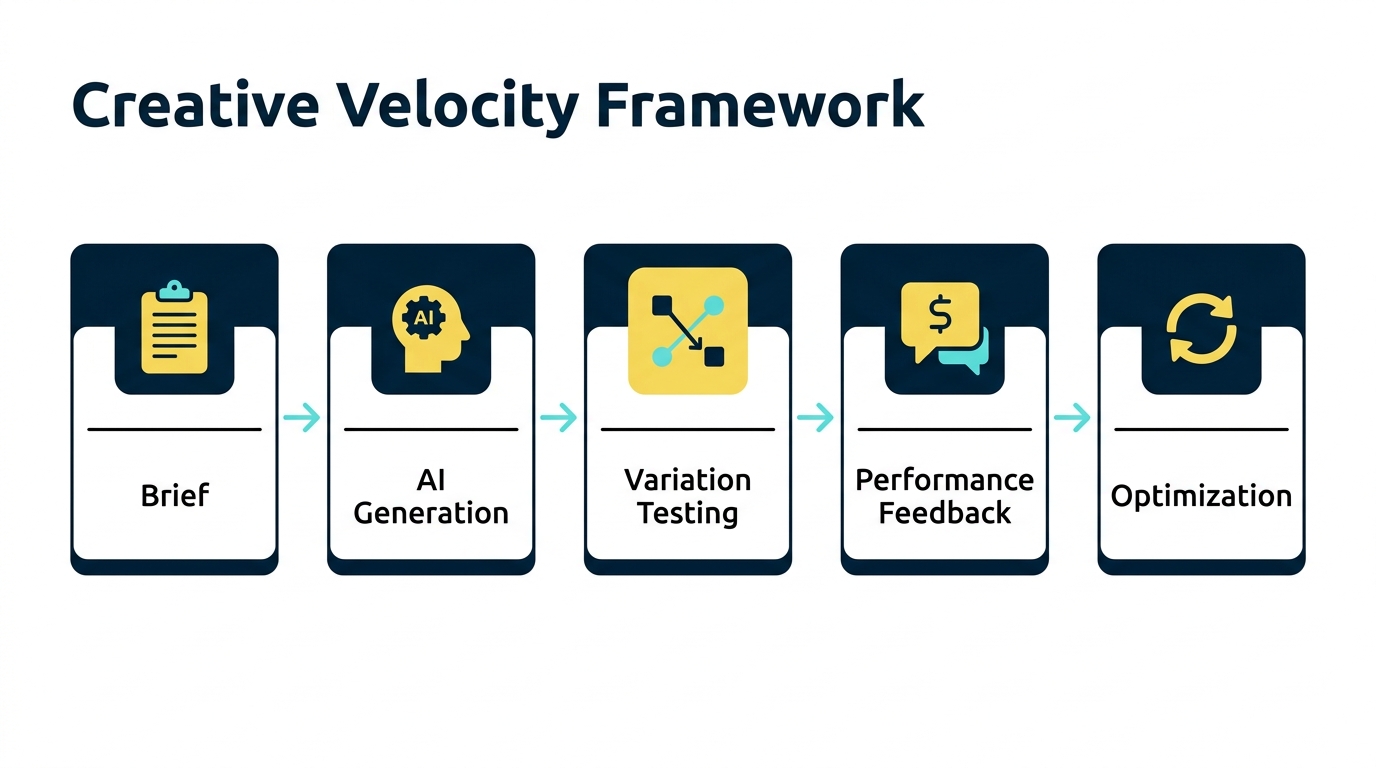
To achieve these results, you need a Creative Velocity Framework. This is the metric of how many new, distinct creative concepts your brand can push live and analyze per week. For most scaling brands, the goal should be to move from testing 2-3 ads per month to 10-20 per week.
Velocity is the antidote to ad fatigue. When you have a high-velocity engine, you aren't worried when a "winning" ad starts to decline, because you already have five more variations in the pipeline ready to take its place. This framework requires a shift in mindset: you are no longer looking for the "one perfect ad," but rather building a Content Engine that perpetually discovers new winners.
AI-Generated Copy: Hooks, Body Text, and CTAs
The first pillar of scaling is messaging. Writing fifty unique ad captions manually is a recipe for burnout and generic output. However, using a precision-engineered AI workflow allows you to splinter a single core value proposition into dozens of psychological angles.
- • The Hook: AI can generate 10 different "scroll-stoppers" based on different triggers: curiosity, fear of missing out, direct benefit, or social proof.
- • The Body: By training AI on your specific brand voice, you can produce variations that range from short, punchy bullet points to long-form storytelling.
- • The CTA: Testing different calls to action (e.g., "Get the Guide" vs. "Start Your Trial") can have a massive impact on conversion rates.
At AI for Marketing, we utilize bespoke agents that understand the nuance of direct-response copywriting. This ensures that your scale Meta Ads creative AI efforts don't result in "robotic" text, but in high-converting, brand-aligned messaging that speaks directly to the user's pain points.
AI Image Generation for Ad Visuals
Visuals are the most labor-intensive part of the creative process. AI image generation has reached a point where it can produce photorealistic lifestyle imagery, product mockups, and "pattern-interrupt" graphics that outperform traditional photography. By using tools like Midjourney or Stable Diffusion within a controlled brand environment, you can generate 50 unique visual directions for the cost of a single stock photo.
The key is Dynamic Creative Optimization (DCO). Instead of guessing which image will work, you upload a library of AI-generated visuals and let Meta's DCO engine mix and match them with your AI-generated copy. This creates a "survival of the fittest" environment where the best-performing combinations are automatically given more budget.
How to Scale Meta Ads Creative with AI: A Step-by-Step Guide
To implement this in your business, follow this structured workflow:
- • Define the Core Brief: Identify your primary offer, target audience, and brand constraints.
- • Generate the Messaging Matrix: Use AI to create 5 hooks, 5 body copy variations, and 2 CTAs.
- • Produce the Visual Library: Generate 10-15 AI images or video hooks that align with your messaging angles.
- • Deploy via Dynamic Creative: Upload these assets into a Meta "Dynamic Creative" ad set.
- • Analyze and Iterate: After 72 hours, identify the winning elements. Use these "winners" as the seed for your next round of AI generation.
This process turns a weeks-long production cycle into a 30-minute task. For brands looking for a "Done-For-You" solution, our Paid Ads Engine handles this entire infrastructure, from strategy to implementation.
Cross-Platform Production: The Google Ads Agent
While Meta is a powerhouse for creative testing, a truly bionic marketing strategy is cross-platform. The insights you gain from your Meta creative testing should be immediately applied to your search and display campaigns. Our Google Ads Agent works in synergy with the Meta engine, taking the winning hooks and visuals and adapting them for YouTube, Discovery, and Search ads. This ensures a unified brand presence and maximizes the ROI of every AI-generated asset.
Conclusion: Complexity Simplified, Strategy Amplified
Scaling Meta Ads in 2026 and beyond requires more than just a high budget; it requires creative volume. By leveraging AI to handle the "manual grind" of asset production, you free your team to focus on what truly matters: strategy, offer innovation, and business growth.
The gap between AI-driven businesses and those relying on legacy workflows is widening. Don't let production bottlenecks hold back your growth. Whether you are looking to build your own internal engine or want a partner to manage the complexity for you, the path to lower CPAs and higher scale starts with AI.
Ready to transform your advertising? Book a strategy session with AI for Marketing today and let us build your bespoke Paid Ads Engine.

Want to build marketing systems like this?
Book a Discovery CallRelated Articles

AI Email Marketing: Beyond Drip Sequences
AI email marketing moves beyond basic rule-based automations to intelligent systems that personalise content, optimise send times, generate copy, and adapt sequences based on recipient behaviour in real time.
Read more →
AI Marketing Strategy Framework (2026)
An AI marketing strategy is a structured plan for integrating artificial intelligence into your marketing operations. This framework covers the maturity audit, prioritisation, the build sequence, KPIs, and common strategic mistakes.
Read more →
AI Content Creation: Scale Without Losing Quality
AI content creation is the use of artificial intelligence to research, draft, edit, and optimise marketing content. Learn how to scale production with quality gates, brand DNA frameworks, and workflows that keep the human where it matters.
Read more →