Paid Advertising in 2025: Why Most Businesses Are Wasting Money (and the AI Solution)

The mechanics of digital acquisition have fundamentally broken away from the playbooks of the past decade. For Founders and Marketing Directors, the reality of Paid Advertising 2025 is stark: you are either operating a precision-engineered ecosystem, or you are quietly funding the inefficiencies of algorithmic black boxes.
Many ad accounts currently present a brutal truth behind the dashboards. Campaigns look efficient on paper, yet the business is bleeding cash. You can feel it in the commercial metrics: Cost Per Acquisition (CPA) drifting upward, performance volatility week to week, attribution models telling conflicting stories, and automation systems that seem to optimize for everything except profitable, bottom-line growth.

This is not because Google Ads or Meta suddenly stopped working. It is because the operating conditions have changed entirely. We are dealing with less data signal, more aggressive platform automation, highly fragmented channels, and a buyer journey that now includes answer engines and retail media networks. The marketing teams still running 2023 playbooks are paying 2025 prices for 2021 certainty.
This article breaks down exactly where capital is being destroyed, why "set and forget" automation is a dangerous myth, and how artificial intelligence, when deployed correctly, becomes an exoskeleton for your paid media team: enabling faster decisions, tighter financial control, and superior creative learning loops without ever sacrificing human strategy.
The $1.2 Trillion Leak: The State of Paid Advertising 2025
The current financial inefficiency in digital marketing is a systemic issue. Industry projections indicate that global ad waste is expected to hit a staggering $1.2 trillion by the end of 2025. That number is not driven by one bad channel or one broken platform. It is driven by legacy systems that were never engineered for today's data constraints.
The headline most leadership teams miss is the compounding effect of small, daily inefficiencies. Broad targeting expands faster than your creative strategy can support. Measurement gaps push media buyers to simply trust the platform, leading to scaled spend on the wrong objectives. Furthermore, platform automation naturally consolidates spend into whatever is easiest to attribute, not what is actually driving incremental business growth.
A primary driver of this financial drain is poor infrastructure. Multiple industry analyses confirm that 60% of marketing budgets wasted can be directly attributed to poor targeting, misaligned strategy, and generic campaign structures. Businesses are feeding premium capital into advertising networks without the proper guardrails, allowing the platforms to optimize for their own revenue rather than the advertiser's return on investment. This is not a creative failure. It is an engineering failure.
At AI for Marketing, we treat paid media as a precision system. It requires strict inputs, clean measurement, and rigid budget control rules. When those components are built to work together, automation becomes a distinct competitive advantage. When they are ignored, automation becomes a budget accelerant pointed in the wrong direction.
The Hidden Culprits Bleeding Your Budget: Signal Loss and PMax Cannibalization
Most underperformance in Paid Advertising 2025 is not a bidding issue. It is a visibility issue. You are steering a complex machine with missing instruments, then judging success based on a dashboard that undercounts specific outcomes and over-credits others.
Founders and Marketing Directors are currently facing unprecedented friction with traditional search engine marketing. The strategies that reliably generated leads in the past are failing, and relying on old marketing tactics is a liability that directly threatens top-line revenue. Two specific culprits are responsible for the vast majority of this budget bleed.
The Privacy Sandbox and the 15-25% Under-Reporting Gap
Signal loss is no longer a future threat. It is a day-to-day operating condition. With third-party cookies deprecated in many environments and privacy updates restricting tracking, platforms are increasingly relying on modeling to fill the gaps.
The result is a persistent under-reporting gap, commonly seen as 15-25% in conversion reporting depending on your specific mix of devices, browsers, and user consent rates. When ad platforms lose the ability to track users across the web, their algorithms are forced to operate blindly. This gap creates three highly expensive failure modes:
- • Budget Misallocation: If conversions are under-reported, the platform algorithm believes some campaigns are weaker than they actually are. It then shifts your budget to what it can clearly see, not what is actually driving profit.
- • False Creative Conclusions: Your marketing team kills highly effective ads because the performance appears to drop on the dashboard. In reality, the measurement degraded, not the marketing message.
- • Broken Forecasting: When leadership asks for growth projections based on increased spend, your model answers based on incomplete data. You either under-invest and miss market share, or over-invest and burn cash.
The fix is to build a measurement stack that reduces uncertainty. This requires stronger first-party data capture, server-side tracking, consistent conversion definitions, and offline conversion imports for qualified leads. You do not need absolute perfection, but you do need enough truth to make sound financial decisions.
The PMax Illusion: Are You Buying Your Own Brand?
Google's Performance Max (PMax) campaigns are heavily marketed as an automated solution for busy teams. However, without expert oversight and strict negative keyword engineering, PMax becomes a highly efficient budget-wasting machine.
The most common waste pattern is Brand Cannibalization. PMax algorithms are designed to find the easiest path to a conversion to prove their own value. Often, this means the algorithm aggressively bids on your own branded search terms. It captures users who were already looking for your company and were going to buy anyway.
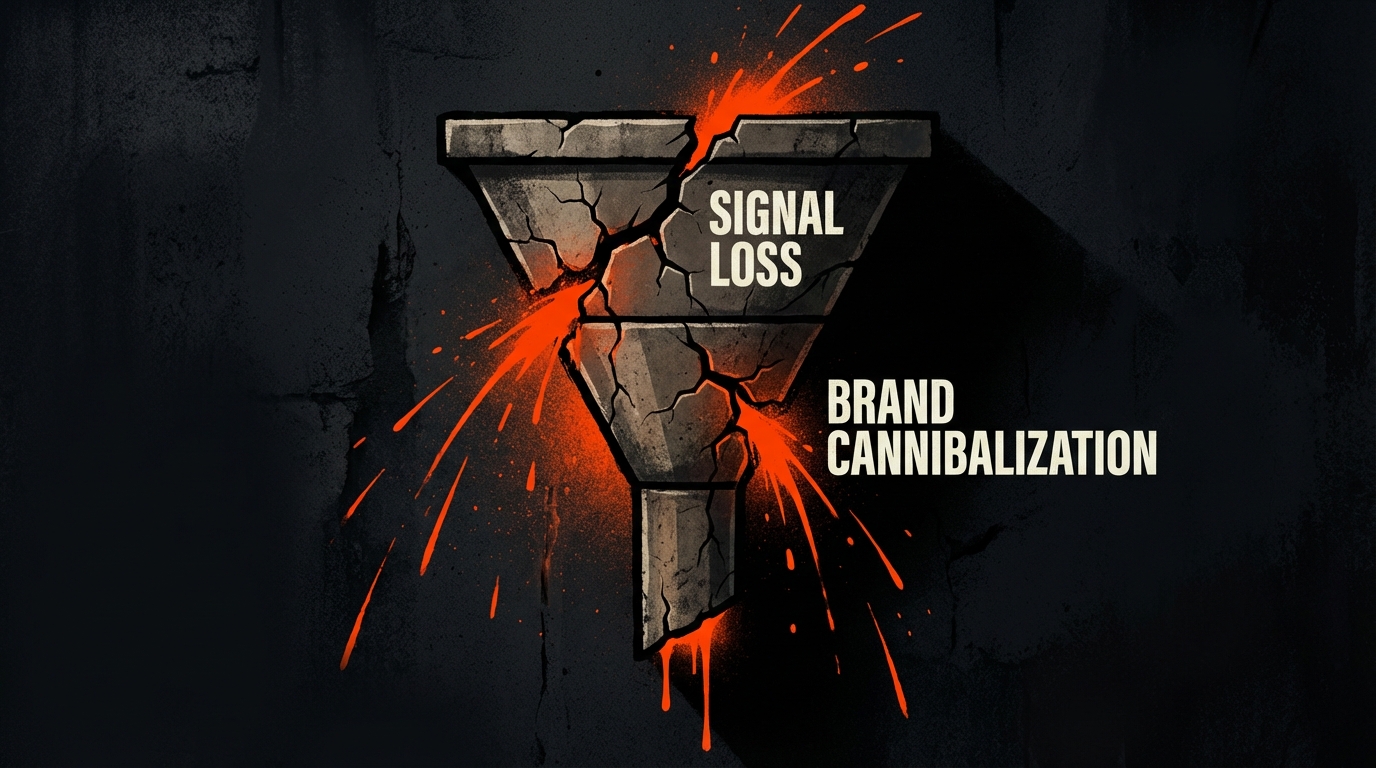
The platform takes credit for the sale, generating an illusion of high Return on Ad Spend (ROAS), while entirely ignoring cold customer acquisition. You end up paying a premium to acquire your own existing demand. A month later, new customer volume is flat, CPA rises, and the team has no clean explanation.
Combatting the PMax illusion requires structured brand controls, separate budgets for acquisition versus efficiency, and strict incrementality checks. The goal is not to turn off automation. The goal is to make automation strictly accountable to incremental business outcomes.
The Paradigm Shift: From Search Engines to Answer Engines
Consumer behavior is shifting faster than most marketing departments can adapt. We are transitioning away from an era of searching for a list of links, moving rapidly toward an era of demanding synthesized answers.
The data confirms this behavioral pivot. There has been an 8x increase in consumers preferring ChatGPT over Google for search within just a six-month window. Users no longer want to click through three different landing pages to compare software features or service pricing. They want an AI to aggregate the data and present a definitive, authoritative answer.
This represents a fundamental change in the digital acquisition funnel. The shift from searching for options to searching for answers means that if your paid strategy relies solely on traditional Google Search text ads, you are actively missing the top of the funnel.
In practical terms, text ads alone are no longer a complete strategy. Your creative assets must do significantly more work: explaining, proving, differentiating, and pre-handling objections. Furthermore, your landing page experiences must compress the time-to-trust, because users arrive pre-informed and highly impatient. Optimizing for AI-driven conversational discovery requires a different approach to content structure and brand positioning, ensuring language models view your brand as the definitive solution in your market category.
Enter the "Bionic Marketer": How AI Agents Are Fixing Ad Waste
The most expensive misconception about AI in paid media is that it replaces human judgment. It does not. It replaces operational friction.
At AI for Marketing, we utilize the "Bionic Marketer" framework. We believe in the synergy of human creativity and AI efficiency. The human dictates the strategy, understands the market nuance, and crafts the brand narrative. The AI executes the mathematics, monitors the anomalies, and scales the output. This hybrid approach is highly effective, with 87% of organizations currently reporting measurable improvements in customer engagement through the implementation of AI tools.
Creative Is the New Targeting
Historically, media buyers spent their days tweaking audience demographics and adjusting bid caps. Today, algorithms like Meta's Advantage+ and Google's automated inventory handle the bidding mechanics automatically. Because the targeting has been commoditized by the platforms, your control has shifted entirely to creative inputs.
Data shows that 70% of success in PMax and Advantage+ campaigns is driven by the creative assets. If the creative is weak, the system will still spend your money. It will simply spend it wider, longer, and less profitably until it finds something that sticks.
AI assists here in a highly disciplined way. It enables message map generation, turning positioning into structured angles. It allows for variant production at scale, creating dozens of high-quality iterations that stay strictly on brand. This is how you reduce waste: not by chasing micro-optimizations in the dashboard, but by increasing the rate at which you discover profitable marketing messages.
Deploying Autonomous Agents for Campaign Management
The manual grind of daily bid adjustments, pacing checks, and routine campaign monitoring is the quiet killer of performance. Human error and fatigue are the enemies of media buying efficiency.
By deploying autonomous agents to manage your campaigns, you introduce a layer of 24/7 algorithmic oversight. These custom-built agents monitor your ad accounts around the clock. They monitor spend velocity, alert you when a campaign is overspending relative to performance, detect creative fatigue patterns, and identify placement risks early so exclusions happen faster.
This is not a generic SaaS tool. It is a bespoke intelligence layer trained on your specific business margins and acquisition targets. The outcome is controlled automation: your team makes fewer reactive decisions, and more deliberate, strategic ones.
Beyond Search and Social: RMNs, CTV, and the Mobile Imperative
If your paid mix is still just Google Search and Meta with a small retargeting layer, you are highly exposed. A comprehensive strategy for 2025 requires a broader view of the advertising ecosystem, managed through centralized AI reporting.
Retail Media Networks (RMNs) are rapidly becoming the most valuable real estate in digital advertising. Because platforms like Amazon, Walmart, and specialized industry retailers possess rich, closed-loop first-party purchase data, they are completely immune to traditional signal loss. RMNs are expected to command 50% of total ad spend by 2030. Integrating RMN data into your broader marketing mix requires sophisticated data warehousing and AI analysis to find cross-channel correlations.
Simultaneously, Connected TV (CTV) is bridging the gap between brand awareness and direct response. Modern CTV ads are highly interactive, with 70% of CTV viewers engaging with QR code-enabled ads. This transforms the living room screen into a direct point of sale, requiring short, high-clarity storytelling and strict frequency control.
Underpinning all of these channels is the undeniable reality of mobile dominance. Mobile devices generate over 60% of all web traffic. Every AI-generated creative asset, every landing page, and every checkout flow must be engineered for a mobile-first experience. If your post-click experience introduces friction on a smartphone, your upfront ad spend is entirely wasted.
How to Stop the Bleed: Building Your AI-Driven Paid Ads Engine
Transitioning from a manual, outdated setup to a precision-engineered ecosystem requires a structural tear-down. You cannot simply layer a new software tool over a broken foundation.
The first step is moving away from fragmented tools and generic agency templates. You need a unified system that aggregates your data, protects your margins, and scales your message. Building a custom-built Paid Ads Engine involves auditing your current tracking setup, implementing server-side tagging to combat signal loss, and restructuring your campaigns to feed clean data to the bidding algorithms.
This framework requires strict discipline:
- • Establish a single definition of success: Define exactly what counts as a conversion and map your value model based on revenue, margin, or lifetime value.
- • Fix measurement before you scale: Create a truth layer in your reporting that the leadership team actually trusts.
- • Separate capture from creation: Isolate branded search and remarketing from cold prospecting so cannibalization has nowhere to hide.
- • Put guardrails around automation: Implement budget caps, acquisition-only settings, and strict exclusion lists aligned to your brand standards.
Technology without strategy is just expensive noise. Before deploying capital into autonomous agents or hyper-personalized creative, you must define the commercial mathematics of your business. We strongly advise leadership teams to stop guessing and start with a comprehensive Clarity Roadmap. This strategic audit defines your true acceptable Cost Per Acquisition, maps your customer journey, and identifies the exact points where AI automation will yield the highest financial return.
Conclusion: The Cost of Inaction in 2025
Paid Advertising 2025 is not forgiving. Ad waste is accelerating because automation scales whatever you feed it, signal loss reduces clarity, and cannibalization makes mediocre growth look excellent on paper. The era of easy digital growth is over. In this environment, inefficiency is penalized heavily.
The businesses that win are not the ones with the biggest budgets. They are the ones with the best systems: clean measurement, creative-led learning, and AI-augmented operations that keep performance tight. The gap between businesses using AI to optimize their ad spend and those relying on manual, outdated tactics is widening rapidly.
You do not need to become a machine learning engineer to survive this shift. AI for Marketing provides the comprehensive, done-for-you infrastructure required to scale. We build the bespoke engines that allow your business to thrive in a complex digital ecosystem, handling the technical complexity so you can focus entirely on strategic growth. Stop funding the algorithm and start engineering your growth.

Frequently Asked Questions (FAQ) on Paid Advertising 2025
Why is Performance Max (PMax) wasting my advertising budget? PMax algorithms prioritize the easiest path to conversion to demonstrate high performance. Without strict negative keyword lists and expert oversight, PMax will heavily target your existing branded search terms. This creates an illusion of high ROAS while actively wasting your budget on customers who were already intending to purchase from you.
How is AI changing paid advertising strategy in 2025? AI is shifting the human role from manual execution to high-level strategic oversight. Because algorithms now handle real-time bidding and demographic targeting, the primary lever for success is AI-driven creative testing and hyper-personalization. AI agents also monitor campaigns continuously to prevent budget waste and detect market anomalies instantly.
What is signal loss in digital marketing and how do we fix it? Signal loss occurs when privacy updates and the removal of third-party cookies prevent ad platforms from tracking user behavior across the web. This causes platforms to under-report conversions by up to 25%. The solution involves implementing server-side tracking and utilizing AI predictive modeling to feed accurate conversion data back to the advertising algorithms.
How can AI agents improve my Return on Ad Spend (ROAS)? Autonomous AI agents monitor your ad accounts continuously, identifying inefficient spending patterns that human teams often miss. They can automatically pause underperforming ads, reallocate daily budgets to high-performing keywords, and adjust bids based on real-time margin data. This constant optimization drastically reduces wasted spend and protects overall ROAS.
Will AI replace my marketing team? No. AI is designed to act as an exoskeleton for your marketing team, not a replacement. The Bionic Marketer approach combines human strategic thinking, emotional intelligence, and brand knowledge with the speed and data-processing capabilities of AI. The technology handles the mathematical heavy lifting so your team can focus on creative and commercial strategy.
Want to build marketing systems like this?
Book a Discovery CallMore Insights
The Ultimate Guide to Retargeting AI Ad Creative That Converts
Discover how retargeting AI ad creative scales personalization, combats fatigue, and drives incremental lift with predictive audience segmentation and server-side tracking.
Read more →
How to Measure the ROI of AI Marketing Automation: Metrics, Frameworks, and Dashboards
Learn how to measure the ROI AI marketing automation provides. Discover the frameworks, metrics, and dashboards needed to scale revenue and save time.
Read more →
How to Reduce Your Cost Per Acquisition by 40% with AI-Powered Ad Creative
Discover how to reduce CPA with AI ad creative strategies. Shift to creative-led growth, accelerate platform learning, and cut acquisition costs by up to 40%.
Read more →