n8n vs Relevance AI for Marketing: Why the Agentic Era Beats the Workflow Era

When evaluating n8n vs Relevance AI for marketing, most teams focus entirely on features: integrations, triggers, templates, and pricing tiers. That approach is understandable, but it misses the fundamental architectural shift happening underneath modern marketing operations. Modern business leaders are faced with a definitive choice regarding their operational infrastructure. We are moving decisively from the Workflow Era to the Agentic Era.

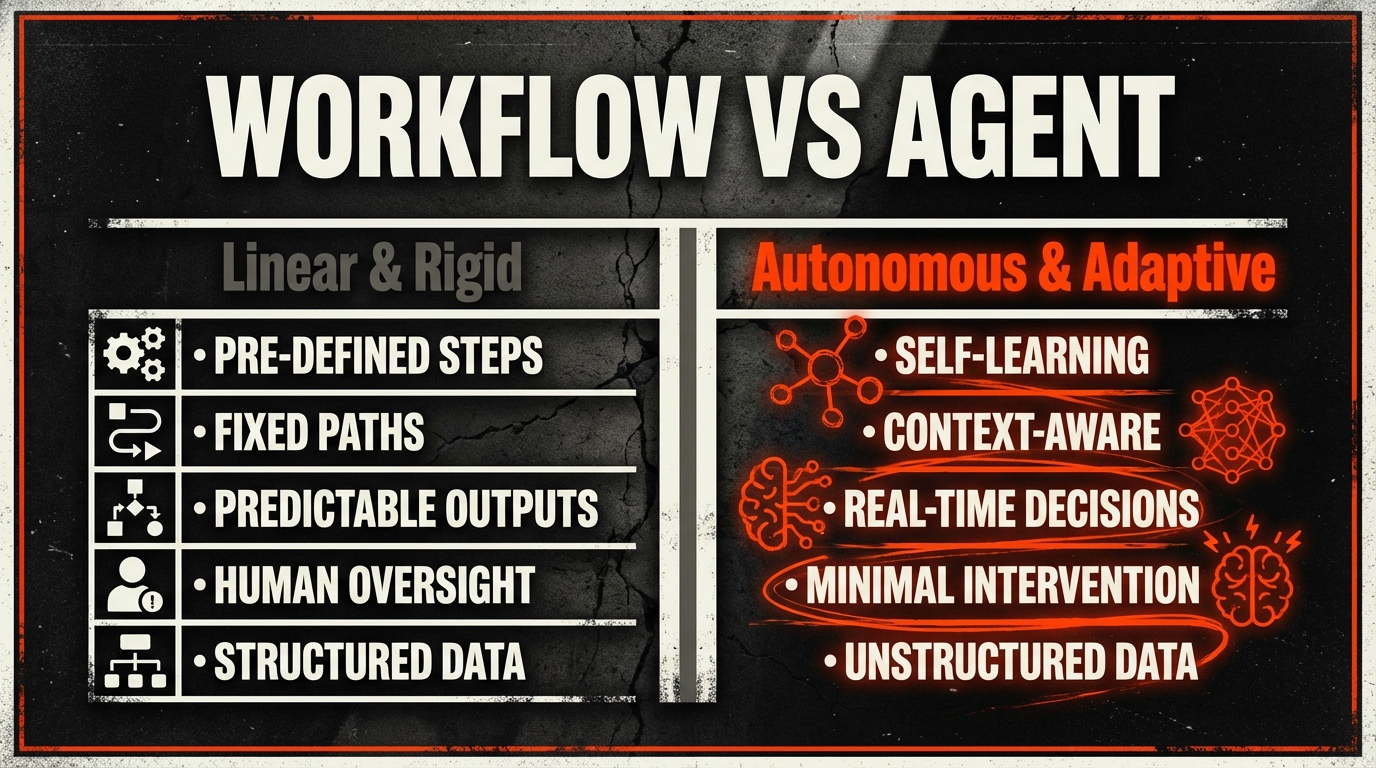
The Workflow Era is built on deterministic, linear logic: "If X happens, do Y, then Z." It is reliable, but it is inherently rigid. It scales only until complexity arrives, and then it becomes fragile. For years, marketing automation has relied on these linear, step-by-step instructions. Teams mapped out exact pathways for their data, hoping that every variable would behave predictably. This approach brought initial efficiency but ultimately created a hard ceiling on scalability.
The Agentic Era is built on autonomous, goal-oriented systems: "Here is the objective. Use the available tools, reason through edge cases, and produce a useful outcome." It scales differently because it is designed specifically for ambiguity. Today, the operational standard requires more than just moving data between platforms. It requires systems capable of reasoning, adapting, and executing complex strategies without constant human intervention.
This is not about replacing marketers. It is about building systems where human judgement is reserved for high-value decisions, and the operational grind is handled by autonomous components. By deploying AI Agents, marketing departments are transforming from manual execution hubs into precision-engineered strategy centres. These autonomous systems act as an exoskeleton for your marketing team: reducing busywork, decreasing oversight, and increasing throughput without lowering standards.
Understanding the Contenders: Deterministic Workflows vs. Autonomous Agents
To build a robust AI marketing architecture, you must first understand the fundamental mechanics of the tools at your disposal. The comparison between these two platforms is not a matter of one being universally superior to the other. Rather, it is about understanding their distinct roles within a broader technological ecosystem. The cleanest way to compare n8n and Relevance AI is to stop treating them as competing automation tools and start treating them as different layers of a marketing operating system.
n8n: The Deterministic Plumber (The Workflow Era)
n8n is a powerful, self-hosted or cloud-based workflow automation tool. It operates strictly on deterministic logic. n8n is excellent at what deterministic workflow engines are meant to do: execute a defined sequence of steps with absolute precision. It acts as the plumbing for your digital infrastructure.
When you build a workflow in n8n, you are creating a rigid pipeline. You must define every single step, every data transformation, and every potential error outcome. In practical marketing terms, n8n is a strong fit when you can clearly define the rules and the data is highly structured.
Examples of ideal n8n deployment include:
- • When a lead submits a form, create a record in the CRM and alert the right account owner.
- • When a Stripe payment succeeds, add the customer to a billing sheet and tag them in your email platform.
- • When a webinar ends, push attendance status to HubSpot and enqueue a follow-up sequence.
This is the Workflow Era at its best: predictable inputs, predictable outputs, and minimal interpretation. However, n8n lacks inherent reasoning capabilities. It is entirely dependent on the exact instructions provided by the user. If a lead enters a form and inputs their company name in the job title field, a deterministic workflow will blindly push that incorrect data into your CRM. It cannot look at the data, recognize the human error, and correct it. n8n requires absolute predictability to function correctly. In the dynamic environment of digital marketing, absolute predictability is rarely achievable.
Relevance AI: The Autonomous Workforce (The Agentic Era)
Relevance AI represents a paradigm shift from deterministic logic to autonomous, goal-oriented execution. Relevance AI is built around agentic systems: components that can interpret messy inputs, plan a route to an outcome, and use tools to get there. Instead of building rigid pipelines, Relevance AI allows you to construct a digital workforce.
With Relevance AI, you do not script every individual click or data transformation. Instead, you define the objective and the constraints. You might instruct an agent to research ten competitors, analyze their pricing models, identify gaps in their content strategy, and draft a positioning document based on those findings.
The agent then operates on "fuzzy logic" and LLM-native reasoning to:
- • Interpret the brief and the data available.
- • Break the complex work into manageable sub-tasks.
- • Execute those tasks using connected tools.
- • Evaluate its own output against the primary goal.
- • Flag uncertainty or escalate when human judgement is required.
This capability fundamentally changes the economics of marketing operations. You are no longer managing software integrations: you are managing digital employees. Relevance AI excels at tasks requiring contextual understanding, qualitative analysis, and dynamic problem-solving.
The "Spaghetti Problem" of Visual Workflows
A critical operational bottleneck in the Workflow Era is the visual degradation of complex systems. Platforms like n8n rely heavily on visual node-based builders. On day one, these visual canvases look clean, logical, and highly organized. You connect a trigger node to an action node, and the logic is immediately apparent. They promise clarity: drag-and-drop nodes, visible logic, and a diagram that explains itself.
Then a real marketing team uses it for a real marketing system.
What begins as a simple flow quickly becomes a web of complexity. As a business scales, its workflows must accommodate increasing variables. You begin adding:
- • Conditionals: routing leads differently based on geographic region, company size, or lead score.
- • Enrichment steps: finding company data, role data, and tech stack data from third-party APIs.
- • Filters and fallbacks: instructing the system to retry if an enrichment ping fails.
- • Approvals: sending high-budget queries to a director and sensitive content to legal.
- • Error handling: catching API timeouts, rate limits, and malformed fields.
Within months, that clean visual canvas devolves into an unmanageable tangle of intersecting lines and overlapping nodes. Industry professionals refer to this as the visual workflow spaghetti problem. When a process breaks within this tangled web, debugging becomes a monumental task. The pain is not theoretical. It shows up as "nobody wants to touch it" workflows that become fragile institutional knowledge. It causes slow iteration cycles because every change risks unintended consequences. The maintenance cost of the automation quickly begins to outweigh the operational benefits it was supposed to provide.
The Agentic Solution: LLM-Native Logic
The Agentic Era solves this problem by abstracting the complexity. Relevance AI utilizes text-based, LLM-native logic. Instead of connecting hundreds of visual nodes to account for every possible variable, you provide natural language instructions.
Agents operate with text-based policies, tool use, reasoning over unstructured inputs, and memory. In practice, this means you do not need forty visual nodes to handle forty variations of lead quality. You need one agent that can interpret lead context, score it against your criteria, and decide the next action autonomously. Because the logic is inherently conversational and goal-driven, there are no tangled visual webs to untangle. The system scales cleanly, allowing marketing teams to focus on strategy rather than untangling operational knots.
Why Agents Beat Workflows: The 70% Reduction in Manual Oversight
The true value of any automation system is measured by the amount of human capital it frees up. Traditional deterministic workflows often fail to deliver on their promises of absolute efficiency because they require continuous manual oversight. Workflows are not "set and forget." They are "set, monitor, patch, and babysit."
The oversight burden usually comes from structural limitations. Deterministic workflows break the moment they encounter unexpected data. Real-world marketing data does not comply with rigid rules: job titles are inconsistent, website copy is messy, intent signals are ambiguous, and form fields are free-text. When an API changes or a user inputs an irregular character string, the workflow halts. A human operator must then intervene, diagnose the error, adjust the rigid parameters, and restart the process. Over time, the flow becomes dominated by retries and exception handling.
Autonomous agents fundamentally alter this dynamic because they can reason through ambiguity. If an agent is tasked with scraping a website for pricing data and the website layout changes, the agent does not simply crash. It reads the new layout, uses contextual reasoning to locate the pricing information, and completes the task.
This resilience translates to a measurable reduction in management time. Transitioning from rigid pipelines to goal-oriented agents reduces manual oversight by 70%. This is not a theoretical metric or a marketing slogan: it is the practical outcome of shifting supervision from monitoring every step to reviewing only exceptions.
In an agentic marketing system, oversight reduces because agents handle variability without needing a bespoke branch for every case. Confidence scoring means the system escalates only when uncertain. Self-checking loops allow agents to verify outputs against criteria like tone and structure. Structured logging provides a readable narrative of what the system decided and why, instead of requiring someone to interpret a complex diagram.
When your automation handles its own exceptions, your human team is liberated from the manual grind of system maintenance. If your strategy is to scale output while maintaining high standards, you need an operating layer that can absorb complexity. That is precisely what a properly built Content Engine is designed to do: transform content operations from ad-hoc production into a repeatable system with governance. The agents manage the heavy lifting of research, drafting, and formatting, while the human experts refine the messaging and ensure brand alignment.
Case Study: Saving 50+ Hours Monthly with Agentic Systems
Theoretical advantages must be validated by real-world application. Agentic systems earn trust when they produce measurable operational outcomes, not just interesting demos. The shift from deterministic workflows to autonomous agents is already generating significant operational returns for forward-thinking marketing teams.
Consider the operational transition executed by VertoDigital. Like many growing agencies, their team was bogged down by the manual grind of SEO research, competitor analysis, and initial content drafting. They initially attempted to solve this bandwidth issue using traditional workflow automation. While this provided some relief for basic data entry, the rigid nature of the workflows meant that any complex research task still required heavy human involvement. The workflows could pull data, but they could not interpret it.
VertoDigital transitioned their operations to an agentic system, deploying autonomous agents to handle the qualitative aspects of their marketing operations. They tasked these agents with analyzing search intent, identifying keyword gaps, and structuring comprehensive content briefs based on real-time competitor data.
The results were immediate and highly measurable. By allowing the agents to handle the reasoning and data synthesis, VertoDigital saved over 50 hours monthly on marketing operations. This time was previously lost to repetitive, manual research and workflow debugging. The significance is not only the hours saved. It is what those hours represent: fewer repetitive tasks, fewer manual checks, and fewer stalled processes waiting for someone to drive the workflow.
In many agencies and in-house teams, time loss hides in places like manual content QA across tone and structure, copy variants, creative iteration cycles, and lead triage based on incomplete information. Agentic systems reduce the need for constant human stitching between steps. When examining workflow automation software comparisons in agency case studies, a clear pattern emerges. Organizations that move beyond basic plumbing and adopt autonomous, goal-oriented systems consistently report massive reductions in operational overhead. A practical takeaway for marketing leaders is this: once you cross a certain complexity threshold, the main cost is no longer execution. It is coordination. Agents reduce coordination cost by bundling sub-tasks into a goal-driven unit of work.
The Hybrid Architecture: Combining n8n and Relevance AI
A mature approach to AI marketing automation avoids absolute binaries. The most sophisticated operations do not force a choice between n8n and Relevance AI. Instead, they recognize that maximum efficiency is achieved through a hybrid architecture that leverages the specific strengths of both platforms. The mature answer is "right tool, right layer."
Pure software is easily commoditized. A custom-built, integrated system acts as a protective moat around your business operations. In a precision-engineered marketing stack, n8n and Relevance AI work together seamlessly because they solve entirely different problems.
Use n8n for Deterministic Data Sync (The Plumbing)
n8n serves as the central nervous system. It is well-suited when inputs are structured, logic can be expressed as explicit rules, and the success criteria is simply moving data correctly.
Examples of n8n in a hybrid marketing automation architecture:
- • Routing leads from landing pages into CRM fields with consistent mapping.
- • Syncing lifecycle stages across HubSpot, Google Sheets, and internal Slack channels.
- • Creating support tickets when payment fails or SLAs are breached.
- • Scheduled extraction of ad spend into a reporting dashboard.
This is infrastructure. It should be deterministic. You want predictability and zero latency for these tasks.
Use Relevance AI for Fuzzy Logic and Reasoning (The Brain)
Relevance AI serves as the cognitive layer of the operation. It is well-suited when inputs are unstructured, decisions require interpretation, and outputs require language, judgement, or synthesis. When n8n catches a complex data point that requires analysis, it passes that data to Relevance AI.
Examples of Relevance AI marketing use cases in the same stack:
- • Analyzing a lead's website and scoring intent against your ideal customer profile.
- • Synthesizing competitor messaging into positioning themes.
- • Classifying inbound requests by urgency and commercial potential.
- • Producing first-pass content drafts that adhere strictly to brand voice constraints.
A Reference Hybrid Flow
Here is what integrating n8n and Relevance AI looks like in practice for a sophisticated inbound lead qualification system:
- • n8n captures the form submission, validates required fields, writes the initial record to the CRM, and triggers the next stage.
- • n8n sends the prospect's company URL and inquiry text to a Relevance AI agent.
- • The Relevance AI agent autonomously browses the prospect's website, analyzes their business model, infers intent based on the inquiry text, and produces a lead score with a written rationale.
- • The agent drafts a hyper-personalized outreach email tailored to the prospect's specific pain points and aligned to your brand tone.
- • Relevance AI passes the drafted email and score back to n8n.
- • n8n routes the output: if the lead score is high, it notifies sales and attaches the draft for review; if medium, it adds the contact to a nurture segment.
This hybrid approach eliminates the spaghetti problem while maintaining absolute data integrity. It applies rigid rules where rules are necessary and deploys fuzzy logic where nuance is required. By integrating n8n and Relevance AI, businesses create a marketing ecosystem that is structurally sound, highly intelligent, and easy to govern.
Conclusion: Building Your Precision-Engineered Marketing Stack
The evolution of marketing technology is clear. The Workflow Era gave marketing teams leverage, but it also created a ceiling. The moment your automation needs to interpret intent, handle messy inputs, or produce nuanced outputs, deterministic workflows start accumulating complexity debt. The result is familiar: spaghetti diagrams, constant patching, and high manual oversight.
The Agentic Era is different. Agents are not just better workflows. They are a different unit of automation: autonomous, goal-oriented, and designed to operate inside ambiguity. When analyzing n8n vs Relevance AI for marketing, the conclusion is not about selecting a single software vendor. It is about upgrading your operational philosophy. Deterministic workflows will always have a place in managing basic data transfers, but they cannot scale to meet the demands of modern content generation, deep research, and dynamic campaign optimization.
Agents beat workflows because they reduce the manual oversight tax by 70%. They bypass the visual spaghetti problem, handle data anomalies with LLM-native reasoning, and allow your human team to focus on high-leverage strategic initiatives. Humans stop managing steps and start managing outcomes.
Stop struggling with fragile automation pipelines that break at the slightest variable change. It is time to build a robust, autonomous workforce that executes your marketing vision with precision. To map out a bespoke architecture tailored exactly to your business objectives, secure your Clarity Roadmap consultation today and transition your operations into the Agentic Era.

Frequently Asked Questions (FAQs)
What is the main difference between n8n and Relevance AI? n8n is a deterministic workflow engine designed for linear data routing and API connections. It requires exact, step-by-step instructions and cannot adapt to unexpected variables. Relevance AI is an autonomous agent builder that uses LLM-native logic. You assign Relevance AI a broader goal, and the agent determines the necessary steps to achieve it autonomously.
Can I use n8n and Relevance AI together for marketing? Yes, combining them creates a highly effective hybrid architecture. n8n excels at deterministic plumbing, such as syncing lead data instantly between web forms and a CRM. Relevance AI can be triggered by n8n to handle complex reasoning tasks, such as analyzing a lead's website and drafting personalized outreach copy.
What is the "spaghetti problem" in workflow automation? The spaghetti problem refers to the visual chaos that occurs when node-based workflow builders scale. As conditional logic, error routing, and multi-step processes are added, the visual canvas becomes a tangled web of intersecting lines. This makes the workflow incredibly difficult to debug, maintain, and scale effectively.
How do AI agents reduce manual marketing oversight? Traditional workflows break when they encounter unexpected data, requiring a human to manually fix the error and restart the process. AI agents use fuzzy logic and natural language processing to reason through anomalies. Because agents can adapt to changes autonomously, they reduce the need for constant human supervision by up to 70%.
Is Relevance AI better than n8n for content creation? Yes. n8n is not designed for content generation: it is designed for data transfer. Relevance AI is natively built on Large Language Models, making it highly capable of researching topics, analyzing competitor content gaps, and drafting sophisticated marketing copy based on custom brand voice guidelines and strategic goals.
Want to build marketing systems like this?
Book a Discovery CallMore Insights
The Ultimate Guide to Retargeting AI Ad Creative That Converts
Discover how retargeting AI ad creative scales personalization, combats fatigue, and drives incremental lift with predictive audience segmentation and server-side tracking.
Read more →
How to Measure the ROI of AI Marketing Automation: Metrics, Frameworks, and Dashboards
Learn how to measure the ROI AI marketing automation provides. Discover the frameworks, metrics, and dashboards needed to scale revenue and save time.
Read more →
How to Reduce Your Cost Per Acquisition by 40% with AI-Powered Ad Creative
Discover how to reduce CPA with AI ad creative strategies. Shift to creative-led growth, accelerate platform learning, and cut acquisition costs by up to 40%.
Read more →