The Complete LinkedIn Outreach Automation Playbook for B2B in 2026
25 March 2026 • By Jakub Cambor, Founder of AI for Marketing | Top 1% Upwork Expert Vetted Talent
Last updated: 25 March 2026
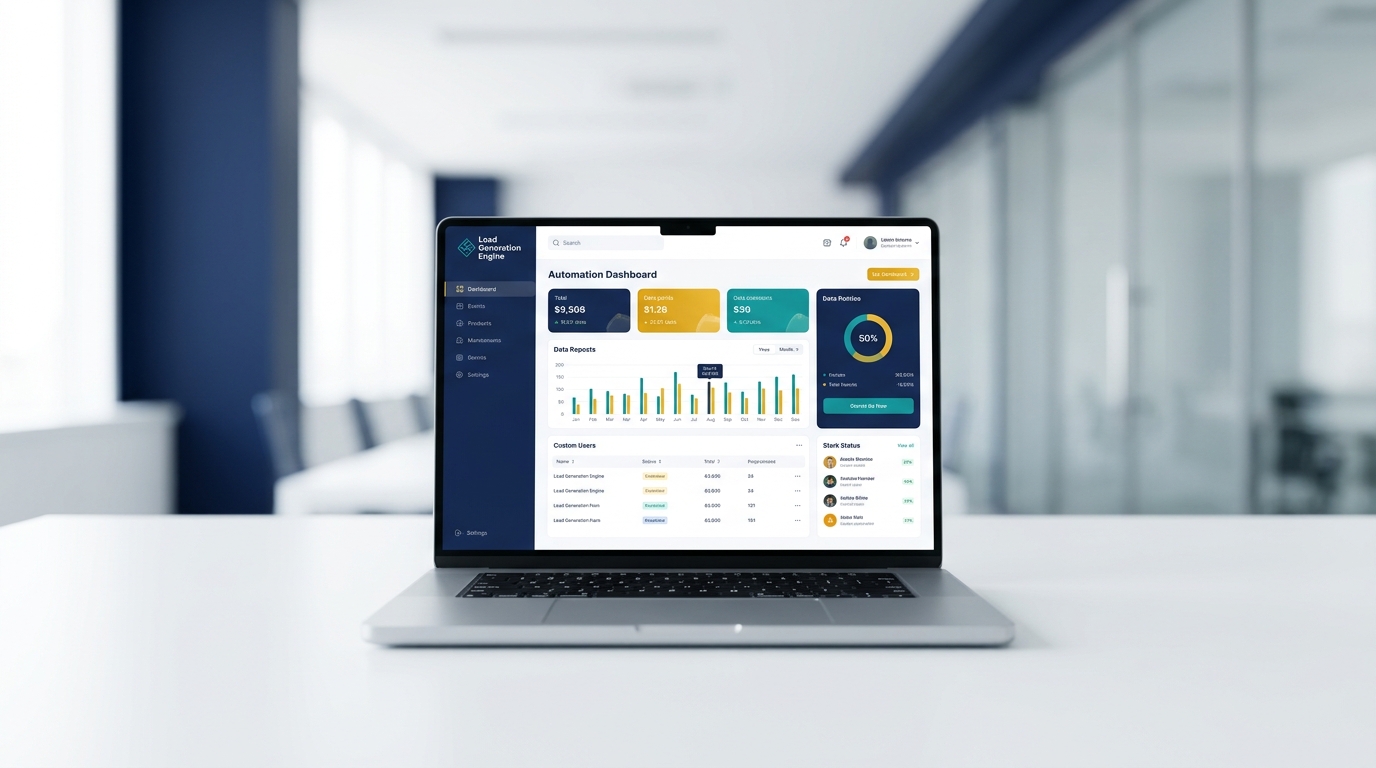
Business-to-business founders and marketing directors are currently facing a specific type of operational paralysis: implementation fatigue. The pressure to adopt artificial intelligence is immense, yet the mechanics of building reliable, automated revenue systems remain frustratingly complex. You know the gap between companies leveraging AI and those relying on manual processes is widening daily. However, the fear of damaging your brand reputation with robotic, poorly executed campaigns keeps your best strategies locked in the planning phase.
This operational bottleneck is exactly why mastering LinkedIn outreach automation B2B requires a fundamental shift in strategy for 2026. The era of high-volume, generic messaging is officially dead. Buyers are sophisticated, platform algorithms are ruthless, and generic ChatGPT templates are instantly recognizable.
Success on LinkedIn today demands precision-engineered systems. It requires building an infrastructure that identifies buying signals in real-time and responds with contextual relevance. This playbook strips away the hype to provide a foundational blueprint for modern outreach. We will break down the exact connection strategies, strict messaging rules, compliance limits, and multi-channel integrations required to turn a static LinkedIn profile into an automated, predictable pipeline asset.
The 2026 Landscape: From 'Spray and Pray' to Intent-Based Systems
To understand the current state of B2B lead generation 2026, we must analyze the failures of the past three years. Between 2023 and 2024, the market was flooded with low-cost software allowing users to scrape thousands of profiles and send identical pitches indiscriminately. This volume-heavy methodology created an unprecedented level of buyer fatigue. Decision-makers abandoned their inboxes, and LinkedIn responded by drastically tightening platform restrictions and algorithm visibility.
The landscape in 2026 is entirely different. Success is no longer measured by the sheer volume of messages sent, but by the precise timing and relevance of the outreach. We have transitioned from volume-based spam to intent-based orchestration.
The data supporting this shift is definitive. Automated, intent-based campaigns are currently achieving baseline reply rates of 10-20%. Top performers who rigorously segment their audiences and trigger messages based on specific behavioral signals are consistently hitting reply rates of 30% or higher. These metrics are impossible to achieve with static, unsegmented lists.
This transformation requires marketers to adopt the new B2B outreach playbook which prioritizes behavioral triggers over basic demographic targeting. Instead of messaging a prospect simply because they hold the title of "Marketing Director," modern systems wait for that director to exhibit a specific behavior: commenting on an industry post, viewing your profile, or attending a relevant virtual event.
By tying automation to these specific actions, the outreach shifts from a cold interruption to a timely, contextual conversation. The technology handles the complex task of monitoring thousands of prospects for these signals, allowing your sales team to step in only when a genuine conversation is ready to occur.
The "Bionic Marketer" Approach to LinkedIn Automation
At the core of sustainable growth in 2026 is a philosophy we call the "Bionic Marketer." This framework dictates that artificial intelligence and automation should augment human creativity, never replace it.
The market is saturated with vendors promising that their software will put your entire sales process on autopilot, allowing you to fire your team and watch the leads roll in. This is a dangerous, short-sighted narrative. Pure automation without human oversight inevitably leads to commoditized, tone-deaf interactions that damage brand equity.
The Bionic Marketer approach treats AI as an exoskeleton. It handles the manual, repetitive heavy lifting: scraping data, tracking intent signals across time zones, managing connection request limits, and executing the initial touchpoints. This frees the human professional to focus entirely on high-leverage activities: building relationships, handling complex objections, and closing deals.
We do not believe in selling generic software subscriptions. We focus on building custom infrastructure tailored to your specific sales cycle. When you implement a bespoke Lead Generation Engine, you are not just buying a tool. You are integrating a precision-engineered system that understands the nuance of your ideal customer profile, respects platform compliance, and operates seamlessly in the background. It is the synergy of ruthless AI efficiency and empathetic human strategy that creates a true competitive moat.
Decoding Intent Signals: The Foundation of High-Converting Campaigns
An intent-based system is only as effective as its ability to categorize and react to prospect behavior. Treating all prospects equally is a critical error. To achieve the 30%+ reply rates seen by top performers, you must segment your intent-based LinkedIn campaigns based on three distinct tiers of intent signals.
Tier 1: High Intent Signals
High intent signals indicate active interest and require immediate, personalized workflow routing. These actions include a prospect commenting directly on your thought leadership posts, repeatedly viewing your profile, or engaging heavily with your company page content.
When the automation software detects a high intent signal, it should trigger a fast-tracked sequence. The messaging here can be direct and clearly reference the specific action the prospect took. Because they have already initiated a micro-interaction with your brand, the friction for a conversation is exceptionally low.
What automation should do here:
- • Detect the event immediately.
- • Enrich the profile with role, company size, and tech stack clues.
- • Generate a draft message that references the context without over-revealing your tracking capabilities.
Tier 2: Medium Intent Signals
Medium intent signals suggest passive interest or strong contextual alignment. This includes prospects liking your posts, interacting with content from your direct competitors, sharing mutual 2nd-degree connections within a niche industry, or RSVPing to the same LinkedIn audio events.
Workflows triggered by medium intent should focus on peer-to-peer networking rather than immediate pitching. The goal of the automation sequence here is to start a dialogue about the shared context: the event they attended or the industry trend they recently liked.
What automation should do here:
- • Batch and rotate audience segments to avoid repetition fatigue.
- • Vary copy blocks to avoid fingerprint patterns.
- • Trigger a light-touch follow-up cadence that stops immediately once they respond.
Tier 3: Low Intent Signals
Low intent signals rely solely on an Ideal Customer Profile match. The prospect fits your target criteria, for example, a "SaaS Founder in London with 50-200 employees." However, they have not interacted with your brand or demonstrated active buying behavior.
Automated campaigns targeting low intent prospects must be highly educational and strictly value-driven. These sequences require a longer time horizon, slowly dripping insights and un-gated resources to build familiarity over weeks or months, waiting for the prospect to eventually trigger a medium or high intent signal.
Messaging Rules for 2026: Selling the Problem, Not the Solution
The technical setup of your campaign is irrelevant if the copywriting fails to resonate. Decision-makers can spot an automated message within the first three words. To bypass this mental spam filter, your LinkedIn outreach automation sequences must adhere to four strict messaging rules.
Rule 1: Eliminate Formal Greetings
Starting a message with "Dear [First Name]" or "Hi [First Name], I hope this finds you well" instantly flags the communication as a mass broadcast. Modern B2B communication on social platforms is asynchronous and conversational. Open your messages naturally. Drop the pleasantries and get straight to the contextual trigger. A simple "Saw your comment on the recent SEO algorithm update, [Name]" is significantly more effective than a formal letter format.
Rule 2: The 500-Character Limit
Attention spans are fractured, and the majority of LinkedIn messages are read on mobile devices. If your message requires the prospect to scroll, they will simply delete it. Keep your initial touchpoints under 500 characters. Every word must fight for its place. State the context, present the observation, and ask a low-friction question.
Rule 3: The 80% Rule of Context
Automation allows you to track incredibly specific data points, but you must avoid sounding like spyware. The 80% rule dictates that you should only reveal about 80% of what you know about the prospect's behavior. If your system flags that they viewed your pricing page, looked at your profile twice, and commented on a competitor's post, do not list all three items. Frame the outreach naturally: "Noticed you were exploring some new marketing infrastructure recently." Keep the technological tracking invisible to the end user.
Rule 4: Sell the Problem, Not the Solution
The most common mistake in automated sequencing is pitching the product in the first message. Your prospects do not care about your software features or your service deliverables. They care about their own operational bottlenecks. Frame your messaging around the pain points associated with their industry. Instead of saying, "We offer custom AI workflows," ask, "Are you finding that your team is spending more time managing API keys than actually launching campaigns?" Validate their struggle first; present your solution later.
Post-Accept Message Sequences: A Field-Tested Blueprint
If you want a clean operational model, build your B2B sales automation motion around triggers and states. Here are the sequence tracks we see hold up consistently in 2026.
Track A: High Intent Sequence (2 to 3 touches)
Message 1 (Day 0): "Thanks for connecting, [Name]. Your take on [topic] was solid. Quick one: when teams try to fix [problem], is it usually [constraint A] or [constraint B] that slows you down?"
Message 2 (Day 2, only if no reply): "If helpful, I can share a simple breakdown of how we see teams structure [process] without spamming inboxes. Worth sending?"
Message 3 (Day 5): "No worries if timing is off. Are you focused on [problem] this quarter, or is it more of a later-year project?"
Why it works: It qualifies without pushing a call, and it respects timing.
Track B: Medium Intent Sequence (3 to 4 touches)
Message 1 (Day 0): "Thanks for connecting. Curious: are you running outbound mostly via email, LinkedIn, or a mix?"
Message 2 (Day 3): "Reason I ask: a lot of teams are seeing reply rates hold steady, but attribution and handoff to CRM is the part that breaks. Is that familiar?"
Message 3 (Day 7): "If you want, I can share a quick checklist for keeping LinkedIn outreach compliant while still tracking intent."
Why it works: It establishes competence and creates permission for future engagement.
Track C: Low Intent Sequence (2 touches, then stop)
Message 1 (Day 0): "Thanks for connecting. What does your pipeline motion look like right now: inbound-led, outbound-led, or partner-led?"
Message 2 (Day 6): "Got it. If you ever want benchmarks on what is working for intent-based LinkedIn in 2026, happy to share what we are seeing."
Why it works: Minimal pressure, leaves a clean brand impression.
Profile Optimization: The Conversion Layer Most Teams Ignore
Automation increases the number of people who look at your profile. If your profile is unclear, outreach performance will look worse than it should, even with great targeting. Think of your profile as your conversion layer. It has one job: help a relevant buyer quickly confirm who you help, what problem you solve, and what a sensible next step looks like.
The Headline: Clarity Beats Cleverness
Avoid vague labels that force the reader to interpret. A strong B2B headline format is direct: "I help [ICP] achieve [outcome] without [pain]" or "[Role] | [ICP] | Solving [problem area]".
The About Section: Build Trust, Not a Biography
Structure this section to highlight the problem you see in the market, the cost of that problem regarding time or margin, your specific approach, and a low-friction call to action detailing what they should message you about.
Social Proof: Signal, Do Not Posture
A few strong recommendations beat dozens of shallow ones. Comments and thoughtful posts create real operator credibility. Consistency beats virality for B2B trust. The goal is to make your direct message claim believable when they check your profile.
Connection Strategy: Building a System, Not a List
Connection requests are not a volume game anymore. They are a filtering mechanism. A good connection strategy protects relevance so your feed, your network, and your message deliverability stay healthy.
Use Negative Targeting
Most teams never do this, and it hurts performance. Exclude people outside your service geography if you are regional, students and job seekers if you are selling B2B services, and direct competitors. Better targeting improves the acceptance rate, which improves everything downstream.
Build a "Do Not Automate" List
Your best prospects often deserve human-first outreach. This includes ideal logos, warm referrals, people actively engaging with you, and strategic partners. Automation should support these conversations by drafting, logging, and reminding, but the outreach itself should be bespoke.
Compliance & Safety: The 4-Week Warmup and Limit Guidelines
The primary fear for founders adopting new outreach technology is the risk of having their LinkedIn account restricted or permanently banned. This is a valid concern. LinkedIn's security algorithms are highly aggressive against sudden spikes in activity that mimic bot behavior. Protecting your digital assets requires strict adherence to LinkedIn message limits and a disciplined warmup phase.
The 2026 Safety Limits
Account safety is dictated by the type of subscription you hold and your historical activity. In 2026, the absolute ceiling for connection requests sits between 100 and 400 per week. Accounts with LinkedIn Premium or Sales Navigator can safely operate at the higher end of this spectrum, provided their connection acceptance rate remains healthy.
Message limits are equally strict. Sending more than 150 direct messages per day is a massive red flag to platform monitors. Precision engineering means you should never need to hit these maximum limits anyway. If your targeting is accurate, 50 highly contextual messages will generate more revenue than 150 generic ones.
The Mandatory 4-Week Warmup
You cannot connect a new automation tool and immediately send 100 requests on day one. A comprehensive LinkedIn automation guide mandates a 4-week warmup schedule to gradually build trust with the platform's algorithm.
- • Week 1: Set your software to send a maximum of 5 to 10 connection requests per day. Focus entirely on 2nd-degree connections with mutual contacts to ensure a high acceptance rate.
- • Week 2: Gradually increase the volume to 15 to 20 requests per day. Begin introducing low-volume direct messaging to existing 1st-degree connections.
- • Week 3: Scale to 25 to 30 requests per day. Monitor your acceptance rates closely. If the rate drops below 15%, pause the volume increase and refine your targeting.
- • Week 4: Safely scale up to your target operational volume, staying strictly under the 400 per week maximum.
This simulated human behavior ensures your account remains secure while building the foundation for long-term automated lead generation.
Multi-Channel Integration: Connecting LinkedIn to Your CRM Ecosystem
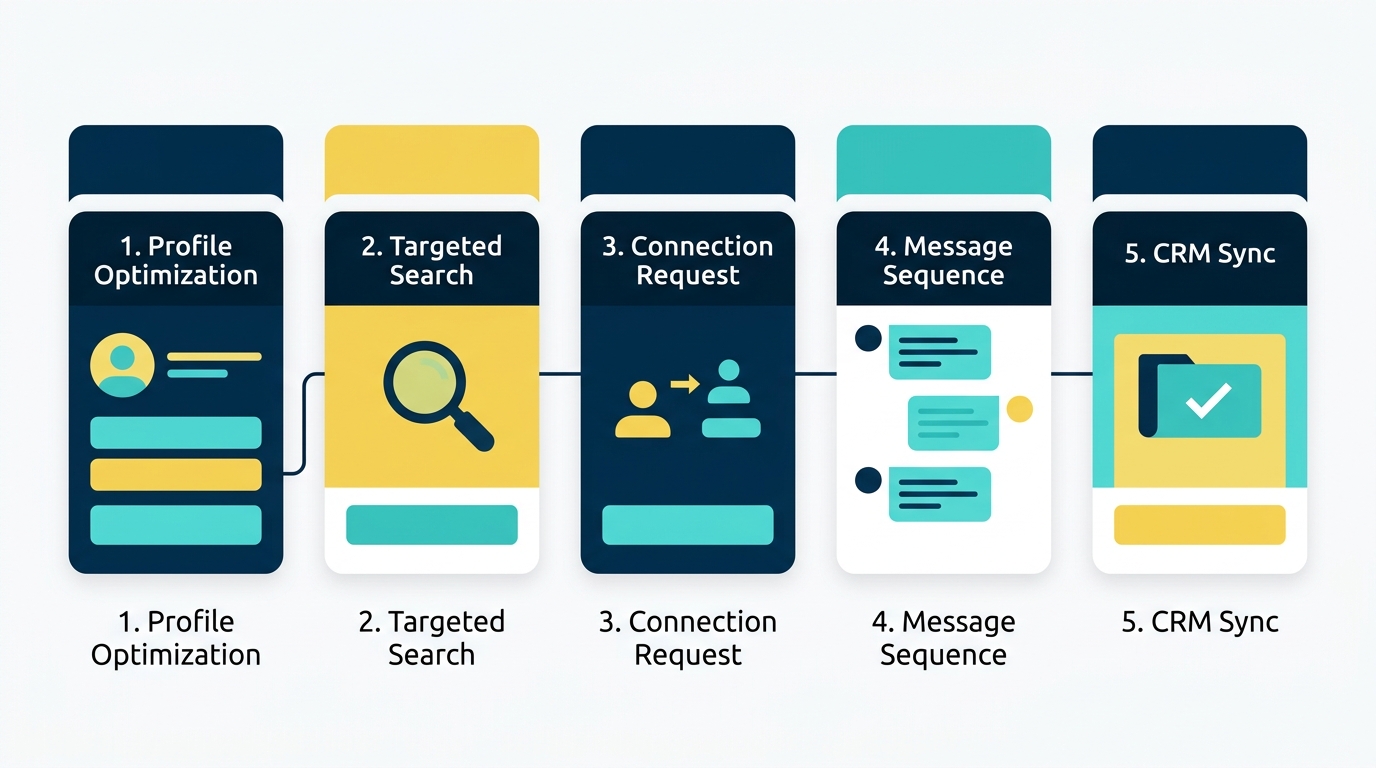
Operating a LinkedIn strategy in isolation is a critical architectural flaw. A siloed workflow creates three problems: conversations get lost in direct messages, sales and marketing cannot measure what is working, and follow-up becomes inconsistent. In 2026, CRM integration LinkedIn workflows are a mandatory requirement for high-performance marketing.
When a prospect accepts a connection request but fails to reply to a LinkedIn message, the system should automatically map that data and trigger an email sequence. If they reply positively on LinkedIn, the automation must immediately sync that interaction to HubSpot or Salesforce, update the deal stage, and halt all further automated outreach to prevent overlapping messages from your sales team.
What CRM Sync Should Actually Mean
A proper sync is not exporting a CSV file once a month. It is event-based logging:
- • New connection accepted: create or update contact record.
- • Reply received: log conversation, assign owner, set a follow-up task.
- • Meeting booked: update lifecycle stage, capture source as LinkedIn.
- • No response after sequence: mark as nurtured, suppress for a set number of days.
This level of multi-channel synchronization removes data silos. It ensures your sales team has a unified view of every prospect's interaction history across social media and email. However, building this infrastructure often introduces a new problem for businesses: software fragmentation. Managing separate subscriptions for LinkedIn scrapers, email warmups, data enrichment APIs, and CRM connectors creates massive administrative overhead and technical debt.
This is where working with expert partners becomes invaluable. By partnering with AI for Marketing, businesses eliminate the headache of managing multiple API keys and fragmented billing. We consolidate the technology stack, providing a unified ecosystem where LinkedIn signals seamlessly dictate CRM actions. You pay for the comprehensive system and the results it generates, completely avoiding the metered taxi anxiety of managing individual software tokens and integration breakages.
Frequently Asked Questions (FAQ)
Is LinkedIn outreach automation legal in 2026? LinkedIn outreach automation is not illegal, but it can violate LinkedIn's terms of service depending on how tools interact with the platform. In practice, most teams focus on compliant behavior patterns, conservative limits, and human oversight to reduce risk and maintain account safety.
How many connection requests can I safely send per day on LinkedIn? A safe 2026 range is typically 100 to 400 connection requests per week depending on account type and trust level, which translates to roughly 15 to 60 per day. New or cold accounts should start at 5 to 10 per day and ramp gradually over a four-week period.
What is the difference between intent-based outreach and traditional cold messaging? Traditional cold messaging treats every prospect the same and relies on volume-based list scraping. Intent-based outreach prioritizes prospects using behavioral engagement signals like comments or profile views, adapting timing and messaging to improve reply quality and reduce spam risk.
Can I connect my LinkedIn automation tool directly to HubSpot or Salesforce? Yes, modern automation infrastructure allows for bi-directional syncing with major CRMs like HubSpot and Salesforce. This integration ensures that connection acceptances, replies, and profile data automatically update your deal stages and trigger cross-channel email sequences.
How long does it take to warm up a LinkedIn account for automation? Plan for a mandatory 4-week warmup schedule. Start with 5 to 10 requests per day and scale weekly while keeping message volume and follow-ups conservative to mimic normal human networking behavior and protect your account reputation.
Want to build marketing systems like this?
Book a Discovery CallRelated Articles

AI Email Marketing: Beyond Drip Sequences
AI email marketing moves beyond basic rule-based automations to intelligent systems that personalise content, optimise send times, generate copy, and adapt sequences based on recipient behaviour in real time.
Read more →
AI Marketing Strategy Framework (2026)
An AI marketing strategy is a structured plan for integrating artificial intelligence into your marketing operations. This framework covers the maturity audit, prioritisation, the build sequence, KPIs, and common strategic mistakes.
Read more →
AI Content Creation: Scale Without Losing Quality
AI content creation is the use of artificial intelligence to research, draft, edit, and optimise marketing content. Learn how to scale production with quality gates, brand DNA frameworks, and workflows that keep the human where it matters.
Read more →