The Ultimate Guide to Custom AI Marketing Solutions: Moving Beyond Generic ChatGPT Wrappers

Most leadership teams are now past the initial phase of questioning whether artificial intelligence can help their marketing efforts. The real question is strictly operational: why did the pilot program look promising in week one, only to quietly stall by week six?
That familiar pattern is exactly why Custom AI Marketing Solutions have become a board-level conversation. The frustration does not stem from the technology itself, but from the fact that generic tools consistently produce generic outcomes. They generate high volumes of words, but they do not generate strategy. They create the feeling of progress, but these outputs rarely survive contact with brand standards, compliance requirements, legacy systems, and the daily reality of shipping campaigns.
The businesses actually winning with artificial intelligence are not using it to replace their marketing departments. They are building an exoskeleton for their teams. They are engineering predictable, integrated systems that augment human judgement with machine speed. They are turning marketing from a series of isolated tasks into a highly reliable, governed engine. Professional marketing requires professional-grade infrastructure, and achieving actual return on investment requires moving past basic chat interfaces.
The "Mediocrity Tax": Why 95% of AI Marketing Pilots Fail
A hard truth from the field is that the vast majority of corporate AI pilots fail. Recent industry data points to a staggering 95% failure rate for these initiatives. When a pilot fails, the post-mortem analysis rarely blames the underlying language model. The failure is almost always a result of poor implementation quality and a lack of deep integration into the company's existing workflows.
When a business relies on a public language model to write blog posts or social media updates without proper grounding, it incurs what is known as the "Mediocrity Tax."
The Mediocrity Tax is the hidden cost of publishing content that is technically correct but commercially weak. Businesses believe they are gaining efficiency by generating hundreds of assets at zero marginal cost. In reality, they are paying a heavy price across four specific areas:
- • Content that fails to rank: Generic outputs are not differentiated. They are not based on proprietary expertise, and they do not align with search intent beyond the most obvious, highly competitive keywords.
- • Content that fails to convert: Buyers use specific credibility signals to de-risk their purchasing decisions. Generic text lacks the evidence, case studies, clear positioning, and consistent point of view required to drive a conversion.
- • Brand dilution: When tone becomes inconsistent across different channels and different generic prompts, it creates a subtle trust decay over time. High-level buyers instantly recognize robotic phrasing, which signals a lack of original thought.
- • Operational drag: Teams waste countless hours rewriting poor outputs, debating quality standards, and managing approvals without a repeatable system. The supposed time savings evaporate during the editing phase.
The true cost of a failed pilot is not the monthly software subscription. The cost is the opportunity loss of publishing content that does not compound in value. Scale without quality is a massive liability. Flooding your digital channels with noise actively harms your performance because search engines and human audiences quickly learn to ignore your brand.
Overcoming this failure rate requires a fundamental shift in perspective. You cannot automate expertise you have not codified. Forward-thinking organizations solve this by investing in a dedicated content engine designed for precision. This system-first approach ensures that every piece of output aligns with brand guidelines, SEO intent, and commercial objectives.
The Illusion of Progress: API Wrappers vs. Custom AI Engines
To understand why generic tools fail businesses so predictably, decision-makers must look at the technical architecture of the current software market. The recent boom has created a flood of new marketing software, but a significant portion of these platforms share the exact same underlying infrastructure.
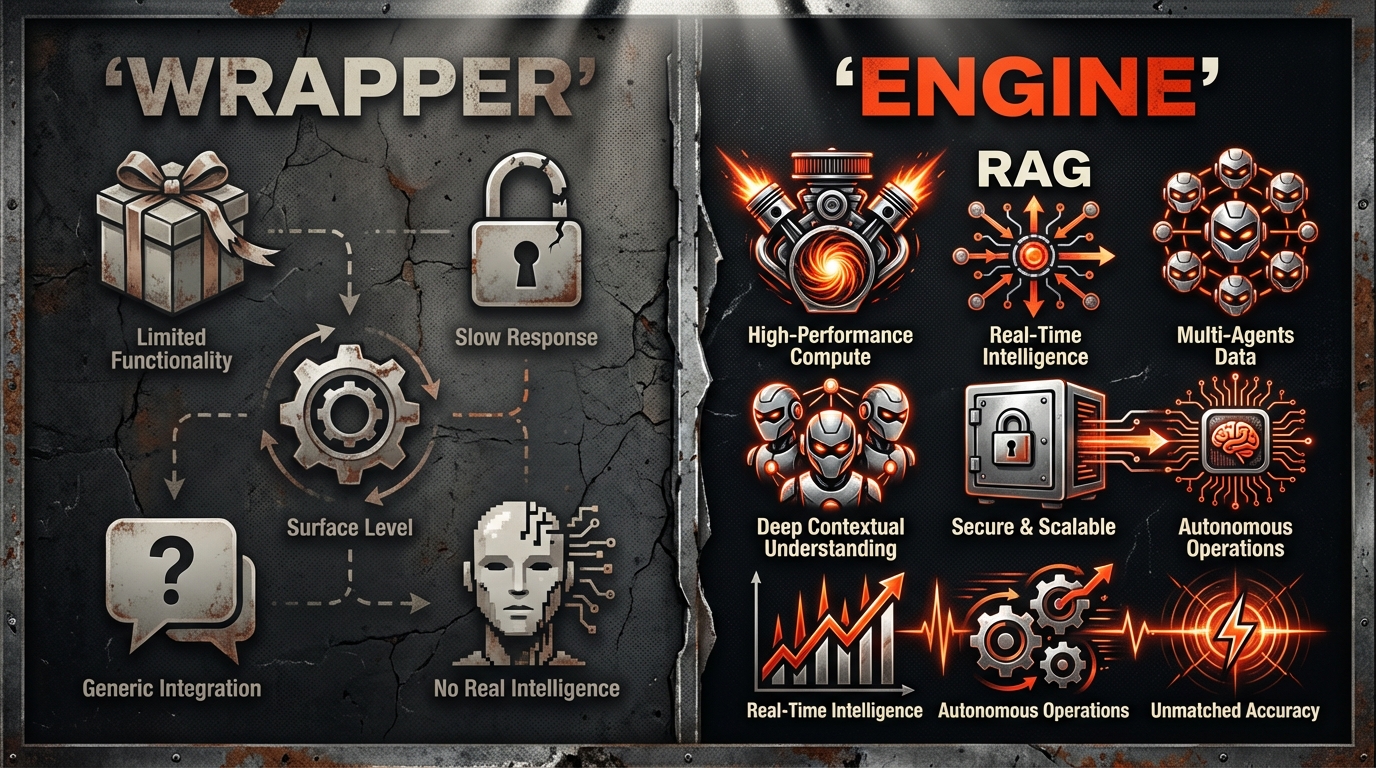
The distinction between consumer-grade tools and enterprise-grade infrastructure is the defining battleground for modern marketing operations. Most off-the-shelf marketing tools are simply wrappers.
A wrapper is a thin user interface layer sitting on top of a foundational large language model API. It might offer a visually appealing dashboard, a few prompt templates, and basic tone settings. However, under the hood, it possesses no proprietary logic. It has no long-term memory of your business. It yields the exact same results as a standard chat interface because it is fundamentally just a reskinned version of that exact same system. This architectural reality explains why most AI startups are just glorified API wrappers built to capitalize on market trends rather than solve complex operational problems.
Wrappers fail businesses because they do not know your internal truth. They do not know your past successful case studies, your compliance constraints, your product nuances, or your specific sales objections. Furthermore, they do not integrate into your real marketing operations, such as your approval workflows, your content management systems, or your analytics platforms.
A custom AI engine operates on a completely different paradigm. An engine is an integrated system that uses artificial intelligence as just one component of a larger architecture. It includes proprietary logic that reflects how your business actually markets and sells.
Practically, a custom engine is built around specific pillars:
- • Context: Your proprietary knowledge, brand voice, and commercial truth.
- • Process: Repeatable workflows that match how your team actually approves and ships work.
- • Control: Strict guardrails, permissions, compliance checks, and quality gates.
- • Integration: Direct connections to your CMS, CRM, analytics, and project management tools.
- • Iteration: Structured feedback loops that make the system measurably better with every use.
This is the key executive-level difference. A wrapper generates a generic answer. Custom AI Marketing Solutions produce an output that is ready to publish or ready to act upon, reliably and within your specific business constraints.
The Anatomy of a Professional-Grade Custom AI Marketing Solution
Understanding the distinction between a wrapper and a true engine requires examining the specific technical components that make custom systems so powerful. A professional-grade system typically consists of a knowledge layer, an orchestration layer, and an action layer.
Two specific capabilities sit at the center of this architecture: Retrieval-Augmented Generation and multi-agent orchestration.
Retrieval-Augmented Generation (RAG) for Business Context
Leadership teams consistently worry about two major risks when deploying language models: hallucinations (confidently wrong answers) and genericness (confidently bland answers). Both issues occur because foundational models are trained on the public internet. They know a little bit about everything, but they know absolutely nothing about your specific company.
Retrieval-Augmented Generation (RAG) directly addresses both risks by changing how the model responds. Instead of relying on general training data, a RAG framework forces the system to retrieve relevant information from your approved, private knowledge base and injects it into the prompt before generating an answer.
In business terms, RAG is the mechanism that stops a system from writing a generic post about "supply chain optimization" and forces it to write a post about "our specific approach to supply chain optimization, using our terminology, and referencing our approved case study outcomes."
A well-built RAG layer includes curated sources like product documentation, sales collateral, brand guidelines, and standard operating procedures. It utilizes strict access controls to ensure sensitive knowledge is only available to authorized workflows. Most importantly, it provides citation and traceability. Reviewers can see exactly which internal document the system used to make a claim, which drastically reduces approval friction.
The process of personalizing AI for a business transforms a basic text generator into a highly specialized subject matter expert. If your marketing truth is not accessible to the system at runtime, you are asking it to guess. RAG ensures that your SEO content is genuinely differentiated, your multi-author tone remains consistent, and your compliance risks are minimized.
Multi-Agent Orchestration for Complex Workflows
Single-prompt chat interfaces are fine for simple, isolated tasks. However, enterprise marketing is rarely a simple task. Real marketing outputs are the result of multiple specialized activities, including competitive research, audience intent mapping, brand positioning, SEO structuring, and channel formatting.
A multi-agent system breaks complex work into specialized roles, then orchestrates those roles in a controlled sequence. Instead of interacting with one general-purpose chatbot, you deploy a team of highly specialized agents that collaborate under a defined workflow.
A typical multi-agent marketing chain operates in a strict sequence:
- • Research Agent: Pulls search engine result patterns, competitor angles, and topic gaps.
- • Strategy Agent: Maps the research to the correct funnel stage and brand positioning.
- • Writer Agent: Drafts the content in the house style, utilizing the RAG context database.
- • SEO Editor Agent: Enforces structural best practices, internal linking, and intent alignment.
- • Compliance Agent: Flags risky statements and requires citations for specific claims.
The key advantage here is the clear separation of responsibilities and consistent quality gates. This is the foundation of multi-agent systems functioning as a complete marketing department in a box.
Furthermore, these systems utilize "Function Calling." The moment a system can take actions, it stops being a writing tool and becomes operational infrastructure. Function calling allows an agent to trigger defined actions in other software safely. An agent can create a draft page in your CMS, generate structured metadata fields, update CRM notes, or produce tagged campaign links. From a governance standpoint, function calling is powerful because every action is permissioned, logged, and constrained by the orchestration layer.
Building a Competitive Moat with the AI Data Flywheel
One of the primary reasons generic tools disappoint business leaders is that they do not get meaningfully better for the specific organization using them. They may improve as a general product, but they do not learn your specific preferences.
Custom engines create a compounding advantage through a data flywheel. The system produces work, humans refine that work, the refinements are captured as structured feedback, and the system uses that feedback to improve all future outputs.
The most resilient AI marketing operations treat human workers as the ultimate standard-setters. This is the "Bionic Marketer" model: augmentation that protects quality and brand equity while exponentially increasing throughput. Human-in-the-loop is not a compromise; it is the core strategy.
Humans define the positioning, voice, and acceptable claims. The system accelerates the research, drafting, and formatting. Humans then approve and refine the judgement-heavy decisions. The system learns the exact delta between a raw draft and a publishable asset.
If an editor consistently changes a specific phrase, or if the sales team flags an objection that needs better handling, that feedback is routed back into the RAG context and the agent instructions. Over time, your team stops starting from a blank page, and they stop fixing the same issues repeatedly.
This bespoke intelligence becomes an uncopyable competitive moat. Competitors can buy access to the same foundational models, but they cannot copy your internal knowledge base, your workflow logic, your accumulated feedback data, or your operational muscle memory. Moving your operations beyond GPT wrappers ensures that your technological advantage accrues internally rather than being shared with the broader market.
Platform Risk: Why You Must Own Your Orchestration Layer
Business leaders must carefully consider the operational risks associated with relying on third-party software for critical marketing production. When your entire content pipeline depends on a generic vendor's interpretation of how workflows should operate, you are building your business on rented land. That is tolerable for early experimentation, but it is highly dangerous for core operations.
Generic platforms introduce severe platform risks:
- • Pricing drift and metered taxi anxiety: API usage costs fluctuate, and vendor pricing tiers frequently change. If your cost base is unpredictable, your marketing output becomes harder to forecast. Owning the orchestration layer allows you to route tasks to the most cost-effective model for the job and consolidate your compute costs into a predictable operational expense.
- • Model quality drift: Foundational models change constantly. Sometimes outputs subtly degrade for your specific use case. If you are locked into one provider through a wrapper tool, you inherit that degradation risk. If you own the orchestration layer, you can seamlessly swap models (for example, moving a workflow from OpenAI to Anthropic) without rewriting your entire marketing process. Your team experiences zero disruption.
- • Vendor instability: The software market is incredibly crowded. Many vendors will pivot away from your needs or cease operations entirely. If your workflows and institutional knowledge live inside someone else's product, your switching costs are massive. Owning your orchestration and knowledge layer reduces lock-in because your logic and data remain entirely portable.
- • Governance and data control: Senior teams care deeply about where proprietary data goes, who can access it, and how outputs are audited. A custom system enforces role-based access controls, data retention policies, and strict audit logs. This transitions the technology from a "shadow IT" risk into governed, secure infrastructure.
Transitioning from Generic Tools to Precision-Engineered Systems
The era of treating this technology as a novelty is over. The transition requires an incremental shift from isolated experimentation to engineered, governed workflows. A practical roadmap for enterprise adoption follows a strict sequence.
First, identify where generic tools are already costing you time. Look for busy work with high standards, such as SEO content briefs that take hours to produce, or sales enablement assets that go stale quickly. These are perfect candidates because the work is repeatable, but the quality bar is non-negotiable.
Second, build your marketing truth layer. Before you orchestrate any agents, you need context. This means digitizing your brand voice guidelines, product messaging, approved case studies, compliance rules, and objection handling frameworks. This becomes your marketing operating system.
Third, orchestrate one workflow end-to-end. Pick a single process and build it as a closed loop: input, research, drafting, editing, compliance, output, and feedback. Once one workflow operates flawlessly, you have a how-it-works pattern you can replicate across all other channels.
Finally, integrate where it matters. Integration is where pilots become production. Connect the system to your CMS for draft creation, your CRM for message alignment, and your project management tools for accountability. The system must live inside the business, not beside it.
Marketing complexity often paralyzes teams when they are overwhelmed by fragmented tools and manual execution. By implementing Custom AI Marketing Solutions, you empower your team to operate at unprecedented levels of speed and scale without sacrificing the integrity of your brand voice.
Professional implementation requires deep domain expertise. It requires partners who understand the intricate nuances of search engine intent, conversion rate optimization, and enterprise governance. If your organization is ready to move past the mediocrity tax and map out a bespoke, multi-agent ecosystem, it is time to book a call for a comprehensive strategy session. Build the engine, own the orchestration layer, and secure your competitive advantage.

Frequently Asked Questions (FAQ)
What is the difference between an AI wrapper and a custom AI solution?
An AI wrapper is a basic user interface layered over a public language model, offering no unique logic, memory, or integration, which results in generic outputs. A custom AI solution is an integrated engine built with proprietary workflows, secure access to your private business data, and specialized agents designed to execute your specific operational strategies.
How does Retrieval-Augmented Generation (RAG) improve marketing content?
RAG improves content by forcing the system to reference a secure, private database of your company's past work, brand guidelines, and factual data before generating any text. This eliminates factual hallucinations, increases specificity, and ensures the output aligns perfectly with your established corporate voice and market positioning.
Can custom AI marketing solutions integrate with my existing CRM and CMS?
Yes. Professional custom systems utilize function calling and API integrations to connect directly with your existing software stack. This allows specialized agents to autonomously format drafts, push them to your CMS for human review, and log marketing activities directly into your CRM without requiring manual data entry.
Why do so many business AI implementations fail?
Most implementations fail because businesses rely on generic tools that lack deep integration into their specific daily workflows. Without proper guardrails, custom data training, and human-in-the-loop feedback mechanisms, the output remains too generic to drive actual marketing ROI, resulting in abandoned pilot programs and implementation fatigue.
How do multi-agent AI systems work in digital marketing?
Instead of using a single chatbot for all requests, multi-agent systems deploy a team of specialized AI roles that operate in a sequence. For example, a research agent gathers search data and passes it to a writer agent to draft the copy, which is then reviewed by an SEO agent and a compliance agent, creating an automated, high-quality production pipeline with strict quality gates.

Want to build marketing systems like this?
Book a Discovery CallMore Insights
The Ultimate Guide to Retargeting AI Ad Creative That Converts
Discover how retargeting AI ad creative scales personalization, combats fatigue, and drives incremental lift with predictive audience segmentation and server-side tracking.
Read more →
How to Measure the ROI of AI Marketing Automation: Metrics, Frameworks, and Dashboards
Learn how to measure the ROI AI marketing automation provides. Discover the frameworks, metrics, and dashboards needed to scale revenue and save time.
Read more →
How to Reduce Your Cost Per Acquisition by 40% with AI-Powered Ad Creative
Discover how to reduce CPA with AI ad creative strategies. Shift to creative-led growth, accelerate platform learning, and cut acquisition costs by up to 40%.
Read more →