The Brutal Math: Cost Content Team vs AI Content System
30 March 2026 • By Jakub Cambor, Founder of AI for Marketing | Top 1% Upwork Expert Vetted Talent
Last updated: 30 March 2026

Chief Marketing Officers and Founders are currently trapped in a predictable paradox. The mandate from the board is clear: dominate search rankings, maintain a relentless multi-channel social presence, and drive inbound pipeline through thought leadership. The traditional response to this mandate is to hire more people. However, scaling a marketing department through linear headcount is no longer a viable financial strategy.
When executives calculate the true cost content team vs AI content system architecture, the financial disparity is staggering. We are witnessing a fundamental shift in how enterprise and SME marketing operates. Throwing human capital at a data and production problem is an outdated architectural model. The future belongs to businesses that understand how to decouple their content output from their payroll liabilities.
This analysis breaks down the brutal financial realities of legacy hiring models and introduces a precision-engineered alternative designed for the modern executive. It is a sober, architectural look at business efficiency, focusing on how you can scale output without sacrificing the quality that protects your brand.
The Illusion of Scale: Why Traditional Content Operations are Breaking
Digital marketing has fractured into a highly complex ecosystem. A decade ago, a single marketing manager could write a weekly blog post, send a newsletter, and manage a corporate social media account. Today, the fragmentation of marketing channels requires dedicated specialists. Search Engine Optimization demands technical rigor and semantic depth. LinkedIn requires executive ghostwriting and nuanced industry commentary. Video platforms require scripting and storyboarding.
Attempting to cover this vast surface area with a traditional human team results in severe operational drag. Founders and CMOs face immense fatigue when trying to manage sprawling departments. The process of ideation, drafting, editing, formatting, and publishing becomes a bureaucratic bottleneck. Every piece of content requires multiple hand-offs, increasing the time-to-market and diluting the original strategic intent.
The fundamental flaw in the traditional agency or in-house model is the reliance on manual keystrokes. When your production capacity is limited by human typing speed and cognitive fatigue, you cannot scale efficiently. You are forced into a compromise: either sacrifice the quality of the content to increase volume, or sacrifice volume to maintain quality. This is the exact bottleneck that an autonomous content system is engineered to eliminate.
The Financial Reality: Fully-Loaded Costs of a UK Content Team
To understand the magnitude of the inefficiency, we must analyze the data. Building a capable, multi-disciplinary content department requires significant capital expenditure. The figures below represent the baseline expectations for a mid-level team operating in the UK market.
Base Salary Breakdown
A functional content department requires strategic oversight, specialized execution, and quality control. A standard team structure includes the following roles:
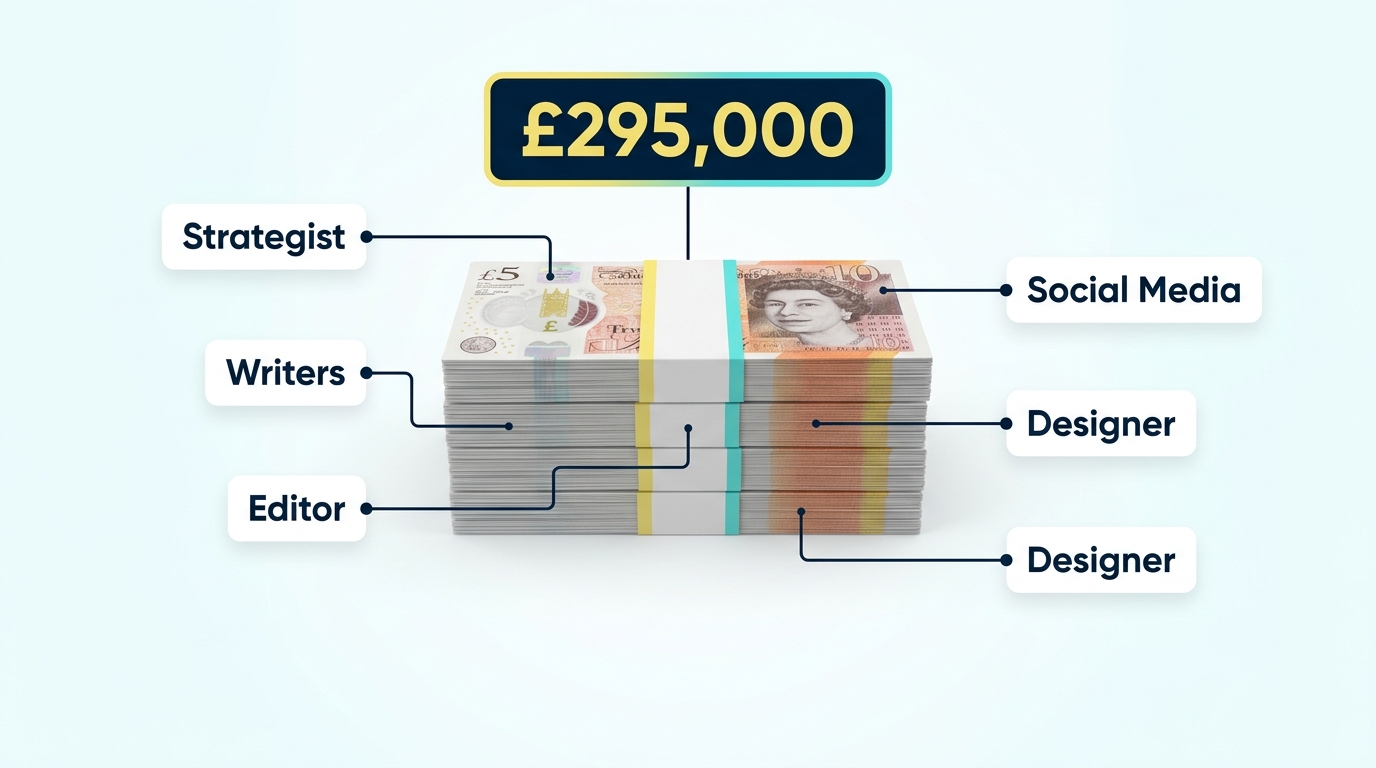
- • Content Strategist: £45,000 to £60,000. This role is responsible for keyword research, campaign planning, and aligning content with overarching business objectives.
- • Two Specialist Writers: £35,000 to £45,000 each. These individuals execute the written deliverables, requiring a total allocation of £70,000 to £90,000.
- • Managing Editor: £40,000 to £50,000. The editor ensures brand compliance, grammatical accuracy, and narrative flow.
- • Social Media Manager: £35,000 to £45,000. This role handles distribution, community engagement, and platform-specific formatting.
- • Graphic/Digital Designer: £40,000 to £50,000. Visual assets are non-negotiable for modern content, necessitating dedicated design support.
The aggregate base salary for this standard configuration results in a fully-loaded cost of a UK content team ranging from £230,000 to £295,000 per year minimum. This figure solely represents the gross payroll. It does not account for the operational reality of maintaining this workforce.
The Hidden Overhead of Human Capital
The true financial burden of a human department extends far beyond base salaries. Executives routinely underestimate the invisible overhead that bloats the marketing budget and degrades overall profitability.
Recruitment is the first hidden tax. Securing top-tier talent requires agency fees, which typically range from 15% to 25% of the candidate's first-year salary. For a £295,000 team, recruitment fees alone can add £44,000 to £73,000 to the initial setup cost. Furthermore, projecting the cost of hiring in 2026 indicates that wage inflation and the demand for specialized digital skills will only push these baseline figures higher.
Once the team is assembled, the software tax applies. A professional department requires an extensive technology stack. This includes Content Management Systems, premium SEO research tools, enterprise social scheduling platforms, design software licenses, and advanced analytics dashboards. These recurring software subscriptions easily add thousands of pounds to the monthly operating expenditure. When calculating exactly how much an in-house content marketing team will cost, these compounding software licenses are frequently omitted from initial boardroom forecasts.
Additionally, businesses must account for employer national insurance contributions, mandatory pension enrollments, and the cost of physical or remote office infrastructure. Finally, there is the cost of downtime. Human workers require annual leave, sick pay, and ongoing professional development training. When a key writer takes a two-week holiday, production stalls unless costly freelance cover is secured. The management overhead required to conduct performance reviews, mediate disputes, and maintain morale further drains executive bandwidth.
When all hidden variables are calculated, the actual cost of sustaining a traditional content team often exceeds £400,000 annually.
Architecting the Alternative: The Autonomous AI Content System
The antidote to bloated payrolls and operational drag is not cheaper labor. The solution is superior infrastructure. Precision-engineered automation replaces the manual grind of content creation, allowing businesses to scale their output without scaling their headcount.
This is not about purchasing a generic twenty-dollar chatbot subscription and expecting professional results. It is about architecting a bespoke system tailored to your specific commercial objectives.
The Economics of Automation
Contrast the staggering £400,000 true cost of a traditional team with the streamlined economics of a custom Content Engine. This engineered solution operates on a fundamentally different financial model, shifting the burden from perpetual operating expenditure to a highly efficient, hybrid capital expenditure model.
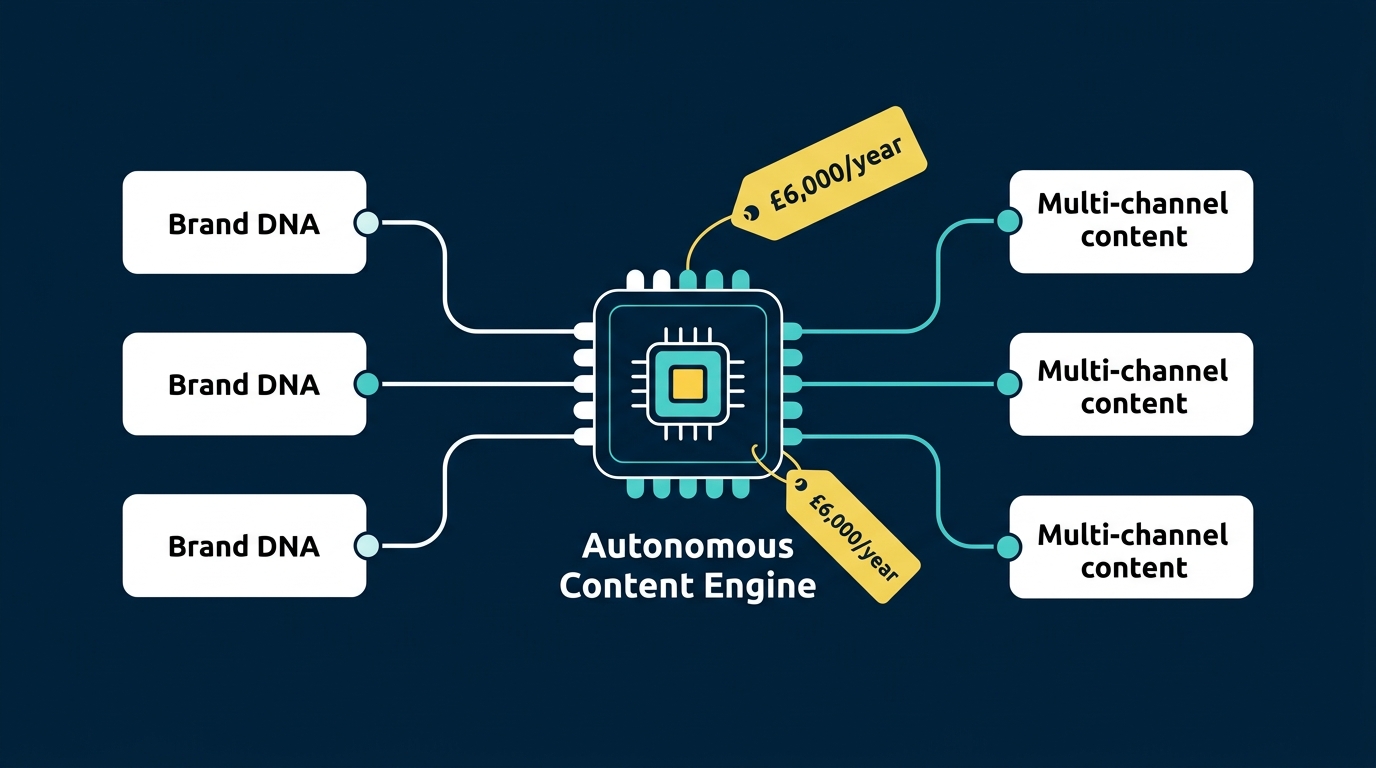
The architecture involves a one-time bespoke build fee of £2,000. This covers the comprehensive setup, API integrations, workflow mapping, and initial system training. Following the deployment, businesses opt for a £297 per month System Health retainer. This unified billing covers all underlying compute costs, continuous optimization, and the security of a dedicated account manager.
The total annual cost is less than £6,000.
This represents a cost reduction of over 98% compared to the legacy human model. The financial asymmetry is profound. For a fraction of the cost of a single junior writer's recruitment fee, a business can deploy an autonomous infrastructure capable of generating SEO-optimized articles, executive LinkedIn posts, and comprehensive newsletter drafts 24 hours a day, 365 days a year. There is no sick leave. There is no holiday cover. There is only predictable, scalable output.
The "Bionic Marketer": Augmentation, Not Replacement
The most common objection from CMOs and Founders regarding automation centers on brand safety. Executives fear that deploying artificial intelligence will result in generic, robotic outputs that damage their corporate reputation. They worry about losing control over their narrative. These are valid concerns when dealing with amateur tools, but professional systems are built with strict safeguards.
The goal is not to entirely remove humans from the marketing equation. The objective is to elevate them. We call this the Bionic Marketer concept.
Quality Control via Brand DNA Calibration
A precision-engineered system does not rely on generic prompts. It is accurately calibrated using your company's unique Brand DNA. During the deployment phase, the architecture is trained on your historical high-performing content, your specific brand guidelines, your target audience psychographics, and your distinct tone of voice.
If your brand voice is authoritative and analytical, the system outputs authoritative and analytical text. If your brand is conversational and direct, the system mirrors that exact cadence. This deep calibration ensures that the output is bespoke to your business strategy, eliminating the recognizable robotic tone that plagues unoptimized setups. The system acts as a highly trained digital employee that inherently understands your corporate identity.
Retaining Control with Human Checkpoints
The Bionic Marketer model operates on the principle of augmentation. The AI serves as a powerful exoskeleton, executing the heavy lifting of keyword research, data aggregation, structural outlining, and initial drafting. It accomplishes in minutes what takes a human writer days to complete.
However, the human marketer remains the pilot. Mandatory human approval checkpoints are built directly into the workflow. The autonomous system generates the draft, but a human expert reviews, refines, and approves the final asset before deployment. This synergy of human creativity and AI efficiency guarantees absolute quality control. The human is elevated from a fatigued typist to a strategic editor, focusing their cognitive energy on nuance, thought leadership, and high-level strategy rather than the manual grind of word counts.
ROI Comparison: The Unfair Advantage in 2026
When evaluating the cost content team vs AI content system, the conversation must eventually turn to Return on Investment. Cost reduction is only one side of the ledger. The true advantage lies in output velocity and speed to market.
A traditional human team is constrained by time. A well-resourced department might successfully publish four high-quality, long-form SEO articles per month, alongside a smattering of social posts. An autonomous content system can generate forty fully researched, structurally perfect drafts in the same timeframe. Because the Bionic Marketer is only spending fifteen minutes reviewing and polishing a draft rather than five hours writing it from scratch, the company's publishing velocity increases exponentially.
This rapid deployment allows businesses to aggressively target long-tail keywords, dominate local and global search verticals, and maintain a ubiquitous presence across multiple social platforms simultaneously. The ability to scale into new marketing channels without triggering a corresponding increase in headcount provides a massive competitive moat.
Conclusion: Escaping the Complexity Trap
Most organizations do not lose to competitors because they lack ideas. They lose because execution is slower than the market. The gap between AI-driven businesses and those relying on legacy hiring models is widening rapidly.
In a landscape where marketing complexity often overshadows potential, clinging to the traditional agency or in-house team structure is a financial liability. A traditional content operation is a legacy architecture built for a lower-output era. It can work, but it demands an ongoing commitment to hiring, management overhead, and tool sprawl.
A Content Engine is a modern architecture: precise, repeatable, and designed for throughput. It does not replace your marketers. It makes them bionic. Strategy stays human. Standards stay human. Approval stays human. The production pipeline becomes systemized.
Stop funding inefficiency. The brutal math is undeniable: spending a quarter of a million pounds annually to achieve a fraction of the output generated by a £6,000 system is a failure of resource allocation. It is time to architect a system that scales your brand without draining your capital.
Frequently Asked Questions (FAQs)
What is the true cost content team vs AI content system for an SME? For an SME, a traditional in-house team requires a minimum investment of £230,000 to £295,000 in base salaries alone, escalating past £400,000 when factoring in recruitment, software, and management overhead. In stark contrast, a bespoke AI system requires a £2,000 initial build fee and an optional £297 monthly retainer. This results in an annual cost of less than £6,000.
Will an AI content system dilute my brand's unique voice? No. Professional, bespoke systems do not use generic templates or standard prompts. They undergo rigorous Brand DNA calibration. The architecture is trained on your past successful content, tone of voice guidelines, and specific industry terminology.
How long does it take to build a bespoke AI Content Engine? Unlike the traditional hiring process which can take months of interviewing, onboarding, and training, a bespoke autonomous system can typically be architected, calibrated, and deployed within a matter of weeks.
Do I still need a marketing manager if I use an AI content system? Yes. The system is designed for augmentation, not total replacement. Adopting the Bionic Marketer approach means your marketing manager transitions from executing manual tasks to directing high-level strategy.
What are the hidden costs of managing an in-house content team? The hidden costs include recruitment agency fees (15-25% of starting salaries), expensive software licenses, employer taxes, pension contributions, and the financial impact of sick leave and holiday pay.
Want to build marketing systems like this?
Book a Discovery CallRelated Articles

AI Email Marketing: Beyond Drip Sequences
AI email marketing moves beyond basic rule-based automations to intelligent systems that personalise content, optimise send times, generate copy, and adapt sequences based on recipient behaviour in real time.
Read more →
AI Marketing Strategy Framework (2026)
An AI marketing strategy is a structured plan for integrating artificial intelligence into your marketing operations. This framework covers the maturity audit, prioritisation, the build sequence, KPIs, and common strategic mistakes.
Read more →
AI Content Creation: Scale Without Losing Quality
AI content creation is the use of artificial intelligence to research, draft, edit, and optimise marketing content. Learn how to scale production with quality gates, brand DNA frameworks, and workflows that keep the human where it matters.
Read more →