The Content Production Bottleneck: How AI Agents Solve the Manual Grind


Introduction: The Delivery Paradox and the 70% "Toil" Tax
If you are currently searching for how Content Production Bottleneck AI Agents can fix your workflow, you are likely living the exact contradiction that plagues modern marketing teams. You adopted artificial intelligence to move faster and scale your output, yet your team still feels completely underwater. This is not because writing has become more difficult, but because the delivery process has become significantly heavier.
We call this the "Delivery Paradox." In plain terms, generating raw content is now theoretically effortless. A standard language model can draft a two-thousand-word article in a matter of seconds. However, the actual delivery of that content remains painfully slow because human beings are still forced to manage the chaotic workflow surrounding that initial draft.
Recent industry data paints a stark picture of this operational strain. Multiple surveys reveal that 64% of B2B marketers cite a severe lack of time and resources as their primary barrier to executing their strategy. The core issue is that AI did not remove your operational constraints; it simply moved them to a different part of the pipeline.
In many marketing departments, up to 70% of a team's time is now spent on "toil." Toil is the manual, repetitive management required to make AI outputs usable. It is the endless cycle of copying text from a chat interface, pasting it into a document, rewriting generic paragraphs to match your brand voice, manually fact-checking hallucinated claims, formatting headers, hunting for relevant internal links, and finally wrestling the asset into a content management system. The model generates the words, but your highly paid human team manages the chaos.
This creates a pervasive "metered taxi anxiety" associated with usage-based AI tools, alongside the endless tweaking of prompts and the uncomfortable realization that quality slips the moment you attempt to increase volume. The industry is actively seeking robust content production bottleneck solutions because businesses realize that relying on manual human intervention for every step of an AI workflow is entirely unsustainable. True efficiency requires moving away from isolated generation tools and moving toward integrated systems that handle the heavy lifting from end to end.
The Death of the Manual Grind: Why Prompt Engineering Isn't Enough
Prompt engineering had its moment in the spotlight. It helped marketing teams cross the very first bridge: moving from a blank page to a rough first draft. However, prompt engineering is fundamentally not a scalable operating model. It is a manual craft layered on top of an already overloaded marketing function.
Scaling content production is an orchestration problem, not a writing problem. Generating one hundred blog drafts is technically simple. The logistical nightmare lies in ensuring those one hundred assets perfectly match your brand voice, cite sources correctly, align with search intent, include the right internal links, follow your strict editorial standards, avoid compliance landmines, pass a rigorous quality assurance checklist, and get scheduled in the correct cadence across multiple platforms.
A human manually feeding prompts into a chat interface cannot manage this complexity at scale. Here is what prompt-led content production looks like in the real world: someone writes a brief, someone prompts a model, the output is predictably generic, the marketer reprompts to fix the tone, someone manually inserts product reality and removes hallucinations, someone else checks the SEO basics, and finally, someone formats and publishes the piece. Next week, the team does it all again, slightly differently, because the entire process lives exclusively in people's heads.
That is not a content system. That is a content sprint, repeated endlessly.
Amateurs use generic ChatGPT prompts, accepting mediocre outputs that damage brand credibility. Professional organizations recognize that real business growth requires infrastructure, not hacks. A spreadsheet of prompts is a fragile workaround that fails the moment a new team member joins, your offer evolves, Google tightens its quality thresholds, or leadership asks for consistency across channels.
At AI for Marketing, our bias comes directly from being marketers building for marketers, which means we understand the deep nuance of SEO intent, brand positioning, and campaign logistics that pure software engineers often miss. We do not treat content like a text-generation task. We treat it like a precision-engineered production line that requires business logic, quality gates, governance, and measurement. The shift that matters now is prioritizing infrastructure over prompts.
From "Generation" to "Orchestration": What Are AI Agents?
To understand how to smash this operational bottleneck, it is crucial to understand the fundamental difference when comparing AI agents vs LLMs. This distinction is the bedrock of modern AI marketing automation.
A standard Large Language Model is entirely reactive. You ask a question, and it provides an answer. It has no memory of your broader business goals, no ability to execute tasks outside its immediate chat window, no concept of your internal processes, and zero capacity to verify its own work against your specific data sets. It is a highly capable digital typewriter, but it still requires a human typist to operate it.
An AI agent is profoundly different. In a marketing context, an agent is a proactive, autonomous system capable of executing multi-step workflows. It makes decisions based on predefined rules, utilizes external tools like search engines and analytics platforms, checks its own work against strict constraints, escalates exceptions to a human when it lacks confidence, and logs every action for review.
In short, agents move far beyond mere generation into the realms of management and orchestration.
A highly useful way to conceptualize this is the "Bionic Marketing Department" model. Instead of a human manually researching keywords, drafting a post, and finding images, an orchestration system handles the entire lifecycle.
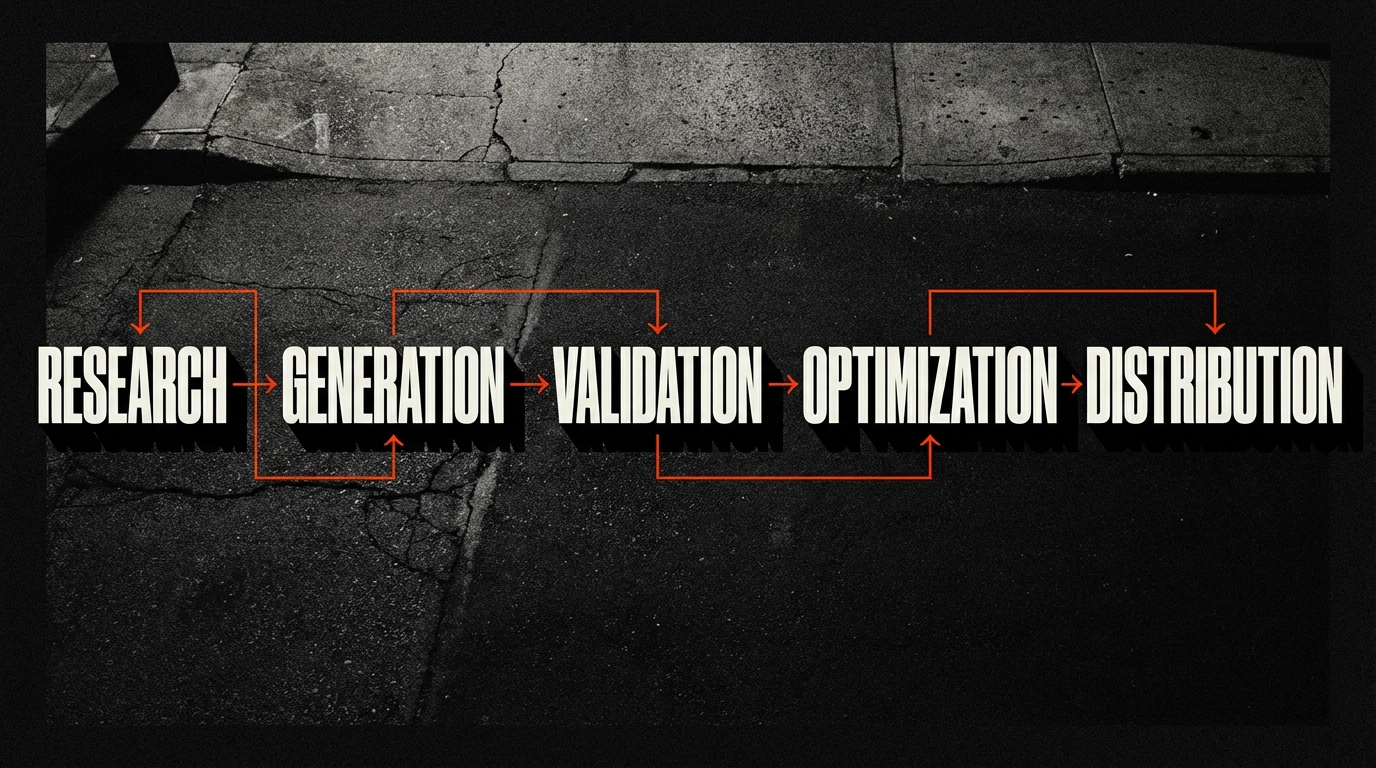
In practice, an agentic content workflow includes multiple specialized agents, each responsible for a distinct part of the pipeline:
- • The Research Agent: Compiles sources, analyzes search engine result pages to identify keyword gaps, and extracts claims safely.
- • The Strategy Agent: Builds a comprehensive content brief based on the research, mapping intent and internal linking opportunities.
- • The Writer Agent: Drafts the content following your specific house style, tone, and structural guidelines.
- • The QA Agent: Checks the draft for missing sections, risky phrases, formatting issues, and readability scores.
- • The Publishing Agent: Prepares the CMS payload, formats the metadata, and schedules the final content.
This multi-agent ecosystem complements human creativity rather than replacing it. It strips away the mechanical toil, allowing human marketers to focus entirely on high-level strategy, audience psychology, and final editorial approval. You get unprecedented speed without ever sacrificing your standards.
The "Production Gap": Why Real AI Costs $35k (Not $3k)
The transition from manual prompt engineering to autonomous orchestration is highly lucrative, but it is not without significant technical hurdles. There is a very specific reason why AI demos feel magical on a screen, yet internal AI implementations feel incredibly painful for marketing teams. We call this disparity the "Production Gap."
In today's market, a developer can easily spin up a flashy demo agent for roughly $3,000. This demo will look incredible because it only needs to work once, in a highly controlled environment, with friendly inputs, and zero operational responsibility.
However, deploying that same agent into a live, unstructured business environment reveals severe fragility. A reliable, production-ready agent typically costs upwards of $35,000 to build, secure, and maintain because it has to survive reality. It must handle messy inputs, changing offers, shifting brand standards, new product launches, inconsistent data, tool outages, edge cases, and demanding leadership expectations.
Being honest about this production gap is exactly how grown-up marketing teams avoid buying into the hype. Production systems require far more than a model and some prompts; they require reliability engineering tied directly to marketing logic. Industry experts consistently point to specific technical reasons why AI agents fail in production when moving from a controlled demo to a live business environment.
Failure Mode 1: Undefined Business Logic
Most AI failures in marketing are not model failures; they are requirements failures. A standard model does not know your company's unique value propositions or legal disclaimers. If your content workflow cannot answer specific questions, you do not have business logic. What is your exact house style? What claims are strictly prohibited? Which pages must be prioritized for internal linking? What is the minimum SEO standard for publication? When these rules are undefined in the code, humans become the manual rules engine. That is the very definition of the toil tax.
Failure Mode 2: Catastrophic Error Handling
In a production environment, the most dangerous outcome is not a poorly written paragraph. It is unobserved, silent failure. What happens when an agent pulls the wrong product name? What happens if an external API times out during a tool call? What if an internal link points to a redirect chain, or a CMS field is mis-mapped? A $3k demo simply crashes or hallucinates. A $35k production system has built-in fallback mechanisms, automatic retry logic, confidence scoring, clear escalation paths, and comprehensive audit trails to ensure the workflow continues safely.
Failure Mode 3: Integration Hell
Marketing teams do not operate in a single tool. They operate within a complex stack comprising a CMS, keyword tooling, analytics, CRM platforms, project management software, and approval dashboards. When people try to bolt raw AI onto this stack without designing the workflow end-to-end, integration becomes the ultimate bottleneck. Agents only help if the orchestration is specifically designed to connect these legacy systems cleanly and securely.
The RAG Failure Mode (Stale Data and Chunking Issues)
When teams realize generic models do not work, they inevitably decide to train the AI on their own data. What they typically mean is they will add internal documents to a knowledge base and utilize Retrieval-Augmented Generation (RAG). RAG is a framework where the system retrieves relevant snippets from your documents and feeds them to the model, theoretically grounding the output in your specific company truth.
While the concept is powerful, basic RAG implementations are notorious for failing in production. The primary issue stems from how the AI processes large documents through a process known as "chunking." If the chunking strategy is poorly designed, the AI retrieves the wrong context. If the chunks are too large, the retrieval becomes incredibly noisy. If they are too small, the context becomes fragmented. The agent might pull a paragraph about a discontinued product simply because the mathematical keywords matched your prompt, leading to confidently delivered, brand-damaging hallucinations.
Furthermore, without a dynamic synchronization system, the RAG database quickly suffers from stale data. Your pricing changes, your positioning shifts, and your feature lists update. If the knowledge base is not strictly version-controlled, the agent retrieves outdated truth. Building a reliable system requires advanced semantic routing and continuous data validation, which is why serious teams treat RAG as just one component inside a larger orchestration system, rather than the entire solution.
Smashing the Bottleneck: Reducing Manual Hours by 15x-30x
The ultimate goal of overcoming the production gap is to achieve a state of true agentic orchestration. If the bottleneck is manual toil, the true return on investment is not simply generating "more content." The ROI is achieving significantly less manual work per published asset.
This is where proper agentic orchestration fundamentally changes the economics of marketing execution. When you move from manual prompting to an orchestrated system, you stop paying human beings to act as operational glue. You stop paying skilled marketing directors to chase formatting issues, copy-paste between browser tabs, rebuild the exact same briefs, rewrite the same introductory paragraphs, and manually apply the same quality assurance checklists.
Instead, you build a precision engine where the repeatable work is executed consistently, logged accurately, and routed for human approval only when it truly matters. This is exactly how proper implementation of AI agents can reduce manual marketing hours by 15x to 30x. This reduction does not happen because the agents write thirty times better than a human; it happens because they remove thirty times the operational friction from the pipeline.
Consider the standard lifecycle of a comprehensive, SEO-optimized technical article. For a human marketer operating manually, this process involves roughly five to six hours of sustained effort. They must conduct competitor research, map out the keyword clusters, draft the content, run it through optimization software, adjust the tone, fact-check the claims, source imagery, format the headers, and handle the final CMS upload.
Under an agentic orchestration model, that five-hour workflow is reduced to a ten-minute review session. The interconnected agents handle the data scraping, the structural outlining, the drafting, the compliance checking, and the SEO scoring autonomously in the background. The human time shifts entirely from "doer" to "approver." The human defines the topic, goal, and constraints upfront. The system executes the labor. The human then reviews a near-publishable asset, makes taste-based editorial edits, and approves it.
By eliminating the 70% toil tax, marketing teams reclaim thousands of hours per quarter. This reclaimed time allows directors to focus on high-leverage activities: building strategic partnerships, refining overall brand positioning, and analyzing market trends. You stop paying for the mechanical execution of tasks and start investing purely in strategic growth.
Building Your Bionic Marketing Department with AI for Marketing
The gap between AI-driven businesses and those relying on manual execution is widening at an unprecedented rate. Relying on generic chat interfaces and isolated software subscriptions is no longer a viable strategy for sustained, professional growth. To truly scale your content production without sacrificing your brand standards, you need a system engineered specifically for your operational realities.
The teams that win with AI are not the teams with the cleverest prompts. They are the teams with the clearest systems. At AI for Marketing, our approach is precision-engineered around one singular goal: removing the operational toil without sacrificing the human layer that makes marketing actually work.
We do not sell generic templates or basic AI agents wrappers. We focus on providing comprehensive, "Done for You" setups that turn chaotic workflows into dependable operating systems. By investing in bespoke Autonomous Marketing Systems tailored directly to your specific business logic, you remove the technical friction of AI adoption.
Furthermore, our unified billing model eliminates the administrative headache of managing multiple API tokens, software subscriptions, and unpredictable usage fees. You gain the full power of an enterprise-grade AI ecosystem with the simplicity of a single, predictable partnership. We provide a practical agent stack that complements your existing team, protects your brand credibility, and handles the heavy lifting of your content pipeline.
It is time to leave the manual grind behind. Stop managing prompts and start managing a precision-engineered bionic marketing department. Partner with the experts who understand both the code and the strategy, and install the infrastructure that turns artificial intelligence into a dependable, highly profitable production line.

Frequently Asked Questions (FAQs)
What is the content production bottleneck in marketing?
The content production bottleneck is the massive operational delay caused by the manual management of marketing tasks. While generating raw text is fast, teams spend up to 70% of their time on the "toil" of formatting, fact-checking, reprompting, and staging content. This manual friction prevents businesses from scaling their output efficiently.
How do AI agents differ from standard ChatGPT prompts?
Standard chat interfaces are reactive tools that require constant human input and manual prompt engineering to function. AI agents are proactive, autonomous systems that can execute multi-step workflows, access external software, follow strict business logic, and verify their own work, acting as a bionic marketing department rather than just a digital typewriter.
Why do so many AI marketing tools fail in production?
Many tools fail because they are built as cheap prototypes lacking robust error handling and undefined business logic. Moving from a controlled demo to a live business environment requires complex infrastructure to prevent data hallucinations, API timeouts, and integration issues with legacy CRM and CMS platforms.
Can AI agents really reduce manual marketing hours by 15x?
Yes, by shifting from manual task execution to autonomous orchestration, businesses eliminate the mechanical toil of content creation. An interconnected system of agents handles the research, drafting, and SEO optimization in the background, reducing a five-hour human workflow to a brief ten-minute final review and approval process.
What is agentic orchestration in content creation?
Agentic orchestration is the process of coordinating multiple specialized AI agents across the content pipeline, complete with strict handoffs, constraints, and exception handling. Instead of relying on one ad hoc prompt, a research agent, a writing agent, and an SEO agent pass data seamlessly to create a repeatable production system that increases throughput while protecting brand quality.
Want to build marketing systems like this?
Book a Discovery CallMore Insights
The Ultimate Guide to Retargeting AI Ad Creative That Converts
Discover how retargeting AI ad creative scales personalization, combats fatigue, and drives incremental lift with predictive audience segmentation and server-side tracking.
Read more →
How to Measure the ROI of AI Marketing Automation: Metrics, Frameworks, and Dashboards
Learn how to measure the ROI AI marketing automation provides. Discover the frameworks, metrics, and dashboards needed to scale revenue and save time.
Read more →
How to Reduce Your Cost Per Acquisition by 40% with AI-Powered Ad Creative
Discover how to reduce CPA with AI ad creative strategies. Shift to creative-led growth, accelerate platform learning, and cut acquisition costs by up to 40%.
Read more →