How to Build a Content Approval Workflow That Does Not Bottleneck Your Publishing Schedule
27 March 2026 • By Jakub Cambor, Founder of AI for Marketing | Top 1% Upwork Expert Vetted Talent
Last updated: 27 March 2026
Every marketing manager knows the quiet frustration of the shared drive graveyard. It is that specific folder where brilliant, timely content ideas go to die, trapped in a perpetual state of awaiting review. You brief the strategy, the drafts are written, the assets are designed, and then the momentum completely stops. The work sits for weeks waiting for sign-off from a busy founder, a legal compliance team, or a brand director. By the time the final approval is granted, the industry trend has passed, the keyword opportunity has been lost to a competitor, and the content is fundamentally stale.
If your content is constantly "almost ready," you do not have a content generation problem. You have a systems problem. The gap between modern, high-growth businesses and those falling behind is no longer just about the ability to generate ideas. It is entirely about the speed of execution and deployment.
Implementing precision-engineered content approval workflow automation is the critical differentiator for modern marketing teams. It transforms a sluggish, manual pipeline into an autonomous engine of growth. At AI for Marketing, we understand that technology must solve operational friction, not add to it. The goal is not to remove human oversight, but to optimize it. By engineering a system that demands human brilliance only at strategic checkpoints, you can eliminate the administrative drag that is currently suffocating your marketing output.

The Hidden Cost of "Waiting for Sign-Off" Purgatory
Marketing is a science of consistency. When your publishing schedule is dictated by the unpredictable availability of executives rather than a strategic calendar, the entire commercial ecosystem suffers. Producing bad content undeniably damages a brand, but producing no content due to internal delays actively kills your market momentum and your organic compounding potential.
The financial impact of these operational delays is not theoretical. Industry research and operational audits consistently reveal that internal bottlenecks can cost businesses up to 5% of their annual revenue. This loss manifests in wasted wage hours, missed lead generation opportunities, and the hidden cost of context-switching as managers repeatedly chase stakeholders for feedback. When a piece of content sits in purgatory, the return on investment for the time spent creating it drops by the day.
Furthermore, in the modern algorithm age, consistency is the primary currency of trust. Search engines like Google and social platforms like LinkedIn reward domains and profiles that publish high-quality insights on a predictable, sustained schedule. Erratic publishing spikes followed by weeks of silence signal instability to both algorithms and human audiences. According to HeyOrca, consistency is a foundational element of how communities form trust with a brand.
When publishing slows down, the damage shows up in places that rarely get attributed back to approvals:
- • Lost timing advantage: A campaign angle that was timely when drafted becomes irrelevant by the time it is approved.
- • SEO compounding stalls: Consistency is how search engines build confidence in your site architecture.
- • Internal waste becomes normalized: Marketers end up re-briefing, reformatting, and re-contextualizing work that should have moved forward the first time.
- • Decision fatigue increases: When everything requires senior sign-off, senior stakeholders start to delay, and marketing becomes a low-priority task.
Marketing bottlenecks are not just a minor administrative annoyance. They are a systemic failure that directly impacts the bottom line.
Why Traditional Sequential Approvals Kill Marketing Momentum
To fix a broken system, you must first understand its architecture. The traditional approval chain is fundamentally flawed because it relies on sequential routing. A standard process usually looks like this: the writer finishes a draft and sends it to the marketing manager. The marketing manager reviews it and forwards it to the legal department. Legal flags a compliance issue and sends it back to the writer. The writer revises, sends it back up the chain, and eventually, it lands on the founder's desk for final brand sign-off.
This sequential method means that every single person in the chain acts as a potential single point of failure. If the legal director is on annual leave, the entire marketing output of the company halts. Sequential approvals mathematically guarantee delays because the total time to publish is the sum of every individual's longest delay.
Sequential approvals create three predictable failure modes:
- • Queueing delays: Work waits for the next person's bandwidth, not because it needs their immediate expertise.
- • Context loss: Each reviewer arrives cold, asks for changes that could have been prevented earlier, and the draft becomes a disjointed patchwork of opinions.
- • Rework loops: Changes requested late in the process force rewrites that restart the entire clock.
Transitioning to a modern framework requires abandoning this outdated model. By mapping out a logical content approval workflow, businesses can identify redundant steps and shift towards parallel processing where appropriate. However, simply rearranging the order of human reviews is not enough to achieve true scale. To eliminate the bottleneck permanently, the system itself must be upgraded from manual routing to intelligent automation.
The "Human-in-the-Loop" Model: Precision-Engineered Automation
The concept of automation often triggers immediate anxiety for brand protectors. The assumption is that automated publishing means handing the keys over to a machine, firing the creative team, and watching helplessly as generic text floods your company blog. This is a fundamental misunderstanding of enterprise-grade AI.
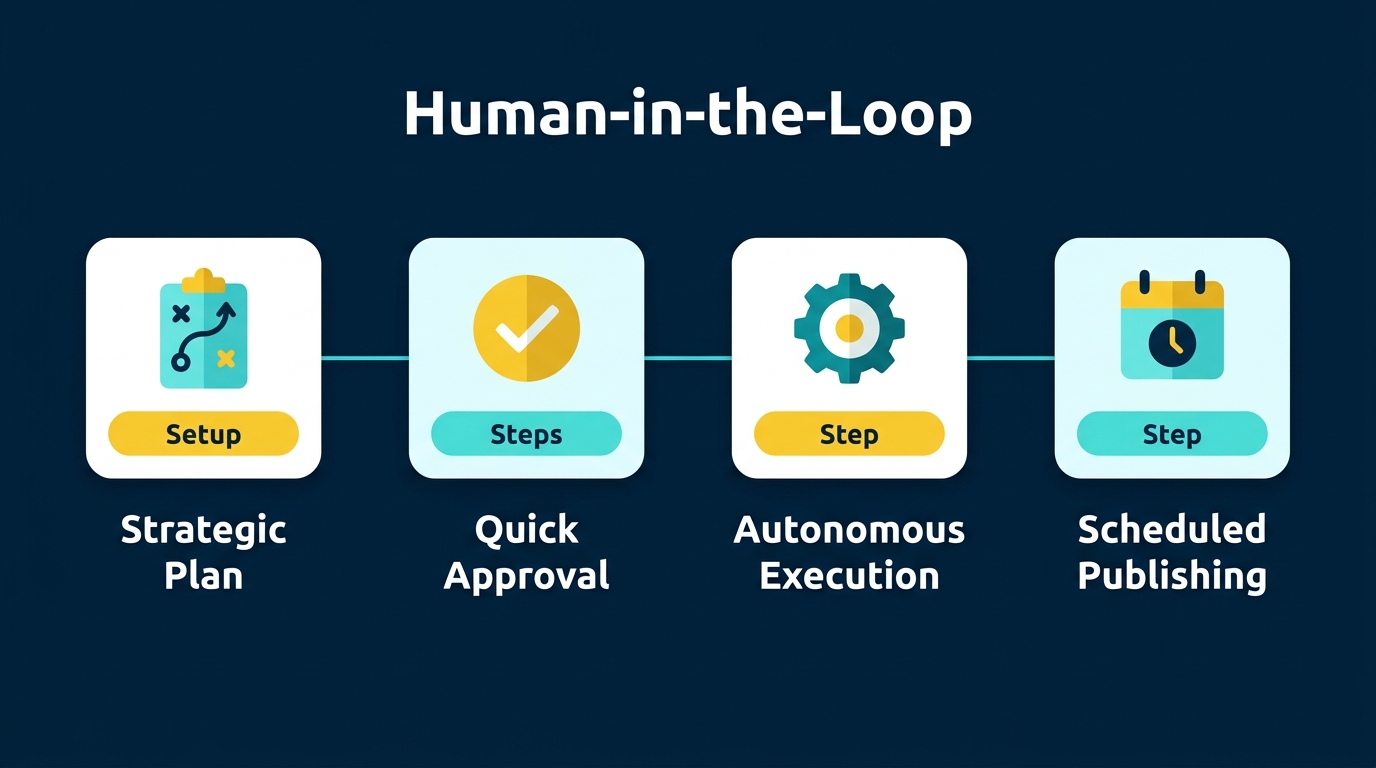
The solution to marketing approval bottlenecks is the "Human-in-the-Loop" model. This philosophy dictates that artificial intelligence should execute the heavy lifting of drafting, formatting, and routing, while human experts provide the strategic guardrails and final validation. It is about synergy, not replacement.
By adopting this model, you empower your team to build approval workflows without bottlenecks that scale effortlessly. The human is elevated from a micro-manager of words to a macro-manager of strategy. AI agents execute the repeatable work, and humans step in only where judgment, accountability, and brand risk genuinely exist. Done properly, this automation is reliable enough to scale and safe enough for serious brands.
Strategic Checkpoints: The Plan Stage vs. Final Review
In a precision-engineered automated system, a human stakeholder only needs to intervene at two highly leveraged moments. We call these the Strategic Checkpoints. Most approval chains fail because they are trying to do direction and quality control in the same step, over and over again.
Checkpoint 1: Plan Approval (Weekly)
Before a single word is generated, the AI system analyzes search trends, competitor gaps, and your strategic goals to present a comprehensive content plan. The marketing manager or founder reviews this high-level roadmap. You approve the topics, the target keywords, and the specific angles. You are approving the architecture of the house before the foundation is poured. This ensures total strategic alignment upfront, preventing the disastrous scenario where a finished article is rejected because the core premise was wrong.
Checkpoint 2: Final Review (Pre-Publish)
Once the AI agents have autonomously researched, drafted, formatted, and optimized the content based on the approved plan, the finished piece is presented for a final scan. Because the strategy was approved at Checkpoint 1, and the brand voice is hardcoded into the system, this final review takes minutes, not hours. It is a quick check against a fixed checklist: Is the message aligned to the approved plan? Are claims compliant? Does it sound like us?
Everything between these two checkpoints: the outlining, the drafting, the SEO optimization, and the platform formatting: is entirely autonomous.
The 48-Hour Nudge Protocol
Even with a streamlined two-checkpoint system, human procrastination remains a variable. Executives are busy, and reviewing marketing copy rarely sits at the top of their daily priority list. The most common reason content stalls is not disagreement. It is silence. Nobody says no, but nobody says yes, and marketing freezes because the system requires a manual response.
To combat this, a robust automated workflow must include a fail-safe mechanism: the 48-hour nudge protocol.
When a piece of content reaches Checkpoint 2 and is awaiting final sign-off, a silent timer begins. If the designated approver does not review the document within 48 hours, the system autonomously sends a polite follow-up notification via email or Slack. This removes the social friction of a marketing manager having to constantly chase their boss for approvals. The system acts as the impartial project manager, ensuring that the pipeline never stalls due to simple oversight. If the content remains unapproved after multiple nudges, the system can be programmed to route the approval to a designated secondary stakeholder, ensuring the publishing schedule remains intact.
Brand DNA Extraction: Curing the "Robotic AI" Rewrite Problem
If we want to solve the approval bottleneck, we must address the massive elephant in the room: why do managers and founders procrastinate on approvals in the first place?
Historically, reviewing AI-generated content was a deeply frustrating experience. It meant reading generic, soulless text that sounded exactly like a standard ChatGPT prompt. The approver would spend two hours rewriting the piece to make it sound like their company, completely negating any time saved by using AI. The reluctance to approve content is almost always rooted in a lack of trust in the output quality.
To fix this, we utilize a process called Brand DNA Extraction.
Before our AI agents write a single sentence for your business, they undergo rigorous brand voice training. We feed the ecosystem your highest-performing past content, your brand guidelines, your sales transcripts, and your executive thought leadership. We extract your specific vocabulary, your preferred sentence structures, your unique industry viewpoints, and your specific formatting quirks.
Brand DNA Extraction typically includes:
- • Voice and tone rules: Sentence length preferences, allowed and banned phrases, and formality levels.
- • Positioning pillars: What you believe, what you challenge, and what you refuse to do.
- • Audience language: The terms your customers actually use and the objections they raise.
- • Compliance boundaries: Regulated claims, disclaimer language, and sector-specific restrictions.
We do not just teach the AI what to say; we teach it exactly how you say it. This level of bespoke engineering solves the robotic AI problem entirely. When the content arrives at Checkpoint 2 for final approval, it already sounds like your best senior writer drafted it.
This transforms the review process from a laborious rewrite into a breezy scan, allowing your team to escape the social media approval bottleneck permanently. Reviewers stop looking for what is wrong with the draft and start confirming that it aligns with the brand. Trust is established, friction is removed, and the speed of publishing skyrockets.
The Weekly Autonomous Workflow: From 30 Hours to 30 Minutes
To truly grasp the transformative power of human-in-the-loop AI marketing, let us walk through a practical, week-in-the-life scenario of a business operating with an automated content ecosystem. The promise of a better workflow is predictable publishing without the weekly fire drill.
Monday: The system presents the plan
A weekly content plan is generated and delivered autonomously. It includes proposed topics with rationale, target keywords, draft titles, and channel mapping for your blog, LinkedIn, and email newsletter. This is the moment stakeholders get involved because their input has maximum leverage.
Tuesday: Review, adjust, and approve
The marketing manager or founder logs in for Checkpoint 1. They spend fifteen minutes reviewing the plan, swapping a topic to align with a new sales priority, adding a legal qualifier, and clicking approve. Once approved, the plan is locked.
Wednesday to Friday: Agents execute autonomously
The human team steps back. The AI agents take over the production pipeline. The research agents pull the latest industry data. The writing agents draft the content utilizing the Brand DNA Extraction guidelines. The SEO agents optimize the headers, apply schema-ready FAQ blocks, and generate internal linking prompts. The formatting agents prepare the text for specific platforms.
Friday Afternoon: Final review and publish
The completed, polished assets are presented for Checkpoint 2. The executive spends another fifteen minutes scanning the final outputs against a stable rubric to ensure perfect alignment. Because the Brand DNA is embedded, the content is approved with minimal changes. The system then autonomously schedules and routes the content to the CMS and social platforms.
The measurable benefit of this workflow is staggering. What previously required 15 to 30 hours a week of manual grinding, chasing stakeholders, managing version control across docs, and rewriting drafts has been compressed into just 30 minutes of high-level executive review. The business achieves enterprise-level content volume without expanding the payroll.
How Our Content Engine Eliminates the Manual Grind
Most teams do not struggle because they lack effort. They struggle because building this infrastructure is genuinely complex. To make content approval workflow automation reliable, you need more than simple prompts. You need a deeply integrated ecosystem.
Constructing a flawless automated pipeline requires complex API integrations, advanced prompt chaining, and deep technical expertise in workflow routing. You need planning logic that understands SEO intent, brand voice constraints that are actually enforceable, and escalation logic like the 48-hour nudge. It is not a project that a busy marketing department can easily build on the side while trying to hit quarterly targets.
This is exactly why we offer a hybrid, done-for-you service model. We are the architects; you are the pilot. We build the bespoke infrastructure tailored entirely to your specific business needs. We handle the technical complexity of the Content Engine so you can focus purely on strategy and growth.
In practice, we run the Brand DNA Extraction that codifies your voice. We configure the weekly plan approvals so stakeholders steer direction without slowing execution. We automate production and routing so content moves through the pipeline predictably. We keep humans in the loop at the only moments that matter: the plan and the final review.
Stop letting your best marketing ideas rot in a drafts folder. If your publishing schedule is constantly delayed, the fix is not to work harder or chase people faster. It is to install a workflow that respects how busy teams actually operate. Book a Brand DNA Extraction kickoff with our team today, and ensure your publishing calendar never misses a beat again.
Frequently Asked Questions (FAQs)
What is content approval workflow automation?
Content approval workflow automation is the use of systems and AI to route marketing assets through defined review stages autonomously. It eliminates manual hand-offs, sends automated reminders, and ensures content moves from draft to published without getting stuck in an inbox, keeping governance and accountability intact.
How does a human-in-the-loop AI model work for content creation?
This model uses AI to execute the heavy lifting of drafting, formatting, and scheduling, while human experts intervene at defined strategic checkpoints. Humans approve the overarching plan first, then perform a final scan before publishing, ensuring maximum efficiency without sacrificing brand voice or factual accuracy.
How can I speed up legal and brand compliance approvals for marketing?
Speed comes from moving compliance input earlier in the process and standardizing it. Define pre-approved claim language and prohibited topics at the planning stage, shift from sequential to parallel approvals, and implement a 48-hour automated nudge protocol to prevent documents from stalling on a desk.
Why does AI-generated content usually require so much editing?
Most AI content requires heavy editing because it is generated using generic prompts without specific brand constraints. By utilizing Brand DNA Extraction to train the AI specifically on your company's unique tone, vocabulary, and past high-performing content, you eliminate the generic tone and drastically reduce editing time.

Want to build marketing systems like this?
Book a Discovery CallRelated Articles

AI Email Marketing: Beyond Drip Sequences
AI email marketing moves beyond basic rule-based automations to intelligent systems that personalise content, optimise send times, generate copy, and adapt sequences based on recipient behaviour in real time.
Read more →
AI Marketing Strategy Framework (2026)
An AI marketing strategy is a structured plan for integrating artificial intelligence into your marketing operations. This framework covers the maturity audit, prioritisation, the build sequence, KPIs, and common strategic mistakes.
Read more →
AI Content Creation: Scale Without Losing Quality
AI content creation is the use of artificial intelligence to research, draft, edit, and optimise marketing content. Learn how to scale production with quality gates, brand DNA frameworks, and workflows that keep the human where it matters.
Read more →