The Business Content Engine: How to Scale Your Marketing Without Scaling Your Team
Growth creates a structural fracture in most businesses. As a company expands, the demand for visibility, thought leadership, and organic traffic multiplies. Historically, leaders faced a rigid trilemma when trying to meet this demand: you could have high-volume content, high-quality output, or low overhead costs. You were permitted to choose two, but the third was always sacrificed.
For the overwhelmed pragmatist, this scaling paradox is a source of constant friction. You know that the gap between AI-driven businesses and those relying on legacy methods is widening daily. Yet, the prospect of managing complex software, hiring a massive team of writers, or losing your brand voice to robotic, generic templates is equally unappealing.

The solution lies in a fundamental shift in philosophy. Modern marketing no longer rewards manual grinding. It rewards precision-engineered infrastructure. By implementing a Business Content Engine, organizations can deploy a bespoke, automated ecosystem that handles the heavy lifting of content creation. This approach shifts the paradigm to systems over tasks, allowing you to achieve unprecedented scale while maintaining strict quality control.
The Scaling Paradox: Why "More Effort" is Breaking Your Marketing
The traditional approach to business growth is deeply flawed. When a marketing channel shows promise, the default executive reaction is to throw more human effort at the problem. If one blog post a week generates ten leads, the logical conclusion is that five blog posts will generate fifty leads.
However, scaling human effort is rarely linear. Adding headcount introduces severe communication overhead, management bloat, and implementation fatigue. Your marketing director transitions from a strategic thinker into an operational bottleneck, spending their days chasing copywriters for drafts, managing editorial calendars, and correcting off-brand messaging. The manual grind of SEO optimization, social media scheduling, and email sequencing quickly leads to burnout.
This reliance on manual effort is what we call the scaling paradox. The harder you try to grow using legacy methods, the more fragmented and diluted your brand becomes. True scale does not come from trying harder or working longer hours. It comes from building robust systems. When founders realize they need to scale marketing without hiring a full team, they often turn to basic generative tools. But pasting generic prompts into a chat interface is not a system. It is simply a faster way to create mediocre work.
When marketing is treated as a series of tasks, the team is forced into constant context switching: research to outline, outline to draft, draft to SEO, SEO to distribution, distribution to reporting. The output may ship, but the system does not compound. The same manual work must be repeated from scratch every week. To break the paradox, businesses need an exoskeleton for their marketing: a framework that amplifies human creativity rather than attempting to replace it with cheap shortcuts.
Enter the Business Content Engine: A Multi-Agent Autonomous System (MAAS)
To understand the future of digital growth, we must move beyond the concept of a single AI chatbot. A true Business Content Engine operates as a Multi-Agent Autonomous System (MAAS). For business leaders and non-developers, MAAS can be conceptualized as a marketing department in a box.
Instead of relying on one generalized model to write, research, and optimize, a MAAS utilizes a network of specialized AI agents that collaborate seamlessly. Think of it as a highly disciplined corporate hierarchy built from code. One agent acts as the researcher, another as the data analyst, a third as the copywriter, and a fourth as the SEO specialist. They pass information between themselves, checking each other's work against your specific brand guidelines before presenting the final asset for human approval.
This orchestration of specialized skills is what separates professional AI marketing infrastructure from amateur experimentation. By deploying a bespoke Multi-Agent Engine, businesses can automate complex, multi-step campaigns that would typically require a team of five full-time employees. This matters because content is rarely a single-step task. A high-performing blog post or SEO cluster is a multi-stage process involving audience intent mapping, narrative structuring, drafting, editing, optimization, and repurposing for distribution. A MAAS handles these steps as a pipeline, not as scattered to-dos, delivering a polished product that aligns perfectly with your overarching commercial strategy.
The 5-Tier Architecture of a Precision-Engineered MAAS
Building a Business Content Engine requires more than simply connecting a few APIs. It demands a precision-engineered architecture designed specifically for the nuances of commercial marketing. This infrastructure is built on five distinct tiers, each serving a critical role in ensuring quality, scale, and security.
1. The Orchestrator (The AI Brain)
At the top of the hierarchy sits the Orchestrator. This is the central intelligence node of your marketing infrastructure. The Orchestrator does not write content directly. Instead, it receives the high-level strategy from your human marketing director and breaks it down into actionable workflows. If the goal is to dominate a specific localized search term, the Orchestrator analyzes the intent, maps out the necessary content clusters, and delegates specific tasks to the sub-agents. It acts as the project manager, ensuring that no task is duplicated and that every piece of output aligns with the initial strategic directive.
2. Specialist Agents (The Doers)
Beneath the Orchestrator are the Specialist Agents. These are narrowly focused AI models trained to execute specific functions with absolute precision. Because they are not burdened with generalized knowledge, their output is vastly superior to standard chatbots. Within this tier, you might deploy a dedicated SEO Engine programmed strictly to analyze keyword gaps, audit competitor metadata, and optimize header structures. Working alongside it could be a specialized LinkedIn Engine designed to study executive thought leadership frameworks and draft compelling social posts. These agents communicate with one another, ensuring that a piece of research generated for a blog is efficiently repurposed for social media distribution.
3. The Human Gatekeeper (The Bionic Marketer)
The most critical tier in this architecture is not made of code. It is human. We firmly believe in the synergy of human creativity and AI efficiency. The Business Content Engine is designed to do the heavy lifting: the data processing, the drafting, the structural formatting. However, the human acts as the ultimate gatekeeper. This is the essence of the Bionic Marketer. The AI serves as a powerful exoskeleton, allowing one marketer to do the work of ten. The human professional provides the nuance, the empathy, the industry relationships, and the final blessing on the output. By removing the manual grind of content production, the human is elevated to an editor and strategist, ensuring the brand remains authentic and authoritative.
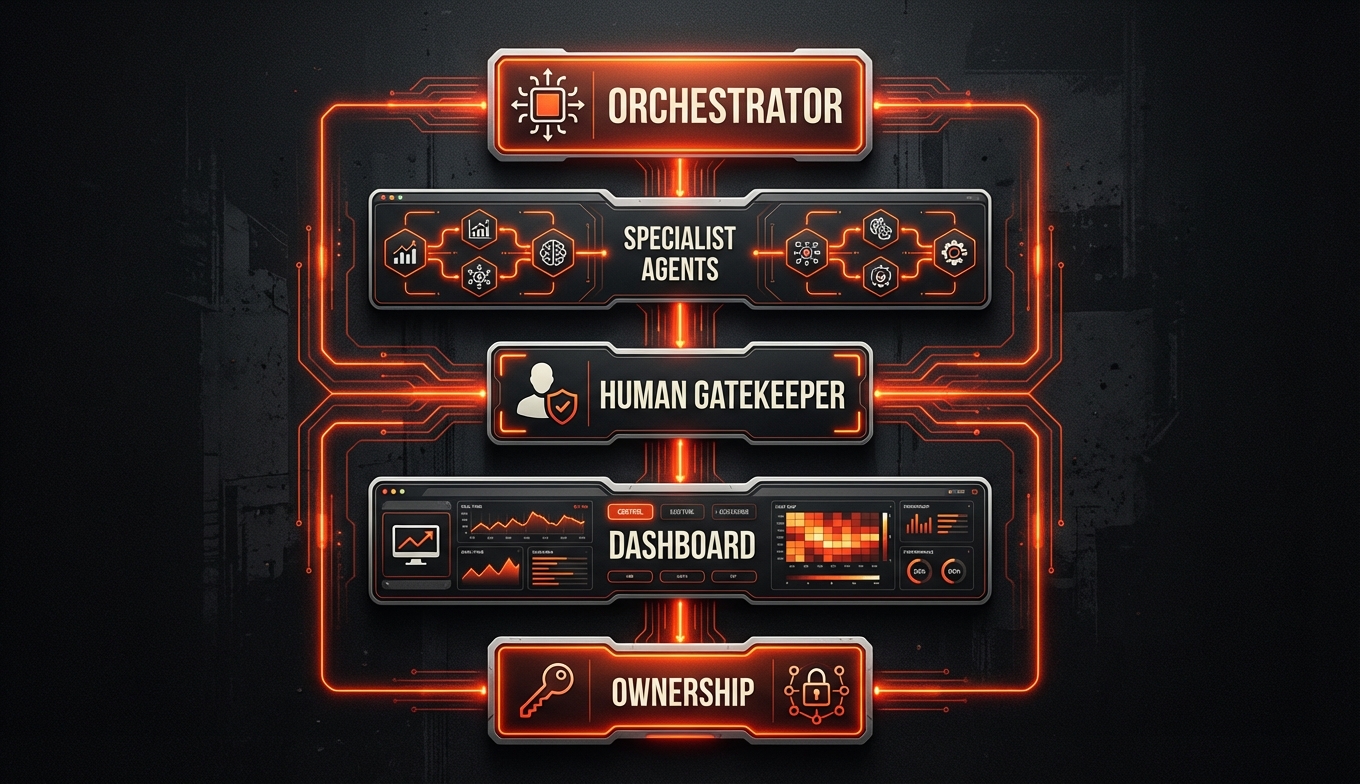
4. The Dashboard (The Command Center)
Complexity is the enemy of execution. A major barrier for businesses adopting AI is the fragmentation of tools. Managing multiple API keys, tracking usage limits across different platforms, and dealing with unpredictable billing cycles creates massive operational friction. The fourth tier of the MAAS architecture is a unified dashboard. This command center provides total visibility into the engine's performance. It consolidates all workflows into a single interface, offering unified billing to eliminate "token arbitrage" and metered taxi anxiety. You pay a predictable rate for a predictable outcome, allowing your finance and operations teams to forecast growth without worrying about hidden software costs.
5. Ownership (The Asset)
The final tier distinguishes a bespoke Business Content Engine from off-the-shelf software subscriptions. When you utilize generic tools, you are training their models for their benefit. A precision-engineered MAAS is built on your proprietary data. The system is trained on your past successful campaigns, your specific brand voice guidelines, and your unique customer psychographics. This means the infrastructure becomes a proprietary asset that belongs to your business. It appreciates in value over time as it learns more about your audience, creating a distinct competitive moat that cannot be easily replicated by rivals using generic ChatGPT prompts. Ownership is how you build a system that sounds like you, because it is engineered around your business.
The Retainer Trap vs. Infrastructure Ownership
The traditional marketing agency model is fundamentally misaligned with the needs of modern, scaling businesses. For decades, companies have been caught in the retainer trap. You pay a premium monthly fee to an agency to manage your SEO, write your blogs, and post on your social channels.
The harsh reality of the current market is that many of these agencies are quietly using the exact same generic AI tools you have access to, but they are charging you human-level hourly rates for the output. The retainer trap usually looks like this: a fixed monthly cost that never decreases, output tied to agency capacity rather than your internal priorities, and limited transparency into the production system. You are effectively renting your marketing capabilities. The moment you stop paying the retainer, the talent, the systems, and the output vanish.
Transitioning to a Business Content Engine flips this economic model on its head. Instead of renting your marketing, you are investing in infrastructure ownership. The initial capital required to build and train a bespoke MAAS is an investment in a depreciating-cost asset. Once the engine is built, the marginal cost of producing the hundredth high-quality article is virtually zero. You own the system, you own the data, and you dictate the volume. This shift from an operational expense to a capital asset is the most significant financial leverage a modern business can acquire.
The ROI of Automation: By The Numbers
For the pragmatic business leader, theoretical architecture is interesting, but purchasing decisions are driven by hard data and risk mitigation. The transition from manual effort to AI marketing infrastructure delivers a measurable, transformative return on investment.
When businesses stop relying on fragmented human effort and deploy a unified MAAS, the financial metrics shift dramatically. Data from recent implementations reveal that organizations can achieve up to a 97% reduction in Cost Per Lead (CPL). By automating the top-of-funnel content generation and localized SEO targeting, the volume of organic traffic scales exponentially without a corresponding increase in advertising spend. Furthermore, replacing the traditional agency retainer model with an owned infrastructure results in profound capital efficiency. Companies routinely see $10k+ in annual savings simply by eliminating the bloated management fees associated with outsourced content creation. You can review detailed Case Studies to see how these exact figures are validated in real-world environments.
Beyond the balance sheet, the most impactful metric is time. Founders and marketing directors report reclaiming 15 to 30 hours per week after deploying their engine. Understanding that small teams win without burnout is crucial for modern talent retention. Instead of acting as stressed project managers chasing deadlines, your core team is freed to focus on high-leverage activities: closing deals, refining product offerings, and building strategic partnerships. The AI handles the volume, the human handles the value.
Building Your Bionic Marketing Department
The gap between businesses that adopt autonomous systems and those that cling to manual processes is no longer just a competitive disadvantage. It is an existential threat. Relying on sheer human effort to scale your digital presence is a recipe for margin erosion and team burnout. A Business Content Engine represents the maturation of digital marketing. It is the transition from chaotic, task-based grinding to calm, precision-engineered mastery.
By implementing a Multi-Agent Autonomous System, you empower your team with an exoskeleton that guarantees high-volume, high-quality output while drastically reducing operational overhead. You reclaim your time, you own your infrastructure, and you protect your brand from the generic noise flooding the internet. Complexity simplified. Strategy amplified. It is time to leave the retainer trap behind and build a system that works tirelessly for your growth.

Frequently Asked Questions (FAQs)
What is a Business Content Engine? A Business Content Engine is a bespoke, automated infrastructure designed to handle the high-volume creation and optimization of marketing assets. Unlike generic AI chatbots, it is a sophisticated system trained on your proprietary brand data to ensure consistent, high-quality output at scale without increasing headcount.
How does a Multi-Agent Autonomous System (MAAS) work in marketing? A MAAS operates like a digital marketing department. Instead of one AI doing everything poorly, it uses multiple specialized AI agents. One agent conducts SEO research, another drafts the content, and a third reviews it against brand guidelines. They collaborate autonomously to execute complex campaigns under human supervision.
Will an AI content engine replace my current marketing team? No. The system is designed around the Bionic Marketer philosophy. It acts as an exoskeleton that automates the manual, repetitive grind of content production. This frees your human marketing team to focus on high-level strategy, relationship building, and final editorial approval, augmenting their capabilities rather than replacing them.
What is the difference between owning AI infrastructure and a marketing agency retainer? A marketing retainer is an operational expense where you rent a team's time, often paying premium rates for generic AI output. Owning AI infrastructure means you invest in a proprietary asset. Once built, the system belongs to you, drastically reducing ongoing monthly costs and allowing for infinite scale without proportional fee increases.
How long does it take to see ROI from an AI marketing system? Because the system automates top-of-funnel content and SEO at an unprecedented scale, businesses often see immediate operational ROI through 15 to 30 hours saved per week. Financial ROI, including up to a 97% reduction in Cost Per Lead and significant annual savings, typically compounds within the first few months of deployment.
Want to build marketing systems like this?
Book a Discovery CallMore Insights
The Ultimate Guide to Retargeting AI Ad Creative That Converts
Discover how retargeting AI ad creative scales personalization, combats fatigue, and drives incremental lift with predictive audience segmentation and server-side tracking.
Read more →
How to Measure the ROI of AI Marketing Automation: Metrics, Frameworks, and Dashboards
Learn how to measure the ROI AI marketing automation provides. Discover the frameworks, metrics, and dashboards needed to scale revenue and save time.
Read more →
How to Reduce Your Cost Per Acquisition by 40% with AI-Powered Ad Creative
Discover how to reduce CPA with AI ad creative strategies. Shift to creative-led growth, accelerate platform learning, and cut acquisition costs by up to 40%.
Read more →