What Is Brand Intelligence and Why Does It Matter Before Any Marketing Campaign?
26 March 2026 • By Jakub Cambor, Founder of AI for Marketing | Top 1% Upwork Expert Vetted Talent
Last updated: 26 March 2026

The modern business environment is saturated with algorithmic tools promising unprecedented speed, infinite scale, and immediate cost reduction. Founders, marketing directors, and agency owners are rapidly adopting these technologies to maintain a competitive edge and satisfy the ever-growing demand for digital presence. However, a significant and costly problem has emerged across the industry. While the sheer volume of output has increased exponentially, the quality, resonance, and distinctiveness of the messaging have plummeted. The market is currently flooded with generic, robotic content that completely fails to connect with human buyers or drive meaningful commercial outcomes.
Most teams are already using artificial intelligence in some form, from ad copy variations to SEO briefs to LinkedIn posts. The uncomfortable truth is that a lot of it reads exactly the same: competent, fast, and strangely forgettable. That is not because your team lacks creativity, or because algorithms cannot understand nuance. It is usually because the campaign started with execution instead of foundational strategy.
This is exactly where brand intelligence marketing becomes non-negotiable. It is the structured understanding of your brand’s identity, voice, audience, and competitive position, translated into inputs that humans and systems can consistently act upon. When this intelligence is missing, language models default to the average of the internet, and your marketing becomes generic at scale.
The missing link between mediocre, easily ignored automated output and precision-engineered commercial results is a structured data core. We firmly believe in the bionic marketer approach. Algorithms are not a replacement for human creativity, emotional intelligence, and strategic insight. Instead, they serve as a powerful exoskeleton designed to augment and elevate your existing capabilities. But exoskeletons only work when they are perfectly fitted to the person wearing them. Building your brand intelligence is that exact fitting process.
The AI Illusion: Why Most Marketing Campaigns Fail Before They Start
Implementation fatigue is a very real and growing challenge for modern executive teams. Driven by an intense fear of missing out on technological advancements, businesses are rushing to integrate language models into their daily operational workflows.
Founders feel the pressure as competitors publish more frequently and test new channels faster. Marketing leaders feel the exhaustion of managing new tools, new workflows, and new prompts, only to find that the resulting content still feels slightly off-brand. Agencies feel severe margin compression as clients demand more output and faster turnarounds without accepting lower quality.
The mainstream promise is highly alluring: write a quick prompt, generate an entire month of social media posts in seconds, and watch the inbound leads pour in. The reality experienced by pragmatic business leaders is far more complex, time-consuming, and often deeply frustrating. Relying on generic, off-the-shelf prompts without a foundational AI marketing strategy leads directly to severe brand dilution.
When you ask a standard, unmodified language model to write a technical blog post, draft a persuasive email sequence, or create advertising copy without providing a highly structured contextual framework, the system has no choice but to guess. It produces content that sounds exactly like everyone else in your category. Your unique value proposition, your specific tone of voice, and your nuanced understanding of your customer's deepest pain points are entirely lost in translation.
Defining Brand Intelligence Marketing: The Foundation of the Bionic Marketer
To move beyond generic outputs and establish a true competitive moat, we must clearly define the core solution. Brand intelligence marketing is the systematic collection, structuring, and ongoing analysis of data related to your company's identity, customer sentiment, and market positioning. It is the highly technical process of translating the abstract, creative concepts of your brand into a strict, machine-readable format that algorithms can process and execute against.
It combines four realities that marketing teams often treat separately:
- • Identity: What you are, what you are not, and the core principles you refuse to trade away.
- • Voice: How you sound when you are at your best, and exactly what off-brand communication looks like.
- • Audience: Who you are building for, their specific motivations, their hidden objections, and the exact language they use.
- • Position: Where you win versus competitors, including the strategic trade-offs you intentionally accept.
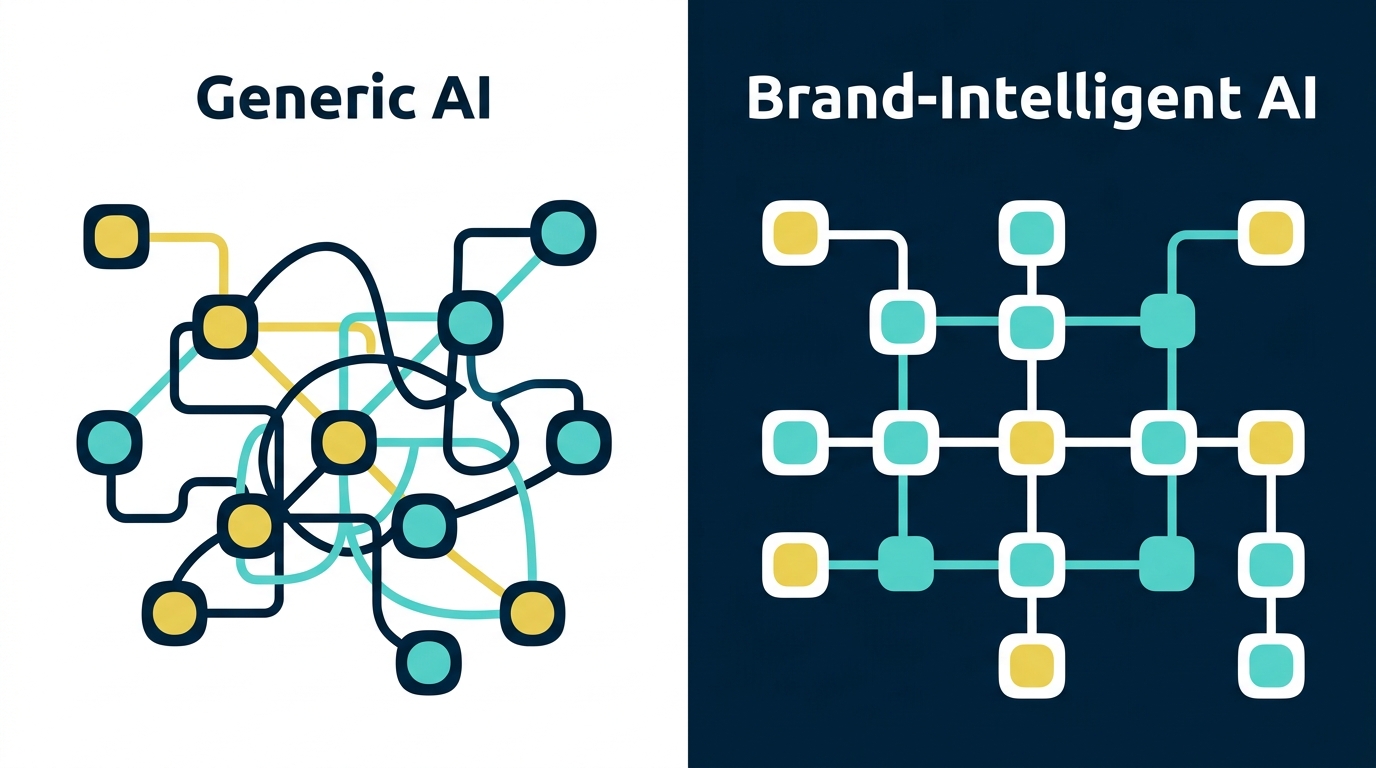
Historically, this type of deep corporate intelligence lived exclusively in the minds of founding teams or within static, rarely updated guideline documents that gathered digital dust on a shared drive. Today, it must become a dynamic, actionable dataset. It involves analyzing competitive positioning and customer sentiment to create a highly specific set of operational rules and parameters. You are not collecting insights to admire them in a presentation; you are converting them into constraints and decision rules that guide every single campaign.
Breaking Down Data Silos and Unstructured Data
One of the primary structural barriers to establishing this critical foundation is the highly fragmented nature of corporate data. Most organizations already have the raw material required to build their brand identity AI framework. The problem is that this information is scattered, messy, and trapped within isolated departmental silos.
Think about where the actual truth about your business lives. Sales teams hold critical insights in their discovery call notes and win-loss records. Customer service representatives understand the exact language buyers use in support tickets and churn feedback. Marketing teams possess the overarching strategic vision and market positioning goals. For an automated system to function effectively and holistically, these internal silos must be completely dismantled.
The Three Pillars: Consensus, Concept, and Consistency
A robust intelligence framework becomes useful when it creates alignment and repeatability. We build this foundation upon three non-negotiable strategic pillars.
1. Consensus: Internal alignment that survives growth
Consensus is not about everyone agreeing on every minor detail. It is absolute agreement on the non-negotiables: your category, the specific customer you serve best, the promises you can defend with evidence, and the lines you will not cross in tone or positioning.
2. Concept: The unifying idea that makes your brand memorable
Concept is the simplest articulation of what you are building and why it matters in the market. It is the strategic center that makes decisions easier. It dictates what stories you tell repeatedly because they are true, what problems you name better than the competition, and what trade-offs you embrace.
3. Consistency: One voice across every channel and asset
Consistency is where most teams break, especially once automation is introduced. Maintaining this level of strict uniformity requires a centralized brain, which is best achieved by deploying a specialized AI Multi-Agent Engine.
The Cost of Skipping the Brand Intelligence Phase
The temptation to bypass the foundational setup and jump straight into high-volume content generation is incredibly strong. However, skipping this phase creates costs that manifest as a slow, corrosive leak across performance, credibility, and team efficiency.
- • Wasted spend that looks like testing: Poor brand intelligence is a severe data quality problem. You are feeding campaigns ambiguous identity signals, then wasting budget trying to optimize the resulting outputs.
- • Conversion drag from almost-right messaging: Generic text instantly erodes trust, skyrocketing the cost of customer acquisition and lengthening sales cycles dramatically.
- • Brand dilution that compounds over time: If you publish one hundred assets a month that sound exactly like a generic category competitor, you actively train the market to see your business as an interchangeable commodity.
Augmentation, Not Replacement: Enter the Brand DNA Agent
If brand intelligence marketing is the foundation, the next logical question is execution: how do you embed that foundation into daily workflows?
The Brand DNA Agent is designed to solve this exact operational bottleneck. It is not a simple template library. It is a highly secure, operational brand layer that captures your identity, voice parameters, audience truths, and competitive position. It then uses that structured data to guide and evaluate content before it ever reaches a customer or a human editor.
When you integrate a custom Brand DNA Agent into your workflow, you are effectively giving your team an always-on brand counterpart. This central agent scrutinizes every prompt, applies your specific corporate guidelines, and ensures the resulting output is perfectly calibrated.
How to Implement Brand Intelligence into Your AI Workflows
Transitioning from chaotic, generic automation to a precision-engineered ecosystem requires a methodical approach.
- • Audit what you have, then label it honestly: Gather your highest-performing historical assets and label them for performance and brand fit.
- • Define voice as parameters, not adjectives: Establish strict parameters for sentence length, rhythm, vocabulary, and banned words.
- • Codify your competitive position into decision rules: Document the exact competitive frame and turn proof points into strict rules that shape every brief.
- • Feed the system, then operationalize it across channels: Embed this proprietary data directly into the tools that produce your output, such as an AI SEO Engine.
Conclusion: Precision-Engineer Your Marketing Ecosystem
The era of relying on generic templates, basic prompts, and chaotic implementation is officially over. The adults in the room build the foundation first, then scale with absolute confidence. Bring brand intelligence into the center of your system, protect your hard-earned reputation, and empower your team to move faster without ever sacrificing consistency or control.
Frequently Asked Questions (FAQs)
What is brand intelligence marketing? It is the systematic collection, structuring, and analysis of data related to a company's identity, customer sentiment, and competitive positioning.
How does brand intelligence differ from standard market research? Brand intelligence is dynamic, machine-readable data that actively governs, restricts, and optimizes how systems generate content in real time.
Why does AI-generated content often sound robotic or off-brand? This occurs when businesses use generic prompts without providing a structured contextual framework regarding tone, negative constraints, and target audience pain points.
What is a Brand DNA Agent and how does it protect my brand voice? It is a specialized system trained exclusively on your specific corporate data and guidelines, acting as an uncompromising gatekeeper for every piece of generated content.
How can marketing agencies implement brand intelligence at scale for clients? By establishing distinct, compartmentalized agents for every account, agencies can scale output volume while maintaining bespoke, high-end quality.
Want to build marketing systems like this?
Book a Discovery CallRelated Articles

AI Email Marketing: Beyond Drip Sequences
AI email marketing moves beyond basic rule-based automations to intelligent systems that personalise content, optimise send times, generate copy, and adapt sequences based on recipient behaviour in real time.
Read more →
AI Marketing Strategy Framework (2026)
An AI marketing strategy is a structured plan for integrating artificial intelligence into your marketing operations. This framework covers the maturity audit, prioritisation, the build sequence, KPIs, and common strategic mistakes.
Read more →
AI Content Creation: Scale Without Losing Quality
AI content creation is the use of artificial intelligence to research, draft, edit, and optimise marketing content. Learn how to scale production with quality gates, brand DNA frameworks, and workflows that keep the human where it matters.
Read more →