How to Turn One Content Brief into 6 Platform-Native Posts Using an AI Social Media Content Creation Tool
26 March 2026 • By Jakub Cambor, Founder of AI for Marketing | Top 1% Upwork Expert Vetted Talent
Last updated: 26 March 2026
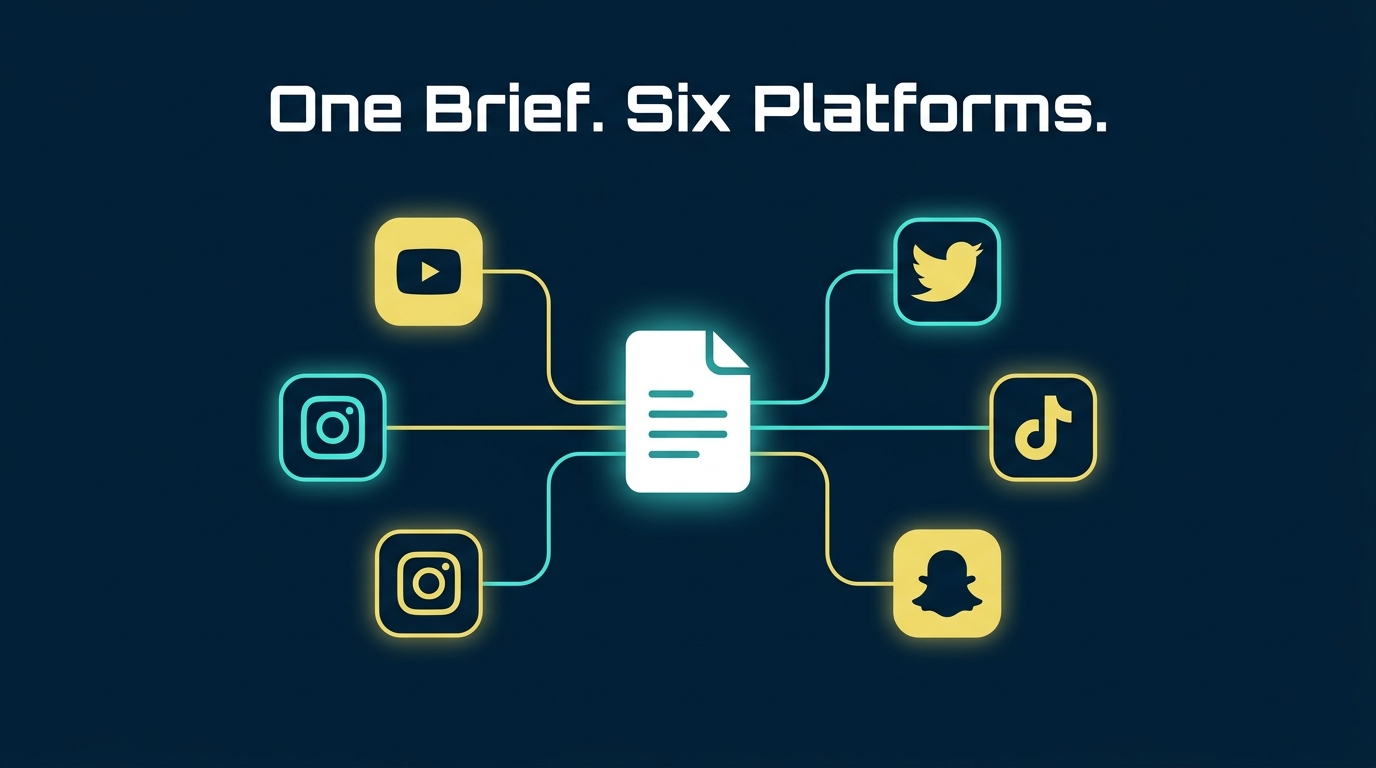
Modern marketing has a scale problem that often disguises itself as a creativity problem. The average marketing team is not short on ideas. It is short on throughput. Every campaign now needs to ship across LinkedIn, X, Instagram, TikTok, YouTube, and Facebook. Each platform rewards a completely different format, cadence, and native style. The result is a predictable operational bottleneck: one solid content brief becomes a week of manual rewrites, formatting tweaks, version control chaos, and last-minute compromises.

This is exactly where an AI social media content creation tool becomes critical operational infrastructure rather than a novelty. The goal is not to generate more generic text. The goal is to take one high-quality brief and systematically transform it into six platform-native assets. These assets must look and read as though they were written specifically for the platform, because they were engineered for the platform.
The demand for a multi-channel digital presence has never been higher. The modern buyer journey is entirely non-linear. Your audience might discover your brand on a TikTok video, research your authority on LinkedIn, and validate your technical depth via a YouTube search. By moving your operations from a manual bottleneck to an automated ecosystem, you can utilize a single, strategic content brief to dominate multiple channels with native, highly engaging messaging.
The 'Copy-Paste Syndrome': Why Generic Content Kills Engagement
The traditional approach to scaling content output is fundamentally broken. When a brand takes a corporate press release or a standard blog post and pastes it verbatim onto X, Instagram, and LinkedIn, they trigger a cascade of algorithmic penalties. Every social network operates on a unique set of variables designed to keep users on their specific platform. When formatting mismatches occur, such as a text-heavy block on a visual platform or corporate jargon on a conversational network, users immediately scroll past. This signals to the algorithm that the content is low-value, effectively killing organic reach.
This phenomenon is known as the Copy-Paste Syndrome. It is a high-effort, low-reward cycle where generic content actively damages brand perception. While the vast majority of modern marketing departments understand the theoretical need to repurpose assets, only 32% use AI effectively to bridge the gap between high volume and high quality.
The reliance on basic scheduling software in the previous decade conditioned marketers to think of distribution as a singular action. You connected your accounts, pasted your link, and hit publish. Today, algorithms are significantly more sophisticated. They demand native feature utilization. They require context. Pushing the exact same text across the digital ecosystem is no longer a strategy: it is a fast track to irrelevance. To capture attention, the core message must remain intact, but the syntax, pacing, and delivery must undergo a complete transformation.
The Evolution of COPE: Upgrading 'Create Once, Publish Everywhere' with AI
The concept of content repurposing has deep roots in digital publishing. The foundational COPE methodology originated as a systematic approach to syndicate content across RSS feeds, websites, and early social channels. The objective was operational efficiency: write the article once and let the software distribute it everywhere.
However, the critical flaw in traditional COPE was its rigidity. It relied on syndicating the exact same text regardless of the destination. It was a solution built for a less complex internet. Modern marketing requires transformation, not just syndication. This is where artificial intelligence redefines the workflow.
An advanced AI social media content creation tool does not blindly copy and paste. It takes the core intellectual property of your initial brief and rewrites the underlying structure for the destination platform. It functions as a digital translator. The system understands that a whitepaper on cybersecurity needs to be an authoritative story on LinkedIn, a punchy statistical thread on X, and a highly visual educational carousel on Instagram. It preserves your strategic intent and brand safety while completely overhauling the delivery mechanism to ensure maximum algorithmic compliance and user engagement.
The 'One Brief, Six Platforms' Campaign: Decoding Platform-Native Languages
To maintain visibility in a highly saturated landscape where brands post approximately 9.5 times per day, intelligent automation is a strict requirement. Automation without contextual awareness is simply spam at scale. The 'One Brief, Six Platforms' campaign solves this by decoding the distinct dialect of each network. Let us examine how a single input, such as a strategic brief detailing a new B2B software integration, is systematically transformed into six distinct, high-performing native formats.
LinkedIn: The Professional Narrative
LinkedIn rewards thought leadership, story-driven hooks, and professional formatting. The platform's algorithm heavily favors zero-click content, meaning the value must be delivered entirely within the post itself rather than relying on an external link. The AI restructures the core brief into a compelling narrative arc. It utilizes strategic line breaks to optimize for the crucial "see more" click, which acts as a positive engagement signal.
The tone is engineered to emphasize business impact, industry context, and actionable takeaways, positioning the author as a definitive authority in their space. For executives looking to scale their personal brand alongside corporate channels, a specialized LinkedIn Engine ensures the tone remains consistently authoritative and engaging without requiring hours of manual drafting from the leadership team.
X (Twitter): High-Impact Punchiness & Threads
The architecture of X demands brevity, immediate value, and high-velocity pacing. Corporate prose goes to die on this platform. The AI social media content creation tool dissects the long-form brief, extracting the most compelling statistics, contrarian viewpoints, and core arguments. It then generates a highly readable, structured thread.
The first post acts as an aggressive hook designed to stop the scroll and open the thread. Subsequent posts deliver concise, standalone value, carefully managing the character count to ensure maximum readability. The syntax shifts entirely from professional storytelling to punchy, high-impact micro-copy that drives retweets and rapid discussion.
Instagram: Visual-First Carousels & Captions
Instagram is fundamentally aesthetic and increasingly educational. Text-heavy briefs fail here unless they are transformed into visual concepts. The system identifies the top three to five key takeaways from the brief and formats them as distinct, concise bullet points optimized for text-based carousel slides.
Simultaneously, the AI generates a caption that balances an engaging narrative with strategic emoji placement. The caption is designed to drive the audience toward the visual asset and ultimately to the link in the bio. The language becomes more accessible, community-focused, and tailored to an audience that prefers visual learning over long-form reading.
TikTok: Vertical Video Hooks & High-Energy Scripts
TikTok requires a complete medium shift. Text posts and static images are largely irrelevant for B2B growth on this network. The platform demands fast-paced, highly engaging vertical video scripts. The AI translates the dry corporate brief into a 60-second performance blueprint.
It dictates visual cues, suggests text overlays for the editor, and drafts auditory hooks for the critical first three seconds to prevent the user from swiping away. The messaging is distilled into high-energy, relatable concepts that align with current platform trends. This ensures the core B2B message resonates in a consumer-centric format, focusing on dynamic delivery and immediate value proposition.
YouTube: SEO-Optimized Descriptions & Community Posts
YouTube operates as a search engine first and a social network second. Success here requires deep optimization. The AI expands the brief into a long-form, search-intent-optimized video description. It integrates secondary keywords naturally, ensuring the video ranks for relevant industry queries.
Furthermore, it automatically generates chapter timestamps based on the core topics outlined in the brief, enhancing the user experience and providing additional metadata for the search algorithm. Just as a dedicated SEO Engine drives organic traffic to your primary website, these precision-engineered YouTube assets drive sustained discoverability and long-term viewership. The system also drafts engaging polls for the Community Tab to maintain audience interaction between major video uploads.
Facebook: Community Engagement & Discussion
Facebook organic reach relies heavily on algorithmic triggers associated with active discussions, particularly within dedicated Groups or established Business Pages. The AI formats the brief to be highly conversational and relatable. It strips away the overly corporate jargon required for LinkedIn and the hyper-brevity needed for X. Instead, it replaces them with open-ended questions and community-focused framing designed to spark comments, shares, and meaningful social interactions. The goal is to build a micro-community around the topic rather than simply broadcasting a corporate update.
The AI Automation Workflow: From Input to Approval Queue
Demystifying the technology is crucial for successful implementation. High-level AI adoption is not a black box where you push a button and hope for the best. It is a structured, four-step architecture designed to augment human strategy with machine efficiency.
- •
Input and Parameter Setting: The process begins by feeding the core brief into the system. This is not a generic prompt. The input includes brand guidelines, specific tone of voice parameters, target audience psychographics, and negative constraints detailing exactly what not to say. This ensures the foundational data is accurate and strictly aligned with your broader marketing objectives.
- •
Scraping and Contextual Enrichment: Before writing a single word, the AI gathers real-time context. It reads any attached URLs, analyzes current competitor positioning on the topic, and pulls live data to enrich the original brief. This prevents the output from sounding generic or outdated.
- •
Transformation via LLM Orchestration: This is the computational heavy lifting. By orchestrating a Multi-Agent Engine, the system routes specific formatting tasks to specialized language models trained on the nuances of each platform. The LinkedIn agent focuses on professional storytelling, while the TikTok agent focuses on script pacing. They work in parallel to process the data simultaneously.
- •
The Approval Queue: We firmly believe in the synergy of human creativity and AI efficiency. The generated assets are never published blindly. They are sent to a human-in-the-loop approval queue. The marketing manager reviews, refines, and signs off on the content, ensuring absolute brand safety and strategic alignment before deployment.
This level of operational maturity is achieved by deploying our dedicated Social Media Agent. This specialized tool handles the complex routing, context gathering, and syntax transformation in the background. It leaves your team to focus exclusively on high-level strategy, relationship building, and final creative approvals.
The Business Impact: Multiplying Output by 20x
Translating this technical workflow into tangible business return on investment reveals a massive competitive advantage. Content creation is traditionally a linear expense: more output requires more headcount. By implementing a precision-engineered AI workflow, you break that linear model.
A single marketing manager utilizing an AI social media content creation tool can output the volume and quality traditionally expected from a five-person social media team. This 20x multiplication in output requires minimal additional time investment from your staff. By eliminating the manual hours spent rewriting, formatting, and agonizing over platform-specific syntax, businesses drastically reduce the Customer Acquisition Cost associated with organic social media.
You achieve total market saturation and maintain a ubiquitous digital presence without the corresponding bloat in payroll or expensive agency retainer fees. It is the definition of operational leverage: doing significantly more with less, without ever sacrificing the premium quality and nuanced thought leadership your audience expects. The gap between businesses utilizing these automated content ecosystems and those relying on manual typing is widening daily.
Precision-Engineer Your Content Strategy Today
Marketing complexity should never overshadow your business potential. The landscape is shifting rapidly, and relying on generic ChatGPT prompts or the manual copy-paste grind of the past decade will only yield diminishing returns. It is time to implement a system that scales your expertise seamlessly across every digital touchpoint without exhausting your internal resources.
Transition from a fragmented, manual workflow to a unified, high-performance content engine. Stop letting platform nuances dictate your output volume and start leveraging technology to multiply your reach. To map out exactly how this architecture can be integrated into your current operations and tailored to your specific brand voice, book a comprehensive Strategy Session with our expert team today. Transform your single brief into a digital asset pipeline.
Frequently Asked Questions (FAQ)
What is the best AI social media content creation tool for B2B companies? The best tool for B2B organizations is one that prioritizes custom brand voice training and multi-agent workflows over generic, off-the-shelf templates. Solutions that integrate directly with your existing strategy, allowing for specific platform dialect transformations while maintaining a strict human-in-the-loop approval process, deliver the highest return on investment and ensure absolute brand safety.
How does AI prevent duplicate content penalties on social media? Advanced AI systems prevent algorithmic penalties by structurally rewriting the core message rather than just swapping a few synonyms. It adapts the syntax, pacing, and formatting to match the native language of each specific platform. This ensures the content is registered by the algorithms as unique, contextually relevant material rather than spammy, cross-posted duplicates.
Can AI write in my specific brand tone of voice across different platforms? Yes. Precision-engineered AI systems are trained on your historical content, brand guidelines, and specific vocabulary constraints. The system applies this overarching brand voice while simultaneously adjusting the localized tone for the platform, ensuring you sound highly professional on LinkedIn but appropriately energetic and fast-paced on TikTok.
What is the difference between content syndication and AI content transformation? Content syndication involves publishing the exact same asset across multiple channels, which often leads to poor engagement due to a mismatch in platform culture and formatting. AI content transformation takes the core concepts of a single asset and completely reconstructs the delivery, formatting, and language to natively fit the technical and cultural expectations of each unique network.
Does AI replace the need for a social media manager? No. AI augments the marketer but does not replace the critical human element. The technology handles the high-volume, repetitive tasks of drafting, formatting, and syntax adaptation. This frees the social media manager to focus on high-level strategy, community engagement, trend analysis, and final creative approval, ultimately driving better overall campaign results.
Want to build marketing systems like this?
Book a Discovery CallRelated Articles

AI Email Marketing: Beyond Drip Sequences
AI email marketing moves beyond basic rule-based automations to intelligent systems that personalise content, optimise send times, generate copy, and adapt sequences based on recipient behaviour in real time.
Read more →
AI Marketing Strategy Framework (2026)
An AI marketing strategy is a structured plan for integrating artificial intelligence into your marketing operations. This framework covers the maturity audit, prioritisation, the build sequence, KPIs, and common strategic mistakes.
Read more →
AI Content Creation: Scale Without Losing Quality
AI content creation is the use of artificial intelligence to research, draft, edit, and optimise marketing content. Learn how to scale production with quality gates, brand DNA frameworks, and workflows that keep the human where it matters.
Read more →