The Complete Guide to AI Marketing for Financial Services and Fintech
30 March 2026 • By Jakub Cambor, Founder of AI for Marketing | Top 1% Upwork Expert Vetted Talent
Last updated: 30 March 2026
Financial marketing is defined by a central tension. The mandate to capture market share and drive pipeline collides directly with the absolute necessity of regulatory compliance. For marketing directors and founders in the financial sector, this creates significant marketing complexity. You are expected to drive growth at the speed of a technology company while operating under the scrutiny of a legacy bank.
The introduction of artificial intelligence has amplified this pressure. The fear of missing out is palpable, yet the implementation fatigue is real. Managing fragmented tools, worrying about rogue algorithms generating non-compliant copy, and sacrificing brand voice for generic output are valid concerns. This is where a precision-engineered approach to AI marketing financial services fintech becomes critical.
Artificial intelligence is not a replacement for human financial expertise. It is an exoskeleton. It augments the marketer with speed, structure, testing, and consistency, while human expertise remains accountable for judgement, suitability, and sign-off. If you feel the fragmentation already—too many tools, too little clarity, and no safe operating model—the fastest path to progress is a strategic baseline. Establishing a Clarity Roadmap is the essential first step for leaders looking to integrate AI safely and profitably, turning ambition into a precision-engineered marketing plan that respects compliance, brand, and commercial targets.

The AI Shift in Financial Services: Why 2026 is the Tipping Point
The integration of AI in the financial sector is no longer a fringe experiment reserved for massive enterprise laboratories. It is a baseline requirement for survival and customer acquisition. The gap between firms operating on legacy manual systems and those leveraging automated intelligence is widening rapidly. Financial services is not adopting AI because it is fashionable; it is adopting AI because the underlying economics of marketing are changing.
Three data points define the moment. First, spending on AI in financial services is projected to rise from $35 billion in 2023 to $97 billion by 2027. That is not experimentation; that is infrastructure investment. Second, 74% of marketers are already incorporating AI into their workflows, meaning the competitive baseline is moving fast. Third, analysts tracking worldwide IT spending note that Gartner reports 80% of financial services firms plan to increase AI marketing spend by 2026, a signal that budgets are shifting heavily toward automation, analytics, and efficiency.
This AI adoption in fintech signifies a shift from viewing machine learning as a cost center to recognizing it as the primary engine for revenue generation. In fintech, the pressure is even sharper. Challenger brands win with distribution, education, and product-led narrative. Incumbents respond with trust, scale, and balance-sheet credibility. AI makes both sides stronger, but only the firms that build an operating system for compliant growth will get compounding returns.
Navigating FCA Regulations: AI and Autonomous Compliance Guardrails
The greatest barrier to AI adoption for any marketing director in this space is the fear of regulatory breach. In the UK, the FCA environment changes how you should design AI marketing from the ground up. The risk is not just a slap on the wrist. It is consumer harm, brand damage, platform bans, remediation costs, and leadership distraction.
Utilizing off-the-shelf, generic AI tools to write financial copy is a significant liability. Generic models hallucinate facts, invent statistics, and lack the nuanced understanding of consumer duty required by law. Two marketers can ask a generic tool the same question and receive different outputs, which is unacceptable when you are building repeatable compliance.
However, when properly architected, custom-engineered AI actually improves compliance rather than threatening it. Bespoke AI agents can be trained specifically on your internal legal frameworks and external regulatory mandates. This transforms AI from a risk factor into autonomous compliance guardrails.
Firms must adhere to strict rules to ensure all communications are fair, clear, and not misleading, as outlined in the FCA financial promotions guidance. By utilizing Retrieval-Augmented Generation (RAG), a custom AI model can be restricted to only pull information from pre-approved, legally vetted documentation.
Before a piece of content even reaches your legal team for final sign-off, the AI can run an autonomous first-pass review against FCA advertising regulations. It flags absolute claims, checks for mandatory risk warnings, and ensures the tone meets consumer duty standards. This drastically reduces the bottleneck between the marketing department and the legal department, allowing compliant financial marketing campaigns to launch faster without compromising safety.
Trust-Based Content Strategies for YMYL Brands
Financial services content lives inside a unique category of digital content known as Your Money or Your Life (YMYL). Content that falls into this category has the potential to impact a reader's future happiness, health, financial stability, or safety. Because the stakes are so high, search engines and consumers demand the highest possible standard of accuracy and authority.
If your content is wrong, misleading, or shallow, the consequences are real. This is where the amateur approach to AI fails completely. Pumping out hundreds of generic, AI-generated articles on how to invest will actively damage your brand and your search rankings. Trust-based marketing for fintech requires a sophisticated synergy of human intelligence and machine efficiency. Trust is not an aesthetic; it is an operating principle.
To succeed in a YMYL content strategy, publishers must align with search engine quality rater guidelines to demonstrate firsthand expertise and trustworthiness, a standard reinforced by Google's helpful content documentation. AI cannot replicate the lived experience of a seasoned wealth manager or the strategic foresight of a fintech founder.
Instead, AI should be utilized for the heavy lifting of research, data synthesis, and structural formatting. The human expert provides the unique thesis, the empathy, and the nuanced market view. The AI then takes that expert input and engineers it for search intent, readability, and platform-specific algorithms. This ensures your brand remains the authoritative voice while still benefiting from the scale that technology provides.
Scaling Compliant Thought Leadership with an AI Content Engine
Most financial firms do not have a content problem. They have a production system problem. They have expertise locked inside investment committee notes, risk team briefings, product insight, adviser conversations, and market commentary. The bottleneck is turning that expertise into a repeatable flow of compliant content across SEO, LinkedIn, email, and sales enablement without rewriting the same idea ten times.
The modern financial firm faces a persistent scale versus quality paradox. To build organic traffic and establish authority on platforms like LinkedIn, you need a high volume of consistent content. To maintain compliance and brand prestige, you need exacting quality control. Hiring a massive team of specialist financial writers is often cost-prohibitive, leading to implementation fatigue.
The solution is a unified, automated infrastructure. Implementing a bespoke Content Engine allows firms to take a single piece of human-led financial insight and safely repurpose it across multiple channels without losing the sophisticated brand voice.
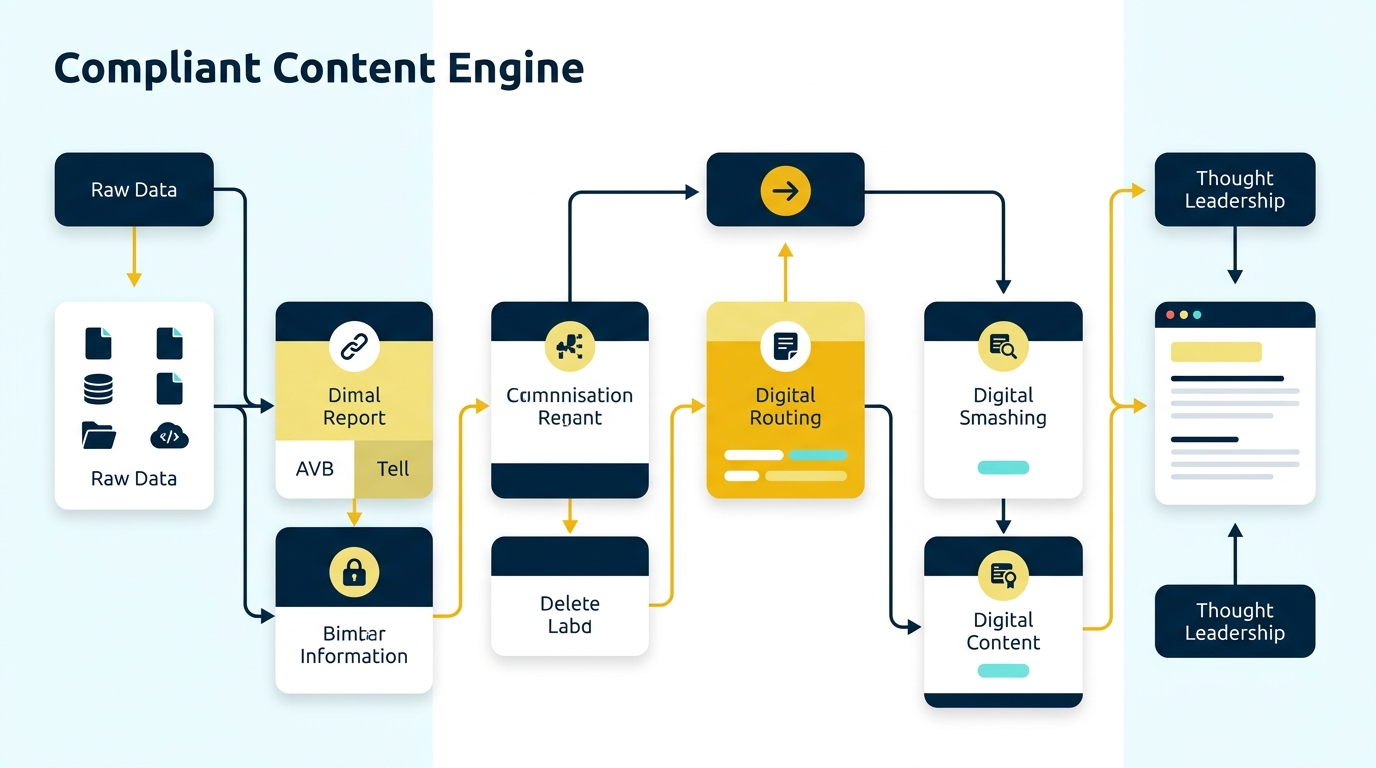
Imagine your lead portfolio manager records a ten-minute video discussing the impact of recent interest rate changes. The AI Content Engine takes that single asset and initiates a multi-agent workflow. First, it accurately transcribes the audio, understanding complex financial terminology. Second, it extracts the core arguments and drafts a comprehensive, 2000-word SEO article optimized for specific search intent. Third, it slices the transcript into a five-part educational sequence for LinkedIn, tailored for executive presence. Finally, it formats a summary for your weekly email newsletter.
Every single output is cross-referenced against your custom compliance guardrails. This is the definition of precision-engineered AI marketing financial services fintech. It transforms a single moment of human brilliance into a month of compliant, multi-channel thought leadership, effectively acting as a marketing department in a box.
Lead Generation & Paid Ads: Overcoming Restrictions in Regulated Industries
Organic thought leadership is the foundation of trust, but performance marketing is the engine of rapid customer acquisition. However, executing financial services paid ads is notoriously difficult. Platforms like Meta, Google, and LinkedIn impose severe restrictions on advertising related to investments, loans, and cryptocurrency. Ad accounts are frequently suspended due to minor policy infractions, causing massive disruptions in pipeline velocity.
AI provides a strategic advantage by operating in the background. Rather than relying on AI to write aggressive direct-response ad copy—which often triggers platform bans—sophisticated marketers use AI for predictive audience modeling and robust data analysis.
Fintech lead generation relies heavily on lowering Customer Acquisition Cost (CAC) while maintaining high lead quality. A regulated sales pipeline is fragile when the top of the funnel is noisy. AI algorithms can analyze your existing CRM data to identify hidden patterns in your most profitable clients. It segments by intent signals from on-site behavior and scores leads based on content consumption patterns. It then builds highly accurate lookalike audiences that convert at a much higher rate, predicting which segments are more likely to convert and shaping nurture paths accordingly.
Furthermore, AI facilitates rapid, compliant A/B testing. It can generate dozens of subtle variations of ad copy and creative that remain strictly within regulatory boundaries. It ensures landing page alignment so the ad promise matches precisely with the risk statements on the site. By connecting these campaigns to automated Looker Studio dashboards, marketing directors gain real-time, unified visibility into Return on Ad Spend (ROAS).
GEO Optimization: Capturing Local and Global Fintech Markets
Search behavior is undergoing a fundamental shift. Users are no longer just typing fragmented keywords into a search bar and clicking the first blue link. They are asking complex, conversational questions to AI-powered search engines like Google's Search Generative Experience (SGE) and Perplexity.
This requires a shift from traditional Search Engine Optimization to Generative Engine Optimization (GEO). AI search engines do not just rank content; they read, synthesize, and summarize it, providing direct answers to the user while citing the most authoritative sources.
For a financial firm, being cited as the authoritative source by an AI engine is the new gold standard of digital visibility. GEO Optimization involves structuring your content with clear, definitive answers to complex financial queries. It requires deep entity optimization, ensuring the AI understands exactly who you are, what services you provide, and why your firm is a trusted entity in the financial space.
Frequently Asked Questions (FAQ)
How can financial services use AI for marketing while staying FCA compliant? Financial firms can maintain compliance by utilizing custom-engineered AI models that use Retrieval-Augmented Generation (RAG). By restricting the AI to only pull data from pre-approved, legally vetted documents, the system acts as an autonomous compliance filter, flagging missing risk warnings and preventing absolute claims before human review.
What is the projected ROI of AI marketing in the fintech sector? ROI typically comes from reduced production cost, faster testing cycles, and higher conversion from better segmentation and personalization. By automating research and data analysis, firms drastically reduce manual operational costs, while AI-driven predictive modeling in paid advertising significantly lowers Customer Acquisition Cost (CAC).
How does Google treat AI-generated content for YMYL financial websites? Google evaluates YMYL content based on Experience, Expertise, Authoritativeness, and Trustworthiness. Purely generic AI content fails this standard, but AI-assisted content can perform exceptionally well when it is expert-led, fact-checked, transparently authored, and genuinely improves the user's decision-making process.
What are the best AI marketing tools for lead generation in regulated industries? The most effective approach is not a single tool, but a unified ecosystem of AI agents governed by strict compliance rules. This includes predictive analytics for audience modeling, automated A/B testing software for compliant ad variations, and advanced CRM integrations that score inbound leads based on historical conversion data.
How do you build a compliant AI Content Engine for a UK financial firm? Building a compliant system requires mapping your specific regulatory requirements, defining claims, and establishing prohibited language first. You then construct a workflow where human experts provide raw insights, and AI agents transcribe, format, and optimize that data, passing it through an automated compliance checklist before final human approval.

Conclusion: Your Next Steps in AI-Driven Financial Marketing
AI marketing financial services fintech is not about publishing faster for the sake of it. It is about building a compliant growth system that protects trust while improving speed, consistency, and commercial outcomes.
The landscape of financial customer acquisition has permanently changed. The gap between AI-driven businesses that can scale personalized, compliant campaigns and those relying on manual, legacy processes is only getting wider. Attempting to navigate the complexities of API integrations, prompt engineering, and strict regulatory guardrails without a systematic approach leads to wasted budgets and brand risk.
You do not have to manage this transformation alone. Success requires moving beyond generic tools and adopting a bespoke infrastructure tailored specifically to your business goals. The firms that win will be the ones with engineered guardrails, trust-led content, and a repeatable Content Engine that turns expertise into pipeline without compromising standards.
The most effective way to eliminate marketing complexity and build a predictable growth system is to architect a strategy before you write a single line of code or generate a single piece of content. Take control of your digital infrastructure today. Book a Growth and AI Clarity Roadmap strategy session to receive a custom, precision-engineered blueprint designed specifically for the rigorous demands of the financial sector. Stop experimenting with generic prompts and start building a compliant, automated engine for long-term market dominance.
Want to build marketing systems like this?
Book a Discovery CallRelated Articles

AI Email Marketing: Beyond Drip Sequences
AI email marketing moves beyond basic rule-based automations to intelligent systems that personalise content, optimise send times, generate copy, and adapt sequences based on recipient behaviour in real time.
Read more →
AI Marketing Strategy Framework (2026)
An AI marketing strategy is a structured plan for integrating artificial intelligence into your marketing operations. This framework covers the maturity audit, prioritisation, the build sequence, KPIs, and common strategic mistakes.
Read more →
AI Content Creation: Scale Without Losing Quality
AI content creation is the use of artificial intelligence to research, draft, edit, and optimise marketing content. Learn how to scale production with quality gates, brand DNA frameworks, and workflows that keep the human where it matters.
Read more →