AI Content Engine vs Freelance Writers vs Agencies: The 2026 Guide for Bionic Marketers
26 March 2026 • By Jakub Cambor, Founder of AI for Marketing | Top 1% Upwork Expert Vetted Talent
Last updated: 26 March 2026


Marketing directors and agency founders currently face a severe operational bottleneck. The demand for high-quality, search-optimized content has never been higher, yet traditional methods of producing it are breaking under the pressure of modern scale. You are likely staring at a spreadsheet right now, calculating how to double your organic traffic without tripling your payroll.
Content in 2026 is not a matter of writing a blog post and hoping for the best. It is a production system that must hit search intent, brand voice, compliance, distribution, and a critical new layer of discoverability: the AI-generated answers that customers read before they ever reach a website.
This brings us to the most critical operational decision you will make this year. The debate of an AI content engine vs freelance writers, and where traditional agencies fit into the mix, is no longer a philosophical discussion about technology. It is a hard-line financial and structural choice.
If your team is under pressure to ship more content without lowering standards, you are feeling two forces at once. The efficiency mandate requires you to publish more, faster, across more formats. The credibility mandate requires you to maintain expertise, originality, and a voice that sounds like a real business rather than a content mill.
While automated systems win on efficiency and humans win on nuance, the strongest content teams in 2026 are not picking a side. They are building a hybrid model that makes both better.
The Evolution of Content Creation: Why 2026 Demands a New Approach
The marketing landscape has shifted dramatically, and the data dictates the reality of the market. The generative AI content sector is projected to reach $80 billion by 2030, and current industry benchmarks indicate that 88% of marketers are already interacting with these technologies daily. Adoption has moved entirely from experimentation to infrastructure.
However, this widespread access has created a new problem: implementation fatigue. Almost every business has access to the same foundational models, but very few possess a functional system to harness them. Teams test a few tools, try a prompt library, generate a handful of drafts, and then stall. The hardest parts of content marketing are not writing sentences. The hardest parts are the operating constraints.
Keeping a brand voice consistent across dozens of pieces, repeating SEO steps without cutting corners, proving performance with clean reporting, and coordinating approvals across channels require a system. Marketing leaders are overwhelmed by fragmented tools and the manual grind of moving data between platforms. They do not need another login. They need a comprehensive infrastructure.
Modern systems are converging on integrated workflows rather than isolated tools. When evaluating the best AI content platforms for 2026, leaders must look beyond simple text output and demand autonomous systems that handle research, drafting, and governance in a single unified motion.
From SEO to GEO (Generative Engine Optimization)
Classic Search Engine Optimization still matters, but the rules of visibility have fundamentally changed. We have entered the era of Generative Engine Optimization (GEO).
Search engines now utilize large language models to generate direct, synthesized answers known as AI Overviews. To appear in these premium digital real estate spaces, your content requires a level of structural consistency, semantic depth, and factual density that manual writing struggles to maintain at scale.
If you want visibility inside these model-generated answers, your content needs to be structurally legible. This means clear sections, definitions, comparisons, and step-by-step formatting. It must be consistent in terminology and entity relationships, supported by verifiable signals, and updated routinely. Stale content gets filtered out rapidly in AI answer layers.
Achieving this optimization across hundreds of articles requires a systemic approach. Relying on human memory to perfectly format every heading, bullet point, and schema markup is a recipe for inconsistency. The effort required to maintain format discipline at scale is exactly the kind of work automated engines excel at, while the craft required to add lived experience is exactly what humans are for.
The Freelance Writer: The Master of Nuance
Before analyzing automated systems, we must acknowledge the enduring value of the human element. Freelance writers have been the backbone of content marketing for decades. They are the masters of nuance, lived experience, and strategic thought leadership.
A great freelancer is not just a person who writes. They are a portable strategy and empathy unit. They can hear what you mean, challenge weak thinking, interview your subject matter experts, and translate expertise into a compelling narrative.
Pros of Freelancers
The primary advantage of a skilled human writer is their creative ceiling. They can synthesize complex, unrecorded human experiences into compelling stories. The best freelancers do more than summarize existing information. They interpret it. They add the "why," the trade-offs, the story behind the decision, and the subtlety that makes content feel earned.
If you are building an executive presence or a category point of view, a strong writer can capture tone, pacing, and conviction in ways that still outperform fully automated drafting. Furthermore, freelancers can get on a call with your product lead or founder and extract what matters. That ability to distill tacit knowledge into structured content remains a significant competitive edge.
Cons & Risks
Despite their creative strengths, freelancers introduce severe operational bottlenecks for growing companies.
- • Cost: Quality human writing is expensive. A mid-range freelance writer typically charges upwards of £300 per comprehensive article, and specialist niches demand even higher rates. While this can be the right investment for flagship pieces, it makes scaling your daily output financially prohibitive.
- • Speed: Turnaround times are measured in days, if not weeks. The process involves pitching, outlining, drafting, and multiple rounds of revisions. In a market where speed to publication can determine search dominance, this latency is a massive disadvantage.
- • Scalability & Risk: The most significant flaw in the freelance model is dependency risk. A human writer has a hard cap on their output. If your primary freelancer gets sick, takes a vacation, or accepts a full-time role elsewhere, your entire content pipeline freezes instantly. Scaling from ten articles a month to fifty requires hiring, vetting, and managing multiple new writers, which multiplies your administrative overhead and introduces severe quality variance across your roster.
The Content Agency: The Strategic Heavyweight
For businesses that possess high budgets but lack internal marketing leadership, the traditional content agency has long been the default solution. Agencies offer a completely hands-off approach, acting as an outsourced marketing department.
When executives weigh the heavy overhead of traditional firms against modern alternatives, they often compare agencies vs freelancers vs AI for content creation to understand where their budget is actually going. Agencies position themselves as the ultimate strategic heavyweights, but that weight comes with significant friction.
Pros of Agencies
Agencies excel at strategic depth and multi-channel management. When you hire an agency, you gain access to an entire team of specialists: SEO strategists, managing editors, dedicated writers, and graphic designers. They handle the content calendar, the keyword research, the publication schedule, and the performance reporting.
Good agencies can align content with positioning, funnel stages, and commercial goals, rather than just publishing topics that might rank. If your plan includes blog posts, LinkedIn updates, email sequences, and paid social creative, agencies can provide orchestration across the entire mix.
Cons & Risks
The agency model is highly effective, but it is fundamentally built on heavy overhead and slow execution.
- • Cost: Traditional agencies are the most expensive option on the market. You are not just paying for the content: you are paying for the account manager, the office space, and the agency's profit margins. Costs typically range from £100 to £500 per 1,000 words, often bundled into rigid monthly retainers that cost thousands of pounds regardless of actual output.
- • Speed: Agencies are notoriously slow. The layers of internal approval required before a piece of content reaches your desk mean that turnaround times are measured in weeks. Reacting to a sudden industry trend is nearly impossible when your content has to pass through an account manager, a strategist, a writer, and an editor.
- • Risk: Agencies can struggle to capture the sharp edges of your product, your customers, and your internal decisions unless you invest significant time in deep onboarding. Furthermore, some agency models optimize for billable hours and scope expansion. That can lead to bloat: more meetings, more deliverables, and less clarity on actual performance.
The AI Content Engine: Scale and Consistency Redefined
It is critical to define what an AI Content Engine actually is in 2026. We are not talking about opening a browser tab, pasting a generic prompt into a chatbot, and copying the output. That is amateur behavior.
A true AI Content Engine is a sophisticated, autonomous workflow system. It integrates research, competitor analysis, keyword clustering, brief generation, and automated drafting into a single, seamless pipeline. It is a production line designed for absolute repeatability.
When comparing the operational efficiency of automated systems against human contractors from a leadership perspective, the debate of an AI content agent vs freelance writer highlights a fundamental shift in how businesses view productivity. Engines do not sleep, they do not suffer from writer's block, and they never deviate from established brand guidelines.
Pros of AI Engines
- • Cost Efficiency: The financial efficiency is unmatched. A typical benchmark in 2026 is approximately £55 per post for engine-driven production, depending on inputs and quality assurance requirements. That cost profile changes the content math entirely. You can publish enough to win categories, not just participate in them.
- • Speed: Turnaround times are measured in minutes. This is not about speed for its own sake: speed unlocks iteration. You can respond to product updates, market changes, and seasonal demand without re-planning the entire quarter.
- • Consistency & Process Discipline: Engines provide an incredibly high, unwavering quality floor. They are excellent at maintaining structure, formatting, entity consistency, and brand rules. They do not forget the checklist. GEO rewards structured clarity, and engines can perfectly enforce headings, summaries, and internal linking patterns that help content perform in both classic search and AI-generated answer surfaces.
Cons & Risks
The primary risk of relying entirely on automation is the originality gap. Left completely unguided and unedited, AI can produce content that is technically perfect but emotionally flat. It can summarize what exists, but it cannot replace lived experience, proprietary insight, or a genuine point of view.
AI can achieve a high quality floor, but the highest-performing pieces often require human judgment: what to include, what to exclude, what is actually true in practice, and what your brand believes. An engine without guardrails can drift into generic claims and repetitive phrasing. In regulated spaces, you need review layers. Engines can support compliance workflows, but they cannot replace the compliance function entirely.
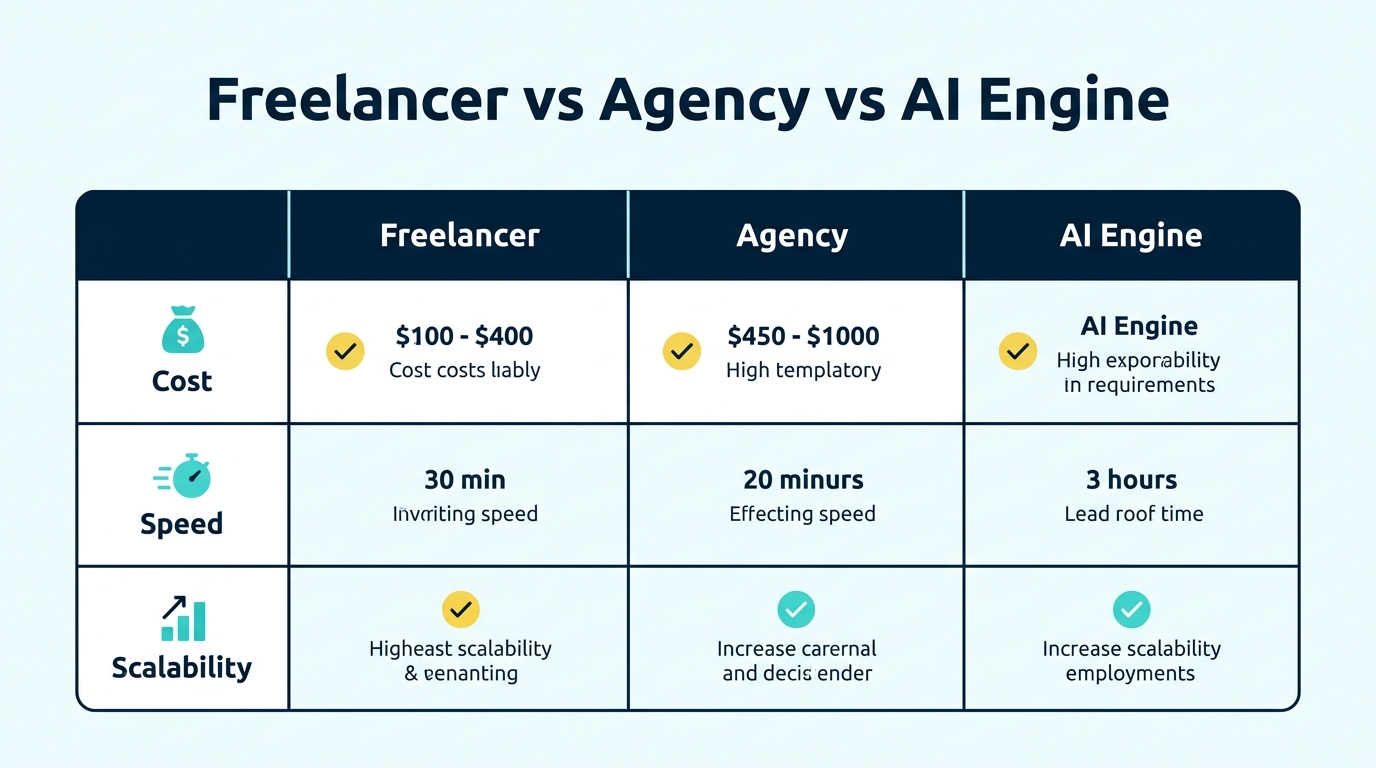
Head-to-Head Comparison: Cost, Speed, and Scalability
To make an informed decision for your business strategy, we must synthesize the data into a hard-hitting operational comparison. The contrast between an AI content engine vs freelance writers and agencies becomes stark when viewed through the lens of unit economics and operational flow.
Cost Per Piece:
- • AI Engine: Highly efficient and predictable, averaging ~£55 per post. Best for high-volume publishing and content refresh cycles.
- • Freelance Writer: Mid-to-high cost, typically £300+ per piece. Best for thought leadership and high-stakes flagship content.
- • Content Agency: Extremely high cost, ranging from £100 to £500 per 1,000 words plus management retainers. Best for fully outsourced, multi-channel campaigns.
Turnaround Time:
- • AI Engine: Instantaneous execution measured in minutes.
- • Freelance Writer: Moderate latency measured in days.
- • Content Agency: High latency due to bottlenecks, measured in weeks.
Brand Consistency & Scalability:
- • AI Engine: Infinite scalability with an unwavering quality floor. Perfect adherence to brand guidelines and formatting rules.
- • Freelance Writer: Hard cap on scalability. Consistency drops if you rotate writers or scale quickly without strong editorial governance.
- • Content Agency: Scalable but expensive. You pay heavily for the coordination overhead that scaling requires.
This is the most useful way to frame the decision. Humans possess a high quality ceiling: they can create emotionally profound narratives. However, they also have a fluctuating quality floor depending on workload and personal variables. AI engines flip this dynamic. They provide an incredibly high, consistent quality floor at infinite scale, ensuring your baseline marketing operations never falter.
The Hybrid Solution: Why the "Bionic Marketer" Wins
The ultimate realization for modern business leaders is that you do not have to choose between scale and quality. The future is not a binary choice between humans and machines. It is a precision-engineered partnership.
This is the core philosophy of the bionic marketer. This approach uses AI as a powerful exoskeleton to augment human creativity, not replace it. Humans own the thinking: positioning, messaging, strategic priorities, editorial judgment, and final approvals. The engine owns the throughput: research assembly, drafting, formatting, optimization, repurposing, and refresh cycles.
This structure eliminates the worst parts of content production: staring at blank pages, repetitive formatting, endless re-briefing, and inconsistent output. It keeps the best parts: taste, originality, and real accountability. Hybrid workflows also reduce creative burnout. Your best people stop spending their time on first drafts and start spending it on strategic decisions.
Introducing the Autonomous Content Engine
At AI for Marketing, we built our model for companies that need scale without compromising brand integrity. We operate as a hybrid "Agency-as-a-Software" model. We are not selling you a generic template library or a basic prompt pack. We build a bespoke system aligned to your strategy, your voice, and your commercial goals.
Our bespoke Autonomous Content Engine offers the strategic depth of a traditional agency, the creative nuance of a guided human expert, and the unprecedented speed and cost-efficiency of artificial intelligence.
We handle the complex setup, the API integrations, and the system training. You avoid the hassle of managing multiple accounts and paying for disparate tokens. We deliver a precision-engineered content pipeline that drives compounding organic growth:
- • Engine-level efficiency: Consistent drafts, structured outputs, and repeatable workflows.
- • Agency-grade strategy: Topic architecture, intent mapping, and strict SEO and GEO alignment.
- • Human nuance built in: Editorial direction, brand governance, and final quality control.
If you have tried using AI and ended up with generic copy or inconsistent results, the gap is rarely the model itself. The gap is the system: the inputs, the guardrails, the review layer, and the publishing rhythm. A hybrid engine gives you a content machine that is fast enough to compete and smart enough to sound exactly like your brand.
Frequently Asked Questions (FAQs)
Is an AI content engine better than a freelance writer for SEO?
For structural SEO and Generative Engine Optimization (GEO), an AI engine is vastly superior due to its ability to process massive amounts of search data instantly and apply perfect formatting consistently. However, a freelance writer is better for injecting unique, original opinions that build deep brand loyalty. The best SEO results come from using an AI engine to build the optimized foundation, followed by a human writer adding unique insights.
How much does an AI content engine cost compared to an agency?
An AI content engine is significantly more cost-effective. While a traditional agency might charge thousands of pounds a month in retainers and hundreds of pounds per article to cover their overhead, a properly configured AI engine can produce comprehensive, optimized posts for roughly £55 each. This unified billing approach removes the metered anxiety of traditional agency pricing while unlocking high-volume publishing.
Can AI content rank on Google and AI Overviews (GEO) in 2026?
Absolutely. Search engines in 2026 do not penalize content simply because it was generated by AI; they penalize content that is unhelpful, spammy, or factually incorrect. A sophisticated AI content engine is specifically designed to produce high-value, factually dense, and perfectly structured content that algorithms favor for both traditional rankings and AI Overviews.
Will AI replace freelance content writers entirely?
No. AI will replace mediocre writers who only produce generic, surface-level content. However, it will not replace expert freelance writers who offer original research, conduct interviews, and provide strong strategic opinions. Top-tier writers are evolving into bionic marketers, using AI engines to scale their own output and focus entirely on high-level creative nuance and editorial leadership.
What is a hybrid content marketing model?
A hybrid content marketing model is a strategic framework that combines the speed, scale, and cost-efficiency of an AI content engine with the strategic oversight, empathy, and creative nuance of human experts. It involves using AI for research, structuring, and drafting, while human professionals handle strategy, unique brand voice injection, and final editorial approval. This model provides the highest possible return on investment for modern businesses.

Want to build marketing systems like this?
Book a Discovery CallRelated Articles

AI Email Marketing: Beyond Drip Sequences
AI email marketing moves beyond basic rule-based automations to intelligent systems that personalise content, optimise send times, generate copy, and adapt sequences based on recipient behaviour in real time.
Read more →
AI Marketing Strategy Framework (2026)
An AI marketing strategy is a structured plan for integrating artificial intelligence into your marketing operations. This framework covers the maturity audit, prioritisation, the build sequence, KPIs, and common strategic mistakes.
Read more →
AI Content Creation: Scale Without Losing Quality
AI content creation is the use of artificial intelligence to research, draft, edit, and optimise marketing content. Learn how to scale production with quality gates, brand DNA frameworks, and workflows that keep the human where it matters.
Read more →