Why Your AI Content Sounds Like a Robot (And How Brand DNA Fixes It)


"AI Brand Voice" should not be an oxymoron. Yet for many businesses, the moment they scale content with artificial intelligence, their writing starts to sound like it was produced by the same invisible company as everyone else: technically correct, broadly agreeable, and strangely empty.
This is the current reality of the modern marketing department. Marketing directors are saving hours of drafting time, only to spend those exact hours rewriting lifeless, mechanized prose that fails to resonate with their target audience. The goal of implementing technology should never be to dilute your corporate identity. The objective is augmentation, not replacement. You do not want to replace your best thinkers: you want to give them an exoskeleton.
The core issue is not a failure of the technology itself. Foundational models are incredibly powerful reasoning engines. The problem is a failure of calibration and architectural design. When you rely on generic prompts, you receive generic outputs. To solve this, businesses must engineer a bespoke AI Brand Voice. This requires moving away from casual experimentation and moving toward precision-engineered systems that protect and project your unique corporate identity at scale.
The "Brand Voice Crisis" and the "Copy-Paste Intern" Effect
We are currently witnessing a homogenization of digital content. As more companies adopt off-the-shelf generative tools without proper configuration, unique corporate tones are merging into a single, predictable cadence. This is the "Brand Voice Crisis." Your audience is becoming highly sophisticated, and their tolerance for mechanized communication is dropping rapidly.
Many organizations treat their new generative tools like a magic wand rather than a highly capable system that requires rigorous onboarding. We call this the "Copy-Paste Intern" effect. Imagine hiring a brilliant intern who has read every book in the world but knows absolutely nothing about your specific company history, your strategic objectives, or the nuanced pain points of your specific buyers. If you ask this intern to write a thought leadership article, the grammar will be flawless. The structure will be logical. But the content will be entirely devoid of strategic intent.
This intern will default to safe, predictable statements. They will use complex vocabulary to mask a lack of deep, proprietary insight. This is exactly what happens when you use uncalibrated generative tools. The resulting content is technically correct but strategically hollow. It does not know what to emphasize, what to ignore, what you would never say, or what you would stake your reputation on.
The danger here extends far beyond boring copy. It directly impacts consumer trust. When a potential client reads a piece of content that feels automated and generic, they unconsciously project that same lack of care onto your core services. Maintaining a consistent, authentic identity is not just a marketing exercise: it is a fundamental pillar of client retention. In fact, recent data on brand voice and consumer trust highlights that audiences quickly disengage when a company's communication style feels disjointed or inauthentic. Trust is built on consistency, and untrained models are inherently inconsistent.
Understanding "Context Debt" in AI Generation
To engineer a solution, we must first diagnose the mechanical root cause of robotic content. The primary culprit is a concept known as "Context Debt."
Large Language Models operate on probability. They are designed to predict the next most logical word or sequence of words based on the vast amounts of data they were trained on. Because their training data encompasses a massive cross-section of the entire internet, their default output represents the absolute average of human communication.
In marketing, average is the enemy. Average does not convert. Average does not position you as a premium service provider. Context Debt is the gap between the model's broad, generic knowledge and your specific, nuanced business reality. When you type a simple command into a basic interface, you are providing zero context. The system has no choice but to fill that void with the most statistically probable, middle-of-the-road phrasing available.
Paying off this Context Debt is the only way to elevate the output. You must bridge the gap by feeding the system highly specific parameters regarding your audience psychographics, your historical successes, and your unique market positioning. You must narrow the probability field so the system stops acting like the entire internet and starts acting exclusively like your best internal experts.
The Solution: Building Your "Brand DNA Framework"
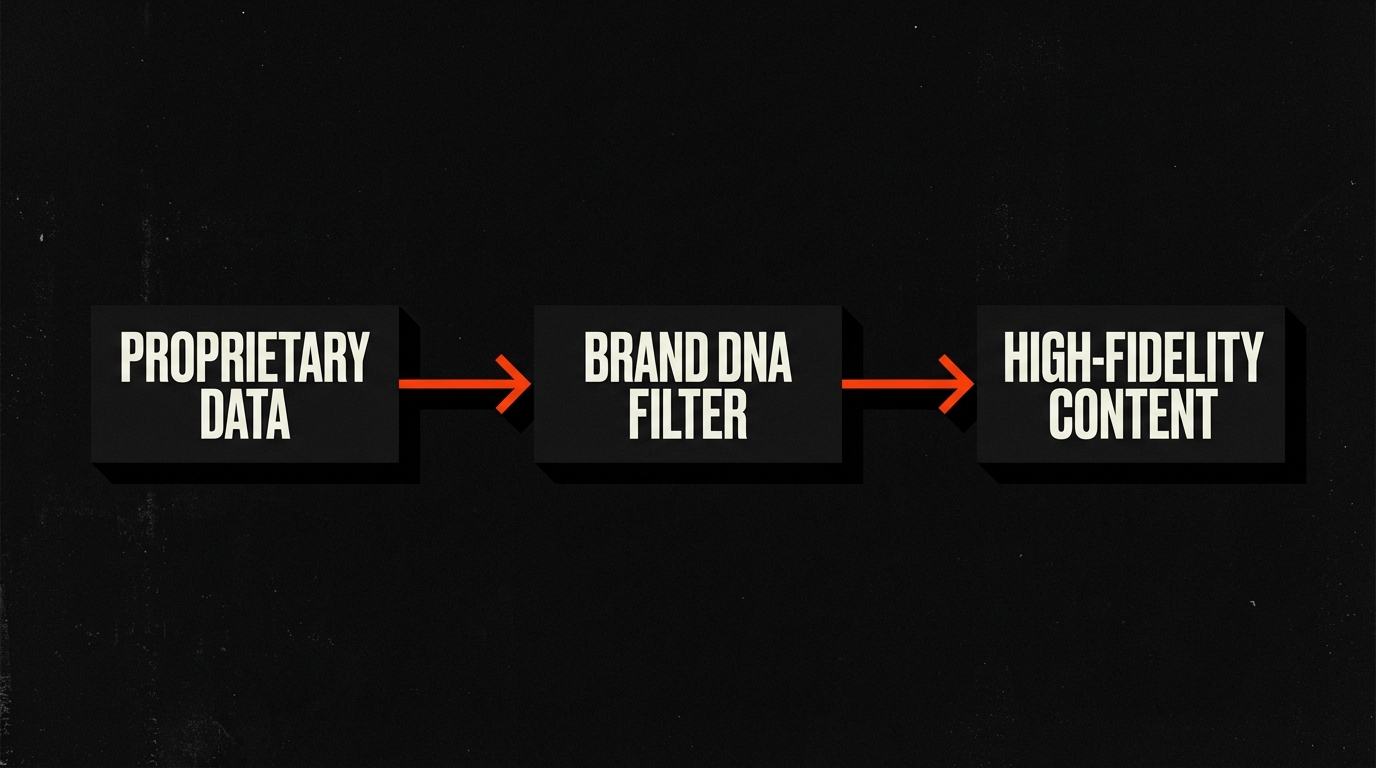
Overcoming Context Debt requires a systematic approach. You cannot simply instruct a machine to sound more engaging. These are subjective terms that a mathematical model cannot accurately interpret without baseline data. Instead, you must build a comprehensive Brand DNA Framework.
A Brand DNA is your organization’s personality, operational philosophy, and strategic intent translated into structural text rules. It is the architectural blueprint that governs how your digital ecosystem communicates. Building this framework is a rigorous, three-step process:
Step 1: Gather Strong Examples
The foundation of any high-fidelity system is the quality of its input data. You must conduct a thorough audit of your existing communications to identify your "golden datasets." These are the assets that perfectly encapsulate your desired tone and have historically driven results. Gather successful sales proposals, high-converting email sequences, and transcripts of your founders speaking on podcasts. This raw data forms the baseline truth that the system will use to understand your unique cadence and vocabulary.
Step 2: Analyze and Summarize
Once you have aggregated your golden datasets, you must reverse-engineer them. You must use the technology to analyze the text and extract the specific, repeatable rules that define your communication style. This involves prompting the system to act as a linguistic analyst. Instruct it to identify your average sentence length, preferred transition phrases, and specific formatting habits. More importantly, identify your negative constraints: what words do you never use?
Step 3: Test, Refine, and Implement
Finding the perfect AI Brand Voice is an iterative process. You must implement a rigorous testing phase where you generate sample content and compare it against your golden datasets. This is where human expertise is critical. A senior marketer must review the output and identify the subtle deviations from the target tone. Once this threshold is reached, the framework is locked in and deployed across your customized architecture, acting as a true digital extension of your marketing department.
Aligning AI Content with Google’s E-E-A-T and Information Gain
The necessity of a Brand DNA Framework extends beyond aesthetic preference: it is a critical requirement for organic search visibility. Google’s primary objective is to serve results that provide genuine value to the user. To evaluate this, they rely heavily on the E-E-A-T framework: Experience, Expertise, Authoritativeness, and Trustworthiness.
Generic models inherently lack these elements. Furthermore, search algorithms prioritize a concept known as Information Gain. Information Gain measures the net new value a piece of content adds to the internet. If an article simply summarizes the top ten existing search results, its Information Gain score is zero. This is exactly what uncalibrated generative tools do.
To rank competitively, your content must introduce original frameworks and unique strategic perspectives. This is where a precision-engineered SEO Engine becomes indispensable. By grounding the generation process in your bespoke Brand DNA Framework, you force the system to filter broad topics through your unique corporate lens, aligning perfectly with Google's guidelines on creating helpful, people-first content.
Generic AI Slop vs. Precision-Engineered Content Engines
The divide in the modern business landscape is no longer between those who use technology and those who do not. The divide is between amateurs using basic interfaces and professionals deploying precision-engineered ecosystems. The amateur approach results in "generic AI slop"—unscalable, inconsistent, and ultimately damaging to the brand.
The professional approach involves building high-fidelity content systems. This is not a single prompt: it is a bespoke, multi-agent architecture designed to mirror the workflows of a high-functioning marketing department. Modern marketing strategy trends indicate that competitive advantage now belongs to organizations that build proprietary, tech-driven ecosystems.
In a precision-engineered environment, the workflow is distributed. One specialized agent might be responsible for analyzing search intent, while another, deeply trained on the Brand DNA Framework, drafts the copy. This is exactly why we build bespoke Content Engines rather than sell templates. Templates create similarity. Engines create consistency and differentiation.
Automated Brand Voice Guardians and Human-AI Synergy
As we look toward the future of marketing operations, we are entering the era of Automated Brand Voice Guardians. Imagine a system where every piece of digital communication is automatically scored and graded against your core identity before it is ever published. This represents the ultimate realization of the Bionic Marketer.
The technology provides the speed and infinite scale, while the human expert provides the strategic vision and final qualitative approval. It is a perfect synergy of human creativity and machine efficiency. The era of robotic, mechanized content is over for those willing to invest in proper architecture.
Stop settling for generic outputs that dilute your market positioning. It is time to transition from casual experimentation to strategic implementation. If you are ready to audit your current workflows and eliminate Context Debt, booking a Clarity Roadmap session with our architectural team is the first step toward precision-engineered marketing.
Frequently Asked Questions (FAQs) About AI Brand Voice
Why does AI-generated content sound so robotic?
Generative models sound robotic because they operate on mathematical probability, predicting the most common word sequences based on broad internet data. Without specific parameters, known as Context Debt, the model defaults to a statistical average that lacks nuance.
What is an AI Brand Voice and how do I create one?
An AI Brand Voice is a customized set of instructions and data inputs that forces a model to replicate your specific corporate identity. You create one by building a Brand DNA Framework through auditing successful content and extracting structural writing rules.
Will Google penalize my website for using AI content?
Google does not penalize content based on its generation method, but it does penalize content that lacks original value and Information Gain. High-fidelity systems trained on proprietary data can perform exceptionally well in search results.
What is the difference between a generic AI prompt and a Content Engine?
A generic prompt is a single instruction resulting in unpredictable output. A Content Engine is a bespoke ecosystem of specialized agents working in sequence to research, draft, and score content against strict brand guidelines.
Want to build marketing systems like this?
Book a Discovery CallMore Insights
The Ultimate Guide to Retargeting AI Ad Creative That Converts
Discover how retargeting AI ad creative scales personalization, combats fatigue, and drives incremental lift with predictive audience segmentation and server-side tracking.
Read more →
How to Measure the ROI of AI Marketing Automation: Metrics, Frameworks, and Dashboards
Learn how to measure the ROI AI marketing automation provides. Discover the frameworks, metrics, and dashboards needed to scale revenue and save time.
Read more →
How to Reduce Your Cost Per Acquisition by 40% with AI-Powered Ad Creative
Discover how to reduce CPA with AI ad creative strategies. Shift to creative-led growth, accelerate platform learning, and cut acquisition costs by up to 40%.
Read more →