AI Ad Images vs Stock Photos: The Ultimate Guide for Google Ads Performance
26 March 2026 • By Jakub Cambor, Founder of AI for Marketing | Top 1% Upwork Expert Vetted Talent
Last updated: 26 March 2026
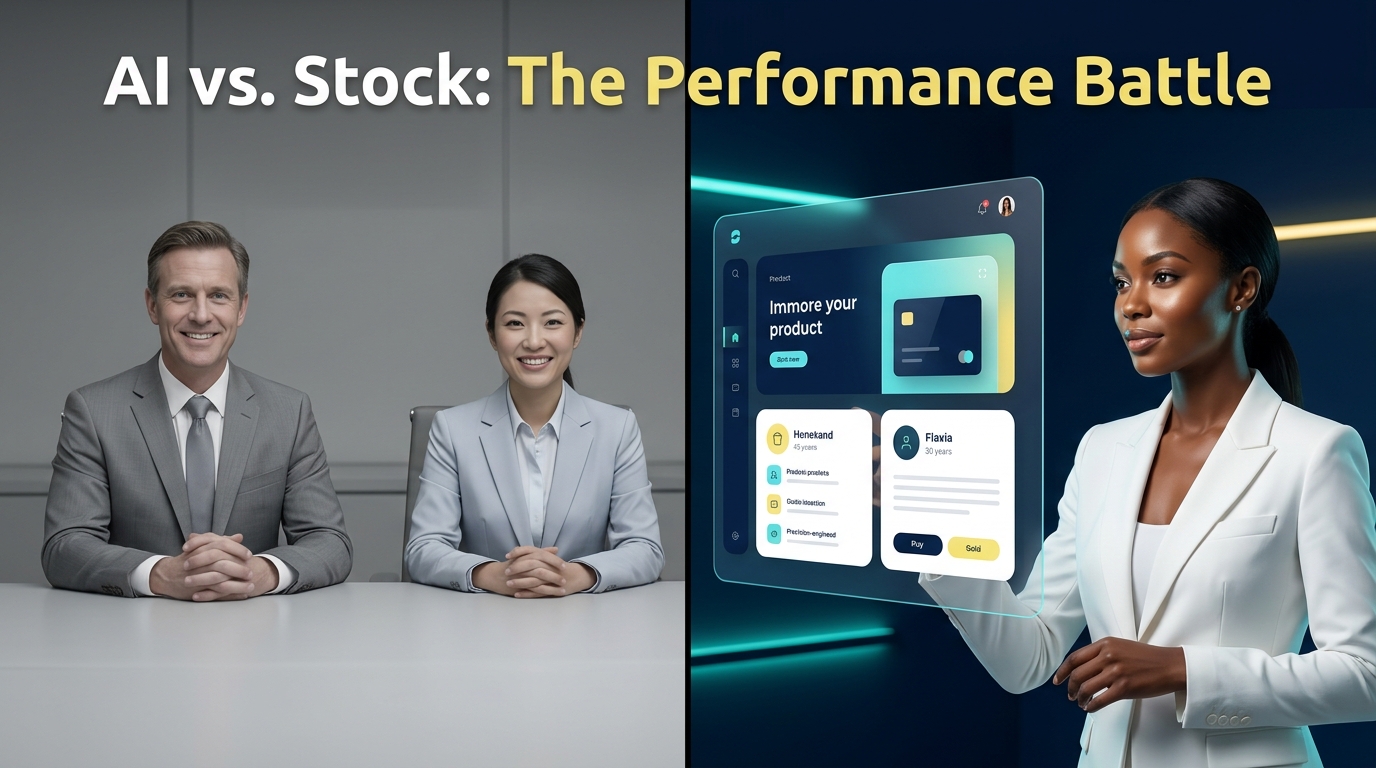
Modern marketing requires a delicate balance between scaling creative output and maintaining uncompromising brand quality. Founders and Marketing Directors face constant pressure to feed visual-heavy campaigns, particularly automated ecosystems like Performance Max (PMax). The core dilemma is how to source these visuals efficiently without sacrificing audience trust.
Understanding the performance dynamics of AI ad images vs stock photos is a fundamental requirement for competitive media buying. At AI for Marketing, we believe in the synergy of human ingenuity and AI efficiency. The goal is precision-engineered augmentation, not replacing your creative team with unchecked algorithms.
To win the visual auction in Google Ads, advertisers must move beyond generic templates and understand the psychological triggers of their audience. This guide breaks down the reality of visual fatigue, the necessity of relevance in automated campaigns, rigorous testing frameworks, and the exact hybrid strategy required to scale your advertising efforts without sacrificing authenticity.

The Visual Battleground: Why Creative Matters in PMax and Display Campaigns
Google Ads has undergone a massive transformation over the last five years. The era of manually bidding on exact match keywords and relying solely on text-based Search campaigns is over. With the dominance of Performance Max and automated Display campaigns, the machine learning algorithm relies heavily on a diverse, high-quality asset group to serve the right message to the right user at the exact right time.
Advertisers can no longer rely solely on persuasive copywriting. PMax demands visual relevance at an unprecedented scale. The algorithm tests combinations of headlines, descriptions, and images across YouTube, Display, Search, Discover, Gmail, and Maps. If your Google Ads visual assets lack diversity or fail to align with the user's specific search intent, the algorithm simply stops serving them.
Visual assets act as the primary hook in a crowded, noisy digital ecosystem. When a user is scrolling through their personalized feed, the image is the first element they process, milliseconds before they read a single word of your headline. In both PMax and Display, images do three jobs simultaneously: they stop the scroll, they qualify the click by signaling category relevance, and they pre-sell trust for high-consideration offers.
When those visual signals are weak, the system learns the wrong lesson. You will begin to see specific symptoms of creative failure in your account. Rising CPCs with flat conversion volume indicate the campaign is buying attention, not intent. High impressions with a weak click-through rate mean your assets are being served but actively ignored. Conversion rate volatility shows that the creative is attracting mixed-quality clicks, forcing the algorithm to chase noise. Mastering your visual pipeline is a mathematical necessity for maintaining a profitable Return on Ad Spend (ROAS).
The Case for Stock Photos: Safety, Speed, and the "Generic Look"
Stock photography has been the backbone of digital advertising for decades. For marketing teams operating under strict deadlines, traditional image libraries offer undeniable practical advantages. They provide immediate speed, allowing a media buyer to fill an asset library and launch a campaign in a single afternoon. They offer legal safety through clear commercial licensing, protecting brands from copyright infringement. Furthermore, they guarantee high-resolution, professionally lit quality that meets the strict technical requirements of the Google ad network.
However, the over-reliance on these libraries has created a severe performance bottleneck. Consumers have evolved. They have developed a psychological filter known as banner blindness in display ads. When a user sees a staged photo of diverse professionals pointing enthusiastically at a laptop screen, their brain instantly categorizes it as an advertisement and ignores it completely.
These images lack originality and fail to build authentic brand trust. They communicate a lack of effort. When your target audience sees the exact same corporate handshake image on your landing page that they saw on a competitor's ad last week, your brand equity diminishes.
The biggest performance issue with stock is not just a lower click-through rate: it is that it produces bland data. If every competitor uses the same visual language, you are not giving the algorithm clear enough signals to differentiate who should click and who should not. You pay to learn slowly. The data supports this fatigue. When analyzing the limitations of generic visuals, marketers see a clear performance drop-off when comparing stock photos vs real images in ads, as consumers increasingly demand authenticity and relatable context before they commit to a click.
The Case for AI Ad Images: Scale, Customization, and the "AI Look"
Generative AI has fundamentally altered the economics of creative production. For performance-minded advertisers, AI generation solves the primary scale problem inherent in PMax campaigns. Instead of spending thousands of pounds on bespoke photoshoots or spending hours hunting for the perfect licensed image, advertisers can generate hyper-specific, customized visuals tailored to niche audience segments instantly.
If you are running a localized campaign for a B2B SaaS product targeting logistics companies in winter, you can prompt an AI to generate an image of a modern warehouse manager holding a tablet with subtle snow visible through the loading bay doors. This level of contextual relevance was previously impossible to achieve at scale. AI makes it feasible to generate creative directions that a team would never commission as traditional photography, expanding your test surface area without multiplying production costs.
Despite the operational advantages, generative tools carry significant risks. The most prominent issue is the "AI Look." AI image hallucinations in marketing remain a persistent threat to brand credibility. Algorithms frequently struggle with human anatomy, resulting in extra fingers, uncanny valley facial expressions, warped background text, and unnatural lighting physics.
Founders must understand that raw, unedited AI output is rarely ready for public consumption. Deploying highly artificial-looking images can damage brand trust faster than generic photography. Consumers are becoming adept at spotting AI-generated content, and if an image feels deceptive or poorly executed, it creates friction in the conversion funnel. Used carelessly, AI images depress performance in two ways: they reduce CTR because they feel like spam, and they reduce CVR because they damage trust after the click. Precision engineering is required. The AI must be guided by expert marketers who understand brand guidelines, visual hierarchy, and strict quality assurance.
The Hard Data: How AI Ad Images vs Stock Photos Actually Perform
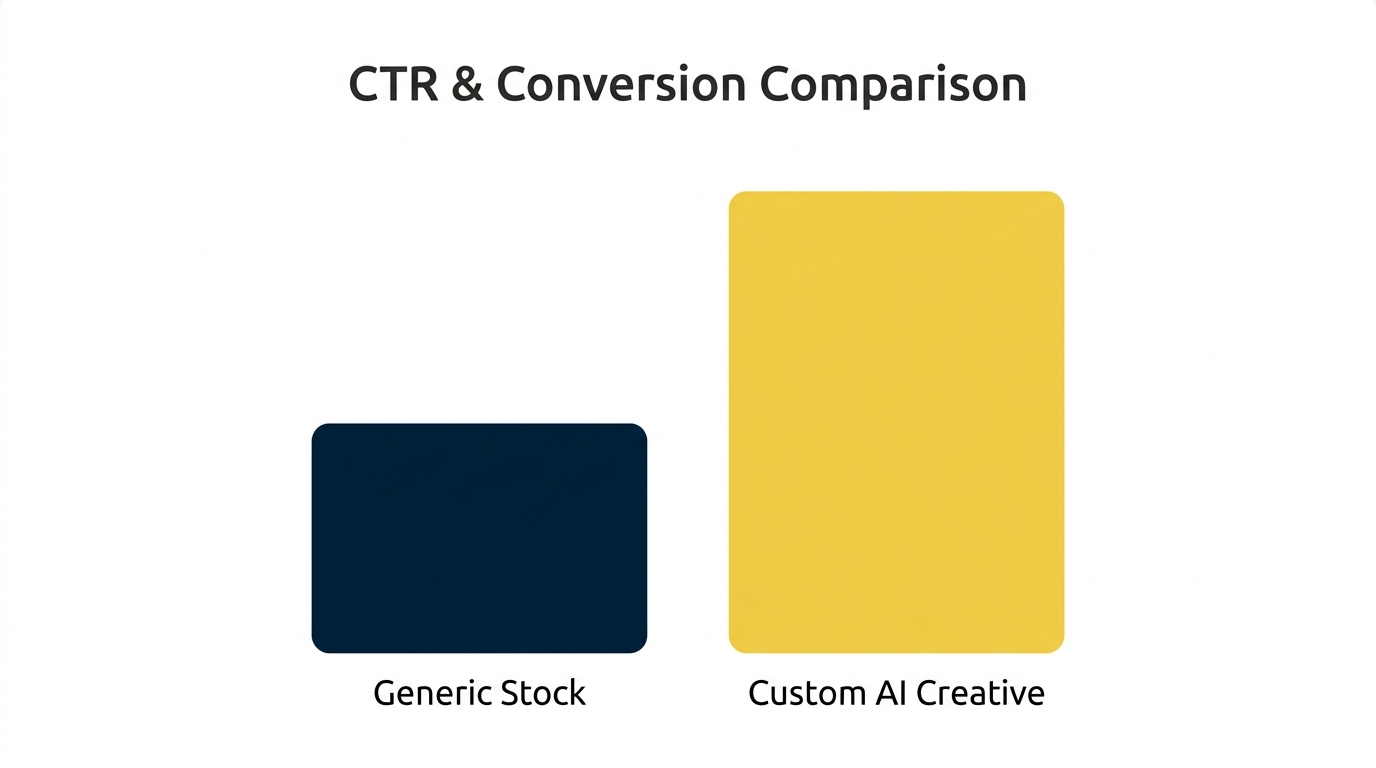
To make informed decisions, Marketing Directors must look beyond the hype and analyze the statistical reality of creative performance. The data reveals a complex landscape where neither traditional photography nor generative algorithms win outright.
Research indicates that human-led, authentic ads often achieve 60% more clicks and a 1.33% higher Click-Through Rate (CTR) than generic, unedited AI content. This metric highlights the enduring power of human connection. When users see real people, genuine emotion, and authentic environments, they are statistically more likely to engage. Trust remains the highest-converting currency in digital marketing.
Conversely, the data also shows that 50% of users prefer AI-generated, highly informative content over sensationalized or cheesy stock photos. If an AI image successfully illustrates a complex concept, visualizes data, or presents a product in a hyper-relevant context without obvious hallucinations, it outperforms staged photography. The audience prefers customized relevance over generic perfection.
Google's official stance on this matter is pragmatic. The search engine does not penalize licensed photography, but its algorithms highly value originality. Unique images that have not been indexed thousands of times across the web are prioritized in both organic and paid placements. Understanding how Google evaluates stock and AI images is critical for compliance and performance. Just as originality dictates paid media success, it is the foundational pillar of organic growth, which is why a custom-built SEO Engine is vital for long-term traffic compounding.
In PMax, creative affects more than just the initial click. It impacts which users the system chooses to serve, which premium placements you earn, how quickly your campaign exits the learning phase, and how stable your Cost Per Acquisition (CPA) remains over time. The right question is not whether algorithms beat cameras, but which asset type increases learning velocity without eroding trust.
The Hybrid Approach: Precision-Engineered Visual Strategy
At AI for Marketing, we do not view this as a binary choice. The most sophisticated advertisers do not choose between algorithms and real photography: they deploy a precision-engineered hybrid approach. A binary choice is the fastest way to build a fragile account. This strategy leverages the strengths of each medium while neutralizing their respective weaknesses.
Phase 1: Real Photos for Trust and Conversion
Authentic, human-led imagery should be reserved for high-stakes, bottom-of-funnel conversion points. Use real photography to showcase your actual team, your physical products, and your customer success stories. This is particularly crucial for B2B trust and executive thought leadership, a core component of a successful LinkedIn Engine. When a prospect is evaluating credibility or is on the verge of booking a high-ticket strategy session, they need to see the real humans behind the brand to reduce perceived risk.
Phase 2: AI Images for Scale and Ideation
Deploy generative tools at the top of the funnel to capture attention and test concepts rapidly. Use AI to create highly specific PMax asset variations, conceptual backgrounds, and tailored visual metaphors for different audience segments. AI is your ideation engine, allowing you to iterate on visual concepts ten times faster than a traditional design team. The key is governance: AI images need constraints, quality assurance, and a strict brand system to prevent off-brand artifacts.
Phase 3: Customized Stock for Speed
When speed is the absolute priority, traditional libraries still have a place. However, the rule of the hybrid approach is that a licensed photo must never be used in its raw form. It must be heavily edited, color-graded to match your brand palette, cropped creatively, or overlaid with bespoke graphic elements and real UI screenshots to eliminate the generic feel. Build a reusable composition system so your ads look proprietary.
Practical Decision Matrix: When to Use Each Asset Type
To operationalize this hybrid approach, performance teams need a clear framework for asset selection.
- • Use real photos when the buyer is evaluating credibility, such as in B2B, high-ticket, or regulated categories. They are essential when you need to show the real product fit, finish, or materials, and when you are pushing bottom-of-funnel actions like a demo or consultation request.
- • Use AI images when you need volume and variation for PMax learning velocity. They are ideal when entering new segments and needing relevance quickly, or when testing visual metaphors before investing heavily in a physical production shoot.
- • Use customized stock when the offer window is short and speed matters most. Stock is highly effective when the creative is supportive rather than the primary differentiator, provided you apply a brand system so the output does not blend in with competitor advertising.
A/B Testing Framework for Visual Creatives in Google Ads
Implementing a hybrid visual strategy requires rigorous validation. Most creative testing fails because it is treated as a simple visual refresh with no controls, run inside a system that changes multiple variables simultaneously. Marketing Directors must establish a scientific framework for testing Google Ads creatives to determine exactly which visual style resonates with their specific audience.
Step 1: Isolate the Variable
The most common mistake in creative testing is changing too many elements at once. To test imagery effectively, you must keep your headlines, descriptions, and landing pages identical. Choose a single test hypothesis, such as comparing a real photo against an AI photo-illustration with the exact same layout and call-to-action. Create two separate asset groups within your PMax campaign to ensure clean data separation.
Step 2: Define the Metrics
Do not rely on vanity metrics. You must track the core performance indicators that impact your bottom line. Click-Through Rate (CTR) measures the initial stopping power and relevance of your visual. Cost Per Click (CPC) indicates how Google's auction judges the quality of your ad, with higher relevance yielding lower costs. Conversion Rate (CVR) is the ultimate test of trust. If CTR improves but CVR drops, you have an attention winner, not a business winner.
Step 3: The Learning Phase
Allow the algorithm sufficient time to gather statistically significant data. In PMax, this typically requires a minimum of 14 to 21 days or a specific threshold of conversions per variant. Do not pause or adjust the assets during this learning phase, as it will reset the algorithm's understanding of the visual performance. When setting up a structured comparison for Google Ads creatives, you must isolate variables strictly and rely on the hard data, not subjective preference.
Step 4: Turn Winners into a System
The most valuable output of testing is not finding a single winning image. It is discovering what visual patterns qualify buyers, what contexts increase relevance, and what design system reduces visual fatigue. Document those rules and feed them directly into your next batch of creative assets.
Automating Your Google Ads Strategy with AI for Marketing
Managing a hybrid visual strategy, generating bespoke assets, running rigorous A/B tests, and constantly updating PMax asset groups is a massive operational drain. For Founders and Marketing Directors, the complexity of modern ad platforms often overshadows the potential for growth. You need the results of a sophisticated AI workflow without the steep learning curve of becoming a prompt engineer or a data scientist.
This is where AI for Marketing bridges the gap. We operate on a premium Agency-as-a-Software model. We do not just hand you generic tools and leave you to figure out the implementation: we build the entire engine for you. We provide the strategic oversight of expert marketers combined with the raw computational power of custom-built workflows.
To eliminate the manual grind of campaign management and implement Performance Max image best practices seamlessly, deploying a dedicated Google Ads Agent transforms your operational efficiency. This system acts as an always-on account manager, analyzing creative performance, identifying audience fatigue, and optimizing your visual assets based on real-time ROAS data. It allows you to scale your campaigns with precision, ensuring that every image, whether captured by a camera or generated by an algorithm, is engineered to drive measurable business growth.
Frequently Asked Questions (FAQs)
Does Google Ads penalize AI-generated images? Google does not explicitly penalize AI-generated images in its ad network simply because they are algorithmically made. However, the algorithm heavily prioritizes originality, compliance, and user engagement. If an AI image is low-quality, highly derivative, or causes users to bounce due to a lack of trust, the ad will suffer from lower quality scores and higher Costs Per Click.
What is banner blindness and how do stock photos cause it? Banner blindness is a psychological phenomenon where web users subconsciously ignore elements on a page that resemble traditional advertisements. Overly polished, generic photography triggers this filter immediately because consumers have seen the same staged scenarios thousands of times, causing them to tune out the marketing message entirely before reading the copy.
How do I fix AI image hallucinations like extra fingers? Fixing hallucinations requires a strict two-step process. First, improve your prompt engineering by specifying anatomical constraints and using negative prompts to avoid warped text or extra digits. Second, never use raw output. Always run the generated visual through professional editing software to manually correct minor rendering errors before deploying it in a live campaign.
Which performs better in Performance Max: real photos or AI images? There is no universal winner: performance depends entirely on funnel placement. Real photos consistently drive higher bottom-of-funnel conversion rates because they establish authentic brand trust. AI images often excel at top-of-funnel engagement due to their ability to be hyper-customized to specific niche audience interests, visual metaphors, and seasonal trends.
Can I use a mix of stock photos and AI images in the same campaign? Yes, utilizing a diverse mix of visual assets is highly recommended for Performance Max campaigns. Google's machine learning algorithm requires variety to test different combinations effectively. A strategic mix of heavily edited licensed photography, custom generative visuals, and authentic brand imagery provides the algorithm with the raw material needed to optimize performance across all network placements.
Want to build marketing systems like this?
Book a Discovery CallRelated Articles
AI Email Marketing: Beyond Drip Sequences
AI email marketing moves beyond basic rule-based automations to intelligent systems that personalise content, optimise send times, generate copy, and adapt sequences based on recipient behaviour in real time.
Read more →
AI Marketing Strategy Framework (2026)
An AI marketing strategy is a structured plan for integrating artificial intelligence into your marketing operations. This framework covers the maturity audit, prioritisation, the build sequence, KPIs, and common strategic mistakes.
Read more →
AI Content Creation: Scale Without Losing Quality
AI content creation is the use of artificial intelligence to research, draft, edit, and optimise marketing content. Learn how to scale production with quality gates, brand DNA frameworks, and workflows that keep the human where it matters.
Read more →